• Displaced Syrian women walk at a camp in Kafr Lusin village on the border with Turkey in Syria's northwestern province of Idlib. When protesters in March 2011 demanded their rights and regime change, they likely never imagined it would trigger a reaction that has led to the 21st century's biggest war. Nine years on, President Bashar al-Assad is still in power and there to stay, more than 380,000 people have died, dozens of towns and cities razed to the ground and half of the country's entire population displaced. AFP
    Displaced Syrian women walk at a camp in Kafr Lusin village on the border with Turkey in Syria's northwestern province of Idlib. When protesters in March 2011 demanded their rights and regime change, they likely never imagined it would trigger a reaction that has led to the 21st century's biggest war. Nine years on, President Bashar al-Assad is still in power and there to stay, more than 380,000 people have died, dozens of towns and cities razed to the ground and half of the country's entire population displaced. AFP
  • Syrian Ibrahim al-Ali is assisted by his children, at the Deir Hassan camp for the displaced where they reside, in Idlib's northern countryside near the Turkish border. The 33-year-old father of four first lost three fingers, later his hearing in one ear. Then all at once, both legs and eyes. Ibrahim al-Ali was wounded every time he tried to escape Syria's war. AFP
    Syrian Ibrahim al-Ali is assisted by his children, at the Deir Hassan camp for the displaced where they reside, in Idlib's northern countryside near the Turkish border. The 33-year-old father of four first lost three fingers, later his hearing in one ear. Then all at once, both legs and eyes. Ibrahim al-Ali was wounded every time he tried to escape Syria's war. AFP
  • Syrian Ibrahim al-Ali sits in his wheelchair at the Deir Hassan camp for the displaced in Idlib's northern countryside near the Turkish border. The 33-year-old father of four first lost three fingers, later his hearing in one ear. Then all at once, both legs and eyes. Ibrahim al-Ali was wounded every time he tried to escape Syria's war. AFP
    Syrian Ibrahim al-Ali sits in his wheelchair at the Deir Hassan camp for the displaced in Idlib's northern countryside near the Turkish border. The 33-year-old father of four first lost three fingers, later his hearing in one ear. Then all at once, both legs and eyes. Ibrahim al-Ali was wounded every time he tried to escape Syria's war. AFP
  • Displaced Syrian children pose for a picture at a camp created by Turkey's Humanitarian Relief Foundation (IHH) in Kafr Lusin village on the border with Turkey in Syria's northwestern province of Idlib. When protesters in March 2011 demanded their rights and regime change, they likely never imagined it would trigger a reaction that has led to the 21st century's biggest war. Nine years on, President Bashar al-Assad is still in power and there to stay, more than 380,000 people have died, dozens of towns and cities razed to the ground and half of the country's entire population displaced. AFP
    Displaced Syrian children pose for a picture at a camp created by Turkey's Humanitarian Relief Foundation (IHH) in Kafr Lusin village on the border with Turkey in Syria's northwestern province of Idlib. When protesters in March 2011 demanded their rights and regime change, they likely never imagined it would trigger a reaction that has led to the 21st century's biggest war. Nine years on, President Bashar al-Assad is still in power and there to stay, more than 380,000 people have died, dozens of towns and cities razed to the ground and half of the country's entire population displaced. AFP
  • Displaced Syrian children play in a camp created by Turkey's Humanitarian Relief Foundation (IHH) in Kafr Lusin village on the border with Turkey in Syria's northwestern province of Idlib. When protesters in March 2011 demanded their rights and regime change, they likely never imagined it would trigger a reaction that has led to the 21st century's biggest war. Nine years on, President Bashar al-Assad is still in power and there to stay, more than 380,000 people have died, dozens of towns and cities razed to the ground and half of the country's entire population displaced. AFP
    Displaced Syrian children play in a camp created by Turkey's Humanitarian Relief Foundation (IHH) in Kafr Lusin village on the border with Turkey in Syria's northwestern province of Idlib. When protesters in March 2011 demanded their rights and regime change, they likely never imagined it would trigger a reaction that has led to the 21st century's biggest war. Nine years on, President Bashar al-Assad is still in power and there to stay, more than 380,000 people have died, dozens of towns and cities razed to the ground and half of the country's entire population displaced. AFP
  • Displaced Syrian children live in a camp created by Turkey's Humanitarian Relief Foundation (IHH) in Kafr Lusin village on the border with Turkey in Syria's northwestern province of Idlib. When protesters in March 2011 demanded their rights and regime change, they likely never imagined it would trigger a reaction that has led to the 21st century's biggest war. Nine years on, President Bashar al-Assad is still in power and there to stay, more than 380,000 people have died, dozens of towns and cities razed to the ground and half of the country's entire population displaced. AFP
    Displaced Syrian children live in a camp created by Turkey's Humanitarian Relief Foundation (IHH) in Kafr Lusin village on the border with Turkey in Syria's northwestern province of Idlib. When protesters in March 2011 demanded their rights and regime change, they likely never imagined it would trigger a reaction that has led to the 21st century's biggest war. Nine years on, President Bashar al-Assad is still in power and there to stay, more than 380,000 people have died, dozens of towns and cities razed to the ground and half of the country's entire population displaced. AFP
  • A Syrian man rides his motorcycle in a destroyed neighbourhood of Sarmin town, about eight kilometres southeast of the city of Idlib in northwestern Syria. When protesters in March 2011 demanded their rights and regime change, they likely never imagined it would trigger a reaction that has led to the 21st century's biggest war. Nine years on, President Bashar al-Assad is still in power and there to stay, more than 380,000 people have died, dozens of towns and cities razed to the ground and half of the country's entire population displaced. AFP
    A Syrian man rides his motorcycle in a destroyed neighbourhood of Sarmin town, about eight kilometres southeast of the city of Idlib in northwestern Syria. When protesters in March 2011 demanded their rights and regime change, they likely never imagined it would trigger a reaction that has led to the 21st century's biggest war. Nine years on, President Bashar al-Assad is still in power and there to stay, more than 380,000 people have died, dozens of towns and cities razed to the ground and half of the country's entire population displaced. AFP
  • A Turkish military tank is seen in a destroyed neighbourhood of Sarmin town, about eight kilometres southeast of the city of Idlib in northwestern Syria. When protesters in March 2011 demanded their rights and regime change, they likely never imagined it would trigger a reaction that has led to the 21st century's biggest war. Nine years on, President Bashar al-Assad is still in power and there to stay, more than 380,000 people have died, dozens of towns and cities razed to the ground and half of the country's entire population displaced. AFP
    A Turkish military tank is seen in a destroyed neighbourhood of Sarmin town, about eight kilometres southeast of the city of Idlib in northwestern Syria. When protesters in March 2011 demanded their rights and regime change, they likely never imagined it would trigger a reaction that has led to the 21st century's biggest war. Nine years on, President Bashar al-Assad is still in power and there to stay, more than 380,000 people have died, dozens of towns and cities razed to the ground and half of the country's entire population displaced. AFP
  • A Syrian woman waits with her children next to a motorcycle in Sarmin town, about eight kilometres southeast of the city of Idlib in northwestern Syria. When protesters in March 2011 demanded their rights and regime change, they likely never imagined it would trigger a reaction that has led to the 21st century's biggest war. Nine years on, President Bashar al-Assad is still in power and there to stay, more than 380,000 people have died, dozens of towns and cities razed to the ground and half of the country's entire population displaced. AFP
    A Syrian woman waits with her children next to a motorcycle in Sarmin town, about eight kilometres southeast of the city of Idlib in northwestern Syria. When protesters in March 2011 demanded their rights and regime change, they likely never imagined it would trigger a reaction that has led to the 21st century's biggest war. Nine years on, President Bashar al-Assad is still in power and there to stay, more than 380,000 people have died, dozens of towns and cities razed to the ground and half of the country's entire population displaced. AFP
  • A mural painting is seen on the wall of a destroyed school in Sarmin town, about eight kilometres southeast of the city of Idlib in northwestern Syria. When protesters in March 2011 demanded their rights and regime change, they likely never imagined it would trigger a reaction that has led to the 21st century's biggest war. Nine years on, President Bashar al-Assad is still in power and there to stay, more than 380,000 people have died, dozens of towns and cities razed to the ground and half of the country's entire population displaced. AFP
    A mural painting is seen on the wall of a destroyed school in Sarmin town, about eight kilometres southeast of the city of Idlib in northwestern Syria. When protesters in March 2011 demanded their rights and regime change, they likely never imagined it would trigger a reaction that has led to the 21st century's biggest war. Nine years on, President Bashar al-Assad is still in power and there to stay, more than 380,000 people have died, dozens of towns and cities razed to the ground and half of the country's entire population displaced. AFP

Nine million Syrian refugees want to return, but security remains a major barrier


  • English
  • Arabic

The majority of displaced Syrians want to go home but unless conditions improve, few will risk returning to their war-torn country, a grassroots civil rights organisation says.

In a report released on July 21, the Syrian Association for Citizens' Dignity said the longer Syrians felt unable to return, the more likely they were to remain permanently displaced, jeopardising hopes for a lasting resolution to the nine-year conflict in their country.

Many are intent on returning one day, but according to the survey of 1,100 displaced Syrians, 73 per cent would return if the conditions were right and 80 per cent were adamant the security situation had to change for that to be possible.

The fate of at least nine million displaced Syrians who want to return is "instrumental to the sustainability of any future political solution to end the conflict and ensure lasting, stable peace", the report, titled We Are Syria, said.

When applied to the total number of displaced Syrians, about 13 million, this suggests that more than nine million people would exercise their right to a safe, voluntary and dignified return to their homes in Syria, the group said.

More than half of the country’s pre-war population has been displaced since 2011, but despite worsening conditions for many Syrians living in refugee camps and increasingly hostile host communities abroad, only a tiny fraction have trickled home in recent years.

"We risk seeing the displacement solidify and become permanent, which would have devastating consequences for millions of Syrians but also for the region and beyond, resulting in constant instability and cycles of violence," Haya Atassi, a spokeswoman for the group said.

"This is why there is such an urgent need for a comprehensive political solution that would guarantee rights to all displaced Syrians, with strong international guarantees," she told The National.

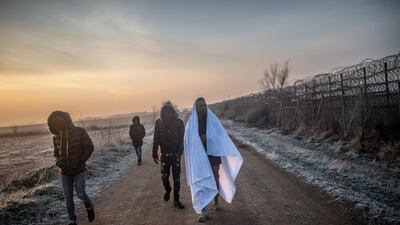
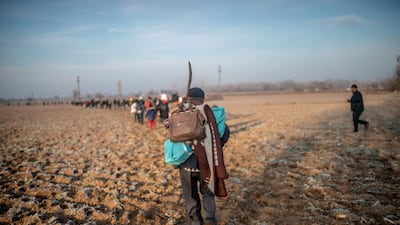
  • Migrants walk towards the Greek border in Pazarkule, in the Edirne district. Thousands of migrants stuck on the Turkey-Greece border clashed with Greek police. AFP
    Migrants walk towards the Greek border in Pazarkule, in the Edirne district. Thousands of migrants stuck on the Turkey-Greece border clashed with Greek police. AFP
  • Children sit on a beach near Skala Sykamineas on the Greek Lesbos island after crossing the Aegean sea between Turkey and Greece. AFP
    Children sit on a beach near Skala Sykamineas on the Greek Lesbos island after crossing the Aegean sea between Turkey and Greece. AFP
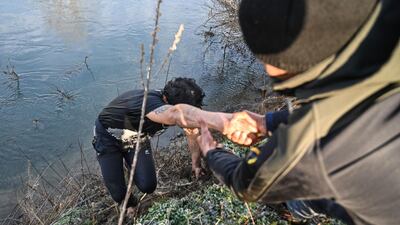
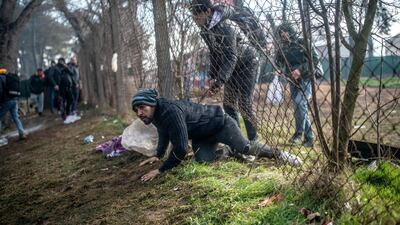
  • Migrants help each other after an attempt to enter Greece from a location near Edirne, Turkey, by crossing the Maritsa river. AFP
    Migrants help each other after an attempt to enter Greece from a location near Edirne, Turkey, by crossing the Maritsa river. AFP
  • Migrants walk towards the Greek border in Pazarkule, in the Edirne district. AFP
    Migrants walk towards the Greek border in Pazarkule, in the Edirne district. AFP
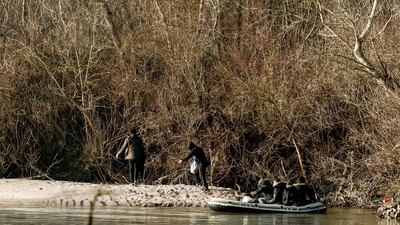
  • Migrants on a dinghy cross the Evros river to reach Greece, pictured from the Turkish border city of Edirne, Turkey. Reuters
    Migrants on a dinghy cross the Evros river to reach Greece, pictured from the Turkish border city of Edirne, Turkey. Reuters
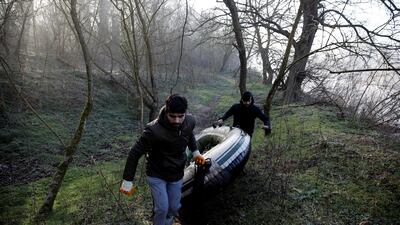
  • Migrants carry a dinghy to cross the Evros river to reach Greece, pictured near the Turkish border city of Edirne, Turkey. Reuters
    Migrants carry a dinghy to cross the Evros river to reach Greece, pictured near the Turkish border city of Edirne, Turkey. Reuters
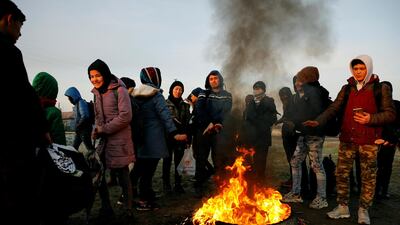
  • Migrants gather around a fire as they wait to cross the Evros river to reach Greece, near Doyran Village, near the Turkish border city of Edirne, Turkey. Reuters
    Migrants gather around a fire as they wait to cross the Evros river to reach Greece, near Doyran Village, near the Turkish border city of Edirne, Turkey. Reuters
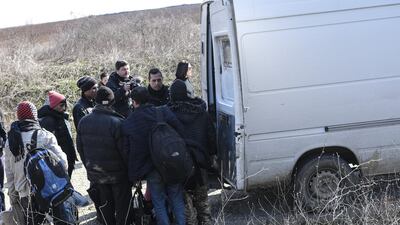
  • A group of migrants are detained after being caught by police on the side of the highway near the Greek-Turkish border. Getty Images
    A group of migrants are detained after being caught by police on the side of the highway near the Greek-Turkish border. Getty Images
  • Migrants on a dinghy cross the Evros river and reach Greece, pictured from the Turkish border city of Edirne, Turkey. Reuters
    Migrants on a dinghy cross the Evros river and reach Greece, pictured from the Turkish border city of Edirne, Turkey. Reuters
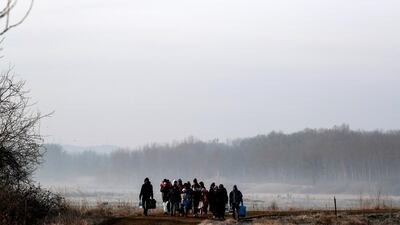
  • Migrants walk along the Evros river to reach Greece, near the Turkish border city of Edirne, Turkey. Reuters
    Migrants walk along the Evros river to reach Greece, near the Turkish border city of Edirne, Turkey. Reuters
  • Migrants sit waiting near the buffer zone at Turkey-Greece border, at Pazarkule, in Edirne district. AFP
    Migrants sit waiting near the buffer zone at Turkey-Greece border, at Pazarkule, in Edirne district. AFP
  • A migrant passes to the buffer zone during clashes with Greek police at the Turkey-Greece border, at Pazarkule, in Edirne distric. Thousands of migrants stuck on the Turkey-Greece border clashed with Greek police. AFP
    A migrant passes to the buffer zone during clashes with Greek police at the Turkey-Greece border, at Pazarkule, in Edirne distric. Thousands of migrants stuck on the Turkey-Greece border clashed with Greek police. AFP
  • A migrant walk towards the Greek border in Pazarkule, in the Edirne district. AFP
    A migrant walk towards the Greek border in Pazarkule, in the Edirne district. AFP

The research indicates that 97 per cent of displaced Syrians in Europe feel settled, in stark contrast to other host countries, including Lebanon and Turkey, where increasing hostility towards refugees "seen as easy scapegoats for internal political and economic problems" has compounded their sense of insecurity.

The changing political narrative in Turkey, which hosts the largest number of Syrians, led to a 34 per cent drop in the number of refugees who say they feel settled there.

In Lebanon, only 9 per cent of refugees feel settled, due to a combination of difficult living conditions and bureaucratic hurdles that make it extremely difficult to obtain legal status and receive access to education, work and health care.

“Life in Lebanon is very difficult ... people are beginning to lose their minds because of the abuse and humiliation,” Maher, 33, told researchers.

Khaled, 26, another Syrian interviewed in the survey, said he had to give up his university studies.

“In addition to security concerns, there is a high possibility that the Lebanese authorities will hand me over to the regime without any deterrence, simply because I work,” he said.

The dangers faced by the few who have been forced to return to areas held by President Bashar Al Assad's regime were documented in a report the civil rights group published this year.

In the latest study, security issues were the main concern for most participants, with 73 per cent citing the need to reform the security sector and curb its powers over civilian life.

Military conscription remains a major obstacle to return for many men aged between 18 and 42 and the fate of people detained in Syria was a priority for 64 per cent of the displaced.

At least 130,000 people are being held in the regime's prisons for political reasons, though some studies estimate the figure is double that.

Families of people missing in Syria's prison system speak of anguish, bribery and torture.

Some families only recently learnt of the death of loved ones after photographs of people tortured and killed in regime custody circulated on social media.

The introduction of the US's Caesar Act has led to the images that that inspired it being recirculated.

Despite several “amnesty decrees”, the detentions are ongoing, leaving many people fearful of reprisals if they do go back.

Fahd, 65, from the regime-controlled city of Latakia, said he lived a good life before the war but told researchers his family had suffered a lot since. H e now lives in Turkey and said he would never return to Syria under the Assad regime.

“I do not trust and I do not believe in partial solutions, false amnesty, or collateral international guarantees. There will be no peace or calm as long as the regime remains, even if only a small part of it," he said.

More than 81 per cent of those surveyed identified the “departure of the regime with all its key figures” as an essential condition for returning to Syria.

For those internally displaced in the country, a group that makes up about 50 per cent of the 13 million Syrians forced to leave their homes since 2011, conditions are becoming steadily worse.

The collapse of the economy has left many without basic services and fears are growing about the increase in the number of coronavirus cases in a country where the healthcare system has been shattered by the conflict.

Meanwhile, the displacement continues, with more than one million people forced to flee their homes during a three-month period at the beginning of 2020 owing to a regime offensive on rebel-held towns in Idlib and northern Aleppo.

Many of those who fled are now enduring dire conditions in makeshift camps on the Turkish border and depend on aid to survive. A decision taken this month by the UN Security Council to close one of two remaining crossing points for cross-border aid is likely to make their situation even worse, Ms Atassi said.

“This is bound to impact people’s desperation to leave, but even in such circumstances the vast majority does not want to go to regime-held areas, out of fear of repression and revenge,” she said.

Some Syrians say they will never go home. Among those enduring the harsh conditions of northern Aleppo's displacement camps, 14 per cent do not believe their requirements for a safe return will be met.

Others are too traumatised by the horrors they witnessed in Syria to consider going home.

“I do not want to return to the place where my husband was executed in front of my eyes, nor return to where my children and I were oppressed ... I can’t live there again,” said Zahra, 50, who fled her home in Aleppo for Turkey.


The biog:

Favourite book: The Leader Who Had No Title by Robin Sharma

Pet Peeve: Racism 

Proudest moment: Graduating from Sorbonne 

What puts her off: Dishonesty in all its forms

Happiest period in her life: The beginning of her 30s

Favourite movie: "I have two. The Pursuit of Happiness and Homeless to Harvard"

Role model: Everyone. A child can be my role model 

Slogan: The queen of peace, love and positive energy

THE BIO

Age: 33

Favourite quote: “If you’re going through hell, keep going” Winston Churchill

Favourite breed of dog: All of them. I can’t possibly pick a favourite.

Favourite place in the UAE: The Stray Dogs Centre in Umm Al Quwain. It sounds predictable, but it honestly is my favourite place to spend time. Surrounded by hundreds of dogs that love you - what could possibly be better than that?

Favourite colour: All the colours that dogs come in

Who has been sanctioned?

Daniella Weiss and Nachala
Described as 'the grandmother of the settler movement', she has encouraged the expansion of settlements for decades. The 79 year old leads radical settler movement Nachala, whose aim is for Israel to annex Gaza and the occupied West Bank, where it helps settlers built outposts.

Harel Libi & Libi Construction and Infrastructure
Libi has been involved in threatening and perpetuating acts of aggression and violence against Palestinians. His firm has provided logistical and financial support for the establishment of illegal outposts.

Zohar Sabah
Runs a settler outpost named Zohar’s Farm and has previously faced charges of violence against Palestinians. He was indicted by Israel’s State Attorney’s Office in September for allegedly participating in a violent attack against Palestinians and activists in the West Bank village of Muarrajat.

Coco’s Farm and Neria’s Farm
These are illegal outposts in the West Bank, which are at the vanguard of the settler movement. According to the UK, they are associated with people who have been involved in enabling, inciting, promoting or providing support for activities that amount to “serious abuse”.

MATCH INFO

Confederations Cup Group B

Germany v Chile

Kick-off: Thursday, 10pm (UAE)

Where: Kazan Arena, Kazan

Watch live: Abu Dhabi Sports HD

MATCH INFO

Alaves 1 (Perez 65' pen)

Real Madrid 2 (Ramos 52', Carvajal 69')

Groom and Two Brides

Director: Elie Semaan

Starring: Abdullah Boushehri, Laila Abdallah, Lulwa Almulla

Rating: 3/5

Mercer, the investment consulting arm of US services company Marsh & McLennan, expects its wealth division to at least double its assets under management (AUM) in the Middle East as wealth in the region continues to grow despite economic headwinds, a company official said.

Mercer Wealth, which globally has $160 billion in AUM, plans to boost its AUM in the region to $2-$3bn in the next 2-3 years from the present $1bn, said Yasir AbuShaban, a Dubai-based principal with Mercer Wealth.

Within the next two to three years, we are looking at reaching $2 to $3 billion as a conservative estimate and we do see an opportunity to do so,” said Mr AbuShaban.

Mercer does not directly make investments, but allocates clients’ money they have discretion to, to professional asset managers. They also provide advice to clients.

“We have buying power. We can negotiate on their (client’s) behalf with asset managers to provide them lower fees than they otherwise would have to get on their own,” he added.

Mercer Wealth’s clients include sovereign wealth funds, family offices, and insurance companies among others.

From its office in Dubai, Mercer also looks after Africa, India and Turkey, where they also see opportunity for growth.

Wealth creation in Middle East and Africa (MEA) grew 8.5 per cent to $8.1 trillion last year from $7.5tn in 2015, higher than last year’s global average of 6 per cent and the second-highest growth in a region after Asia-Pacific which grew 9.9 per cent, according to consultancy Boston Consulting Group (BCG). In the region, where wealth grew just 1.9 per cent in 2015 compared with 2014, a pickup in oil prices has helped in wealth generation.

BCG is forecasting MEA wealth will rise to $12tn by 2021, growing at an annual average of 8 per cent.

Drivers of wealth generation in the region will be split evenly between new wealth creation and growth of performance of existing assets, according to BCG.

Another general trend in the region is clients’ looking for a comprehensive approach to investing, according to Mr AbuShaban.

“Institutional investors or some of the families are seeing a slowdown in the available capital they have to invest and in that sense they are looking at optimizing the way they manage their portfolios and making sure they are not investing haphazardly and different parts of their investment are working together,” said Mr AbuShaban.

Some clients also have a higher appetite for risk, given the low interest-rate environment that does not provide enough yield for some institutional investors. These clients are keen to invest in illiquid assets, such as private equity and infrastructure.

“What we have seen is a desire for higher returns in what has been a low-return environment specifically in various fixed income or bonds,” he said.

“In this environment, we have seen a de facto increase in the risk that clients are taking in things like illiquid investments, private equity investments, infrastructure and private debt, those kind of investments were higher illiquidity results in incrementally higher returns.”

The Abu Dhabi Investment Authority, one of the largest sovereign wealth funds, said in its 2016 report that has gradually increased its exposure in direct private equity and private credit transactions, mainly in Asian markets and especially in China and India. The authority’s private equity department focused on structured equities owing to “their defensive characteristics.”

How to get there

Emirates (www.emirates.com) flies directly to Hanoi, Vietnam, with fares starting from around Dh2,725 return, while Etihad (www.etihad.com) fares cost about Dh2,213 return with a stop. Chuong is 25 kilometres south of Hanoi.
 

The President's Cake

Director: Hasan Hadi

Starring: Baneen Ahmad Nayyef, Waheed Thabet Khreibat, Sajad Mohamad Qasem 

Rating: 4/5

COMPANY PROFILE

Name: Xpanceo

Started: 2018

Founders: Roman Axelrod, Valentyn Volkov

Based: Dubai, UAE

Industry: Smart contact lenses, augmented/virtual reality

Funding: $40 million

Investor: Opportunity Venture (Asia)

Gothia Cup 2025

4,872 matches 

1,942 teams

116 pitches

76 nations

26 UAE teams

15 Lebanese teams

2 Kuwaiti teams

'The Batman'

Stars:Robert Pattinson

Director:Matt Reeves

Rating: 5/5

The fake news generation

288,000 – the number of posts reported as hate speech that were deleted by Facebook globally each month in May and June this year

11% – the number of Americans who said they trusted the news they read on Snapchat as of June 2017, according to Statista. Over a quarter stated that they ‘rarely trusted’ the news they read on social media in general

31% - the number of young people in the US aged between 10 and 18 who said they had shared a news story online in the last six months that they later found out was wrong or inaccurate

63% - percentage of Arab nationals who said they get their news from social media every single day.

MATCH INFO

Juventus 1 (Dybala 45')

Lazio 3 (Alberto 16', Lulic 73', Cataldi 90 4')

Red card: Rodrigo Bentancur (Juventus)

COMPANY%20PROFILE
%3Cp%3E%3Cstrong%3ECompany%20name%3A%3C%2Fstrong%3E%20Clinicy%3Cbr%3E%3Cstrong%3EStarted%3A%3C%2Fstrong%3E%202017%3Cbr%3E%3Cstrong%3EFounders%3A%3C%2Fstrong%3E%20Prince%20Mohammed%20Bin%20Abdulrahman%2C%20Abdullah%20bin%20Sulaiman%20Alobaid%20and%20Saud%20bin%20Sulaiman%20Alobaid%3Cbr%3E%3Cstrong%3EBased%3A%3C%2Fstrong%3E%20Riyadh%3Cbr%3E%3Cstrong%3ENumber%20of%20staff%3A%3C%2Fstrong%3E%2025%3Cbr%3E%3Cstrong%3ESector%3A%3C%2Fstrong%3E%20HealthTech%3Cbr%3E%3Cstrong%3ETotal%20funding%20raised%3A%3C%2Fstrong%3E%20More%20than%20%2410%20million%3Cbr%3E%3Cstrong%3EInvestors%3A%3C%2Fstrong%3E%20Middle%20East%20Venture%20Partners%2C%20Gate%20Capital%2C%20Kafou%20Group%20and%20Fadeed%20Investment%3C%2Fp%3E%0A
Breast cancer in men: the facts

1) Breast cancer is men is rare but can develop rapidly. It usually occurs in those over the ages of 60, but can occasionally affect younger men.

2) Symptoms can include a lump, discharge, swollen glands or a rash. 

3) People with a history of cancer in the family can be more susceptible. 

4) Treatments include surgery and chemotherapy but early diagnosis is the key. 

5) Anyone concerned is urged to contact their doctor