A man distributes sweets to passers-by in Amman on the occasion of the Prophet Mohammed's birthday on October 29, 2020. Health officials say public failure to follow safety guidelines is pushing up Covid-19 infections in Jordan. Reuters
A man distributes sweets to passers-by in Amman on the occasion of the Prophet Mohammed's birthday on October 29, 2020. Health officials say public failure to follow safety guidelines is pushing up Co

New lockdown measures for Jordan as nine doctors die in Covid-19 surge


  • English
  • Arabic

The Jordanian government announced on Sunday it was placing the country on a multi-day national lockdown this month after a rise in Covid-19 cases claimed the lives of nine doctors and pushed the country’s healthcare system to the point of ‘collapse.’

Prime Minister Bisher Khasawneh announced in a press conference on Sunday evening that the government would impose a full, nationwide lockdown for a four-day period starting from November 11, one day after the country’s parliamentary elections until November 15.

According to the government, the four-day period will allow authorities to expand field hospitals, increase intensive care units, strengthen infection prevention, and increase health cadre.

Starting from Monday, the government said it would extend evening curfew to 10pm to 6am, with all commercial outlets closing by 9:00pm. The government also closed all gyms and indoor sports facilities until further notice.

Wael Hajayneh, head of Jordan’s Covid-19 task force, stressed that the measures aimed to protect the lives of health cadre and strengthen hospitals which, due to the influx of COVID19 cases are around “half-capacity.”

Long hours and the heavy workload created by the pandemic are also taking a toll on doctors and nurses in understaffed hospitals, the Jordan Medical Association said.

"Even before coronavirus, we had a chronic shortage of doctors in Jordan. Coronavirus put another burden on the shoulders of doctors," association president Mohammed Tarawneh told The National, noting that kingdom's ratio of 24 doctors per 10,000 residents was among the lowest in the region.

The deceased doctors were in their 50s and 60s, and according to the JMA, each had 20-30 years of experience as specialists in fields such as pulmonology and anaesthesiology.

“The amount of interaction between doctors and Covid patients is high; exposure to the virus is concentrated at a time the long hours are affecting their emotional and physical health, weakening their immune system," Dr Tarawneh said. "We are losing physicians with decades of experience.”

The JMA called for the immediate hiring of medical school graduates and drafting doctors from the private sector into overwhelmed public hospitals. According to the association, an additional 400-600 doctors are needed including general practitioners, emergency room doctors, pulmonologists and anaesthesiologists.

_______________

Coronavirus around the world

  • People register to get tested at a Covid-19 mobile testing site amid coronavirus pandemic in Los Angeles, California, USA. EPA
    People register to get tested at a Covid-19 mobile testing site amid coronavirus pandemic in Los Angeles, California, USA. EPA
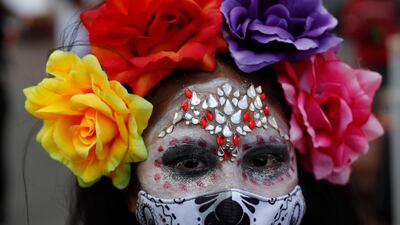
  • A young woman dressed as a "Katrina" poses for photos, as she collects candies during the Halloween celebration amid the Covid-19 pandemic in La Paz, Bolivia. AP Photo
    A young woman dressed as a "Katrina" poses for photos, as she collects candies during the Halloween celebration amid the Covid-19 pandemic in La Paz, Bolivia. AP Photo
  • A paper skeleton dressed as a doctor adorns a Day of the Dead altar for Daniel Silva Montenegro, a doctor who died from symptoms related to Covid-19, made by his wife Kenya Navidad at her home in Mexico City. AP Photo
    A paper skeleton dressed as a doctor adorns a Day of the Dead altar for Daniel Silva Montenegro, a doctor who died from symptoms related to Covid-19, made by his wife Kenya Navidad at her home in Mexico City. AP Photo
  • Medical staff members treat a patient suffering from Covid-19 in the intensive care unit at the United Memorial Medical Centre in Houston, Texas. AFP
    Medical staff members treat a patient suffering from Covid-19 in the intensive care unit at the United Memorial Medical Centre in Houston, Texas. AFP
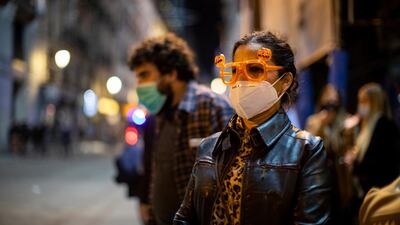
  • A woman stands next to Sol square in Madrid, Spain. AP Photo
    A woman stands next to Sol square in Madrid, Spain. AP Photo
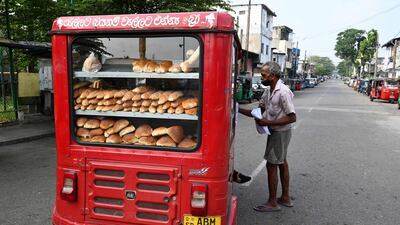
  • A man buys bread from a vendor on a street in Colombo after a three-day curfew was announced to contain the spread of the Covid-19 coronavirus. AFP
    A man buys bread from a vendor on a street in Colombo after a three-day curfew was announced to contain the spread of the Covid-19 coronavirus. AFP
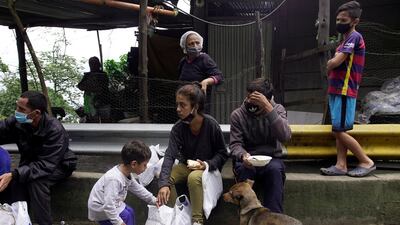
  • Venezuelan migrants receive donated food at a point of care for migrants on Colombian roads, after economic sectors were reactivated by the Colombian government at the end of the quarantine, in Bucaramanga, Colombia. Reuters
    Venezuelan migrants receive donated food at a point of care for migrants on Colombian roads, after economic sectors were reactivated by the Colombian government at the end of the quarantine, in Bucaramanga, Colombia. Reuters
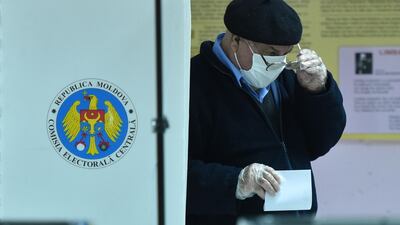
  • A man walks out of a voting booth at a polling station during Moldova's presidential election in Chisinau. AFP
    A man walks out of a voting booth at a polling station during Moldova's presidential election in Chisinau. AFP
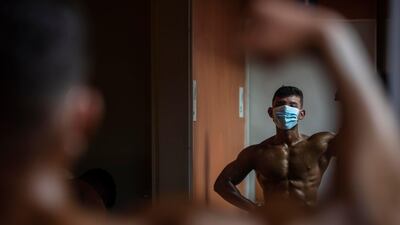
  • A bodybuilder looks at himself on a mirror as he prepares to participate in the National Bodybuilding Championship in Managua. AFP
    A bodybuilder looks at himself on a mirror as he prepares to participate in the National Bodybuilding Championship in Managua. AFP
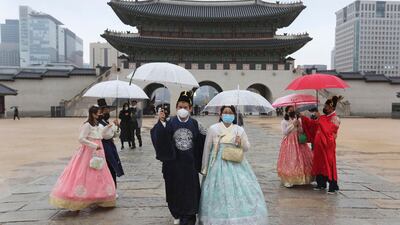
  • People visit the Gyeongbok Palace in Seoul, South Korea. AP Photo
    People visit the Gyeongbok Palace in Seoul, South Korea. AP Photo

_______________

Medical staff have personal protective equipment, but their risk of infection rises as hospitals become overcrowded because people are not following health guidelines, said Wael Hajayneh, head of Jordan’s Covid-19 task force.

“We may have the best hospitals, but the continuous large influx of cases will exhaust the health sector and we will continue to have fatalities like the medical staff we have recently lost,” Dr Hajayneh warned on Jordan Television on Sunday.

Jordan reported a record 57 deaths and 3,300 new coronavirus cases on Saturday, and another 3,259 cases and 37 deaths on Sunday.

Jordan has witnessed a 600 per cent jump in Covid-19 fatalities in October, and a tenfold increase in cases, which health experts attribute to the virus becoming widespread outside the capital and increased social gatherings.

There are currently 1,540 Covid-19 patients in the country’s hospitals, taking up more than 10 per cent of hospital beds, with 274 in intensive care, according to the government. People who test positive for the coronavirus report that they are being turned away as hospitals prioritise cases needing emergency care.

Jordan opened a 570-bed field hospital in Amman last week, the first in the country, with plans to construct four more in other areas.

The government has been resistant to placing the kingdom under lockdown, with unemployment above 23 per cent and businesses and citizens still reeling from a strict lockdown earlier this year. There has also been a strong push from the government and palace to proceed with parliamentary elections on November 10, under strict health precautions; yet the wave of Covid-19 overwhelming hospitals is forcing urgent action from authorities.

Should late investors consider cryptocurrencies?

Wealth managers recommend late investors to have a balanced portfolio that typically includes traditional assets such as cash, government and corporate bonds, equities, commodities and commercial property.

They do not usually recommend investing in Bitcoin or other cryptocurrencies due to the risk and volatility associated with them.

“It has produced eye-watering returns for some, whereas others have lost substantially as this has all depended purely on timing and when the buy-in was. If someone still has about 20 to 25 years until retirement, there isn’t any need to take such risks,” Rupert Connor of Abacus Financial Consultant says.

He adds that if a person is interested in owning a business or growing a property portfolio to increase their retirement income, this can be encouraged provided they keep in mind the overall risk profile of these assets.

Ten tax points to be aware of in 2026

1. Domestic VAT refund amendments: request your refund within five years

If a business does not apply for the refund on time, they lose their credit.

2. E-invoicing in the UAE

Businesses should continue preparing for the implementation of e-invoicing in the UAE, with 2026 a preparation and transition period ahead of phased mandatory adoption. 

3. More tax audits

Tax authorities are increasingly using data already available across multiple filings to identify audit risks. 

4. More beneficial VAT and excise tax penalty regime

Tax disputes are expected to become more frequent and more structured, with clearer administrative objection and appeal processes. The UAE has adopted a new penalty regime for VAT and excise disputes, which now mirrors the penalty regime for corporate tax.

5. Greater emphasis on statutory audit

There is a greater need for the accuracy of financial statements. The International Financial Reporting Standards standards need to be strictly adhered to and, as a result, the quality of the audits will need to increase.

6. Further transfer pricing enforcement

Transfer pricing enforcement, which refers to the practice of establishing prices for internal transactions between related entities, is expected to broaden in scope. The UAE will shortly open the possibility to negotiate advance pricing agreements, or essentially rulings for transfer pricing purposes. 

7. Limited time periods for audits

Recent amendments also introduce a default five-year limitation period for tax audits and assessments, subject to specific statutory exceptions. While the standard audit and assessment period is five years, this may be extended to up to 15 years in cases involving fraud or tax evasion. 

8. Pillar 2 implementation 

Many multinational groups will begin to feel the practical effect of the Domestic Minimum Top-Up Tax (DMTT), the UAE's implementation of the OECD’s global minimum tax under Pillar 2. While the rules apply for financial years starting on or after January 1, 2025, it is 2026 that marks the transition to an operational phase.

9. Reduced compliance obligations for imported goods and services

Businesses that apply the reverse-charge mechanism for VAT purposes in the UAE may benefit from reduced compliance obligations. 

10. Substance and CbC reporting focus

Tax authorities are expected to continue strengthening the enforcement of economic substance and Country-by-Country (CbC) reporting frameworks. In the UAE, these regimes are increasingly being used as risk-assessment tools, providing tax authorities with a comprehensive view of multinational groups’ global footprints and enabling them to assess whether profits are aligned with real economic activity. 

Contributed by Thomas Vanhee and Hend Rashwan, Aurifer

How to help

Call the hotline on 0502955999 or send "thenational" to the following numbers:

2289 - Dh10

2252 - Dh50

6025 - Dh20

6027 - Dh100

6026 - Dh200