


Lebanon's newly designated prime minister plans to form a government of experts and independents to deal with the country's crippling economic crisis.
Hassan Diab spoke to reporters on Friday after meeting former prime minister Saad Hariri, a day after he was asked by the president to form the country's next government.
Mr Diab, who is backed by the militant Hezbollah group and its allies, begins his task against the backdrop of nationwide protests against Lebanon's ruling elite.
He said he would attempt to form a working government in a short period of time.
"Previous governments in the last decade took a year to form and I seek to form a government in the next four weeks or a period that does not exceed six weeks," Mr Diab told Deutsche Welle.
Hours after he spoke, riots broke out on a major avenue in Beirut's western Mazraa neighbourhood as Sunnis who support Mr Hariri closed it to protest against Mr Diab's nomination.
Protesters hurled stones and fire crackers at security forces trying to reopen the road, wounding at least seven soldiers, the Lebanese army said.
As clashes intensified, Mr Hariri on Friday tweeted that "anyone who loves me should leave the streets immediately".
Outgoing Interior Minister Raya El Hassan, a member of Mr Hariri's Future Movement, also urged protesters to leave the streets "to avoid dangers and strife."
The protesters had earlier burnt tyres on the main highway linking Beirut with southern Lebanon, blocking it and causing a traffic jam that was several kilometres long.
The army opened the road briefly in the town of Naameh before protesters closed it again.
The protesters were angered by what they said was Hezbollah and its allies deciding who takes the country's top Sunni post.
Hezbollah backed Mr Hariri from the start but they differed over the shape of the new government.
Mr Diab asked protesters "to give us a chance to form an exceptional government" that can work on resolving the country's many problems that have accumulated over the past 30 years.
It was not immediately clear if the riots that broke out in Beirut would affect Mr Diab's consultations with members of parliament that were scheduled for Saturday over the formation of Cabinet.
Mr Diab, a university professor and former education minister, won the majority of legislators' votes. However, he lacks the support of major Sunni figures, including the party headed by Mr Hariri.
-
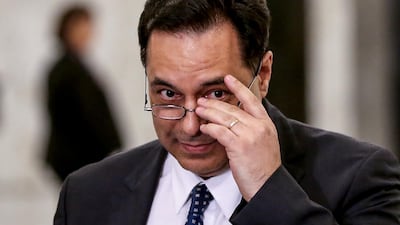
Newly assigned Lebanese Prime Minister Hassan Diab speaks to media after his meeting with Lebanese President Michel Aoun and Lebanese Parliament Speaker Nabih Berri at the presidential palace in Baabda. EPA -

Lebanese President Michel Aoun, Lebanese Parliament Speaker Nabih Berri and the newly assigned Lebanese Prime Minister Hassan Diab, during their meeting at the presidential palace in Baabda. EPA -
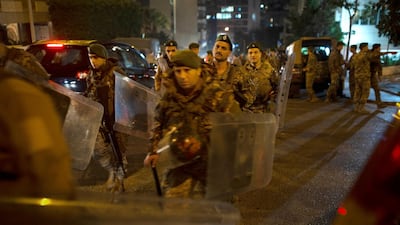
Lebanese security forces move into position outside of the home of newly-assigned Lebanese Prime Minister, Hassan Diab. AP -

Lebanese riot police stand guard outside the residence of the Lebanese designated Prime Minister Hassan Diab in Beirut. EPA -
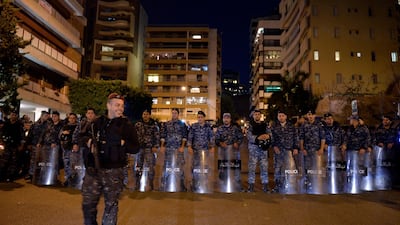
Lebanese riot police stand guard outside the residence of the Lebanese designated Prime Minister Hassan Diab in Beirut. EPA -

Lebanese anti-corruption protesters shout slogans outside the parliament to denounce the nomination of Prime Minister-designate Hassan Diab in the capital Beirut. AFP -

Lebanese anti-corruption protesters shout slogans outside the parliament to denounce the nomination of Prime Minister-designate Hassan Diab. AFP -
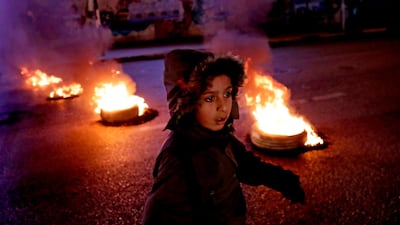
A Lebanese child walks by burning tyres during a rally by supporters of outgoing prime minister Saad Hariri. AFP -
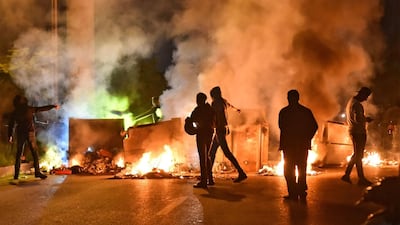
Lebanese supporters of outgoing prime minister Saad Hariri block a road with burning dumpsters in the Qasqas neighbourhood of the capital Beirut. AFP -
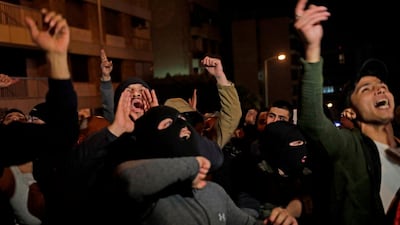
Crisis-hit Lebanon's president on Thursday named former minister Hassan Diab, backed by Shiite movement Hezbollah, as the country's new prime minister. AFP -
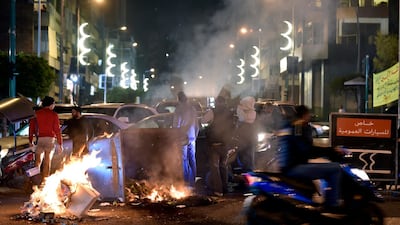
Supporters of outgoing Lebanese Prime Minister Hariri burn dumpsters and woods as they block the main highway to protest against the nomination of Hassan Diab as prime minister. EPA -

The little-known 60-year-old engineering professor at the American University of Beirut (AUB) replaces outgoing premier Saad Hariri amid nationwide anti-government protests and the worst economic crisis since Lebanon's 1975-1990 civil war. AFP


That is particularly problematic for Mr Diab, who as a Sunni lacks support from his own community.
And under Lebanon’s sectarian power-sharing agreement, the prime minister must be Sunni.
Mr Diab, however, said the atmosphere was "positive", after Friday's meeting with Mr Hariri.
“As an expert and an independent, my inclination is to form a government that is truly made up of experts and independents,” he said.
In the first comments after Mr Diab's appointment as prime minister, senior US State Department official David Hale, who arrived on Friday to underline Washington's support for Lebanon's stability, urged the bickering political leaders to act with haste in carrying out economic reforms.
"It's time to put aside partisan interests and act in the national interest, advancing reforms and form a government committed to undertaking these reforms and [that is] capable of doing so," said Mr Hale said after meeting President Michel Aoun.
He later met Speaker of Parliament Nabih Berri and had lunch with Mr Hariri.
Washington, which Hezbollah accuses of inciting some protesters, was not meddling in Lebanon's politics, Mr Hale said.
Mr Aoun told Mr Hale that the new government had "many tasks ahead" of it and said peaceful protesters were being protected by the army to safeguard freedom of speech.
Western countries have withheld $11 billion (Dh40.4bn) in loans and grants pledged by international donors at a conference in Paris last year, until reforms are carried out in Lebanon, where corruption and mismanagement are widespread.
Mr Hale did not directly comment on Mr Diab's appointment, saying only that the United States "has no role in saying who should lead" a Cabinet in Lebanon or anywhere else.
"I'm here to encourage Lebanon's political leaders to commit to and undertake, meaningful, sustained reforms that can lead to a stable, prosperous and secure Lebanon," he said.
Mr Hale is the most senior foreign diplomat to visit the country since the mass protests erupted in mid-October.
The protests forced Mr Hariri's resignation within days but politicians were unable to agree on his successor, causing the economic crisis to take a turn for the worse.

