

Lebanon’s Kataeb Party is holding talks with opposition groups and independent activists about the formation of a coalition that will contest the 2022 parliamentary elections.
Party leader Samy Gemayel resigned as an MP after the massive Beirut port explosion in August that killed at least 190 people, including Kataeb’s secretary general Nazar Najarian.
The blast was caused by the ignition of 2,750 tonnes of ammonium nitrate that had been stored at the port for more than six years.
Mr Gemayel, the son of former president Amine Gemayel and the nephew of assassinated president-elect Bachir Gemayel, announced his resignation alongside two other MPs at Najarian’s funeral.
Within a week of the explosion, eight politicians had resigned in protest against corruption and negligence in state institutions after it was revealed that the country’s top officials and security agencies knew about the dangers posed by the storage of ammonium nitrate at the port.
Even before the blast, the country’s economic crisis or its mass demonstrations, Mr Gemayel tried to shed the Kataeb Party’s image as a hardline, civil war-era Christian faction.
He backed calls for major reforms that would end sectarianism and ensure the country maintained its sovereignty.
He also backed the popular uprising that began last October over corruption and said his party met various groups to lay the ground for a framework that would unite “like-minded” opposition forces.
-
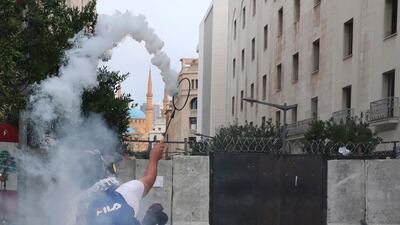
An anti-government protester uses a tennis racket to return a tear gas canister towards riot police near Parliament Square in Beirut on September 1. AP -

An anti-government protester throws a stone towards riot police during a protest near Parliament Square. AP -
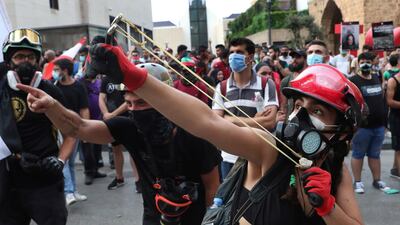
An anti-government protester uses a slingshot to launch a stone towards Lebanese riot police. AP -
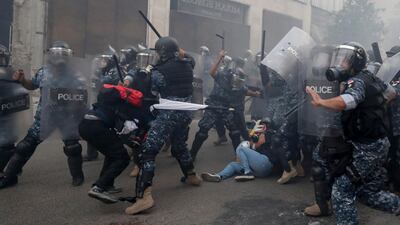
Riot policemen beat anti-government protesters near Parliament Square. AP -
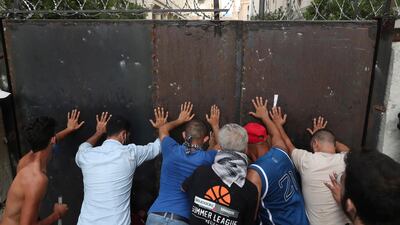
Anti-government protesters try to break open a metal barrier blocking the road to parliament on Sept 1, 2020. AP -
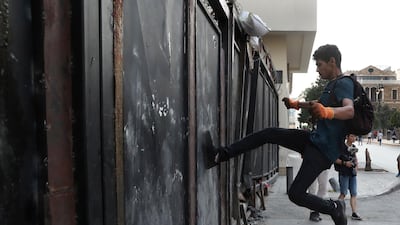
Anti-government protesters try to break open a metal barrier blocking the road to parliament on Sept 1, 2020. AP -
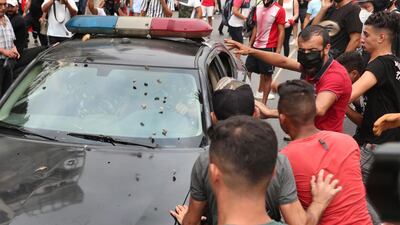
Anti-government protesters throw stones at a police car near Parliament Square on Sept 1. AP -
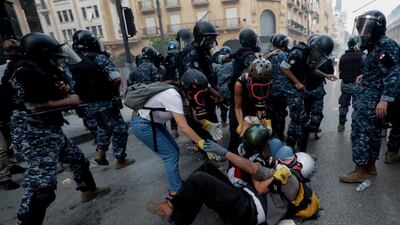
Activists help anti-government protesters after being beaten by riot policemen near Parliament Square. AP -

Riot policemen beat anti-government protesters during a protest near Parliament Square. AP -
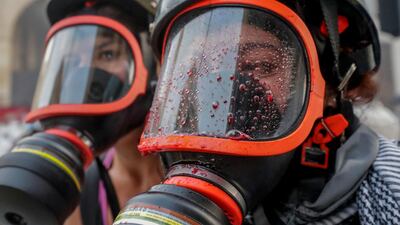
Activists help an anti-government protester with her tear gas mask covered in blood after being beaten by riot policemen near Parliament Square. AP -

An anti-government protester throws a stone towards riot police during a protest near Parliament Square. AP -
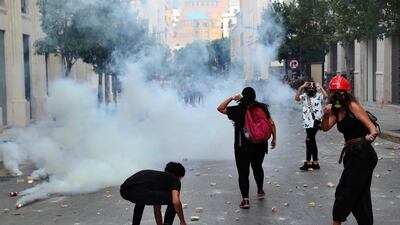
Anti-government protesters throw stones towards police near Parliament Square. AP -
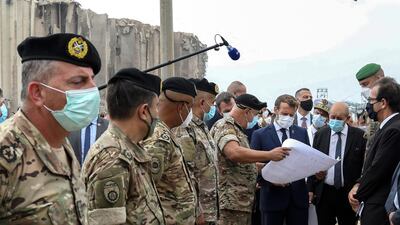
French President Emmanuel Macron and French Foreign Minister Jean-Yves Le Drain meet the military mobilised to help to rebuild the port of Beirut. AP via pool -
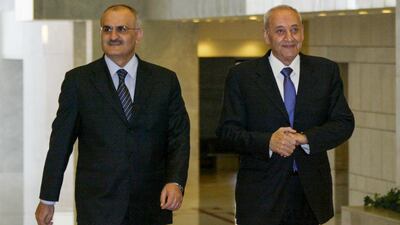
Lebanese Parliament Speaker Nabih Berri (R) arrives with Lebanese MP Ali Hassan Khalil to meet with Syrian President Bashar Al Assad at Al Shaab Palace in Damascus in 2008. AFP, File -
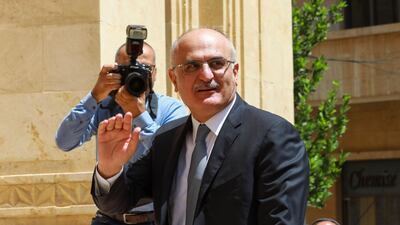
Then Finance Minister Ali Hassan Khalil arriving at the parliament in the Lebanese capital Beirut in 2018. AFP, file -
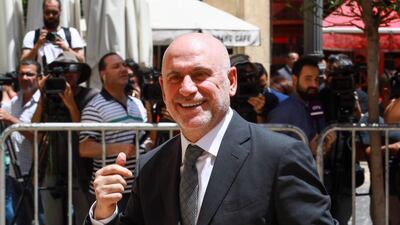
Then Labour Minister Youssef Fenianos arriving at the parliament in the Lebanese capital Beirut in 2018. AFP, File


“For months, we have been meeting with opposition groups, former fellow lawmakers and independent activists from across Lebanon,” Mr Gemayel told The National at the party’s offices in Bikfaya, near Beirut.
“Hopefully, we will be able to make an announcement sometime in the near future.”
He said the focus of the talks was a sovereign and neutral Lebanon and the decentralisation of local elections.
“Neutrality would protect Lebanon against foreign meddling in the country’s affairs and, consequently, put an end to domestic infighting over regional or international issues, which would ultimately guarantee local stability,” he said.
Decentralisation would bridge the gap between the people and the state, reduce red tape and cronyism, and promote sustainable development, he said.
Mr Gemayel said his party submitted a draft law to this effect in 2014. Since then, a parliamentary subcommittee asked to review the proposal met 63 times to iron out the technical details.
The subcommittee achieved near consensus on major points such as the adoption of administrative and fiscal decentralisation, he said.
“The proposal could be enacted into law in the very near future if the political will exists,” he said.
“Do they intend to enact the law? Personally, I don’t think we have a choice, given how the centralised government is failing.”
He said decentralisation would ease political infighting over representation in the centralised government, a recurring theme since the country became independent.
Lebanon has not had a fully functioning government since the resignation of prime minister Hassan Diab after the port explosion.
The explosion resulted in damage worth about $15 billion dollars at a critical time when Lebanon faces its worst economic and financial crisis since the civil war ended.
According to the World Bank, Lebanon’s real gross domestic product growth is expected to fall sharply by 19.2 per cent this year, on the back of a 6.7 per cent contraction in 2019.
Since the collapse of Mr Diab’s administration, political bickering over the allocation of ministerial posts has complicated prime minister-designate Saad Hariri’s mission to form a government.
There is also mounting pressure from the US on Hezbollah, the Iran-backed militant group that Washington and others have called a terrorist organisation.
Hezbollah’s regional agenda and foreign ties have contributed to Lebanon’s isolation at an international level and undermined domestic stability, a must for the country to attract investment and foster a vibrant business environment, Mr Gemayel said.
He accused Hezbollah and the ruling political class of blocking reforms, opposing the formation of an independent Cabinet and resisting efforts to carry out a forensic audit of the central bank, a prerequisite for any financial support programme from the international community.
“The only peaceful course of action is to seek change through elections. As long as this ruling class is in charge, there will be no reforms because they won’t undermine their own interests,” he said.
Mr Gemayel said change was coming, even if elections are held under the current law that favours the country’s major political parties.
Politicians recently came together to discuss an electoral law tabled by Parliament Speaker Nabih Berri’s bloc.
The proposal, which calls for polls under a single electoral constituency and is based on a proportional representation system, drew fierce criticism from the country’s predominantly Christian parties, including President Michel Aoun’s Free Patriotic Movement and the rival Lebanese Forces.
Lebanon last held parliamentary elections in 2018. Polls that were originally scheduled for 2013 were postponed three times amid security concerns and disagreements over the adoption of a new election law that was approved in 2017.
The new law divided Lebanon into 15 electoral districts and embraced a complex proportional representation system by party list, as opposed to the previous winner-takes-all system.
-
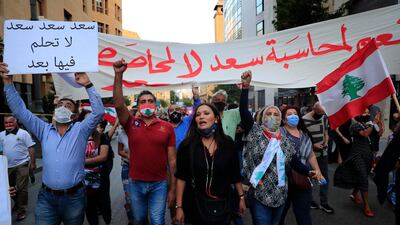
Anti-government protesters shout slogans during a protest to denounce the naming of former premier Saad Hariri as a potential candidate as the country's new prime minister, in downtown Beirut, Lebanon. AP Photo -
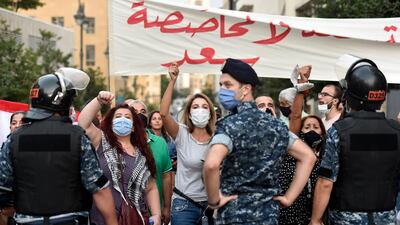
Anti-government protesters shout slogans during a protest against former Prime Minister Saad Hariri in downtown Beirut. EPA -
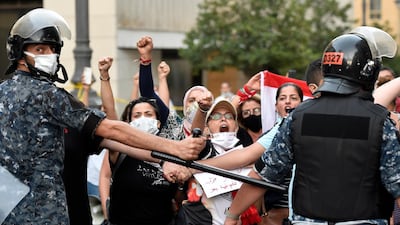
Anti-government protesters shout slogans during a protest against former Prime Minister Saad Hariri in downtown Beirut. EPA -
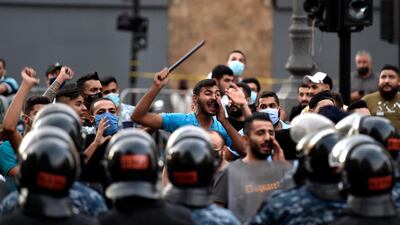
Supporters of former Lebanese Prime Minister Saad Hariri shout slogans against anti-government protesters during a protest against former Prime Minister Saad Hariri in downtown Beirut. EPA -
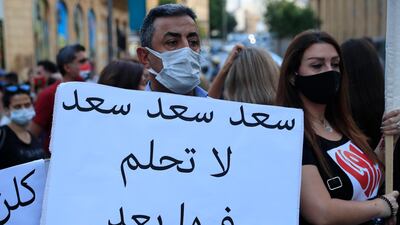
An anti-government protester holds an Arabic placard that reads: "Saad don't dream on it any more," during a protest to denounce the naming of former Prime minister Saad Hariri as a potential candidate as the country's new prime minister, in downtown Beirut. AP Photo -
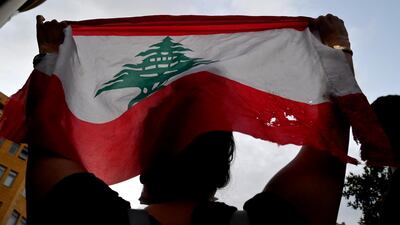
Anti-government protesters carry a national flag during a protest against former Prime Minister Saad Hariri in downtown Beirut. EPA -
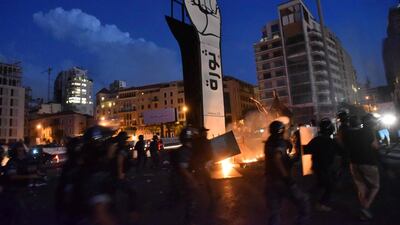
Members of the Lebanese security forces intervene after the ‘Revolution fist’, symbol of Lebanon’s October 2019 uprising, was set on fire during clashes between anti-government protesters and supporters of former prime minister Saad Hariri, in the capital Beirut's central Martyr's square. AFP -
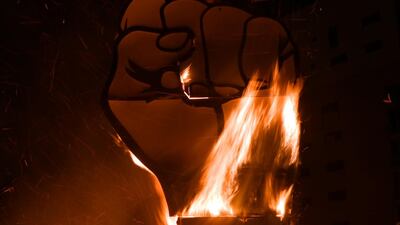
The symbol of the October revolution is set on fire allegedly by supporters of former Prime Minister Saad Hariri at Martyr's square. EPA -
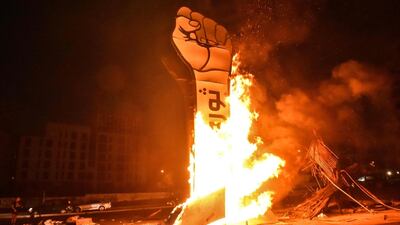
The ‘Revolution fist’, symbol of Lebanon’s October 2019 uprising, burns after it was set on fire during clashes between anti-government protesters and supporters of former prime minister Saad Hariri, in the capital Beirut's central Martyr's square. AFP -
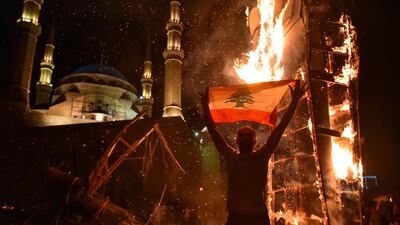
A Lebanese man raises a national flag as the ‘Revolution fist’, symbol of Lebanon’s October 2019 uprising, burns after being torched during clashes between anti-government protesters and supporters of former prime minister Saad Hariri, in the capital Beirut's central Martyr's square. AFP


Today, Mr Gemayel fears similar attempts to derail parliamentary elections scheduled for 2022 is the latest attempt by the country’s major parties to maintain their grip on power.
“This will be our next battle with the ruling class, because they know very well that they will lose ground in the coming elections,” he said.
Mr Gemayel said his party and other opposition groups intend to resist such plans and take to the streets to ensure elections are held in line with constitutional deadlines.
“We want a parliament that represents the aspirations of the Lebanese people,” he said.
He called for early elections and urged Mr Hariri to step down over his failure to form an independent Cabinet amid opposition from the parliamentary majority.
Mr Gemayel said his party’s vision of Lebanon was gaining support, particularly among youth of all confessions.
“Today, the divide is between those who want to build a country where the rule of law prevails and those who don’t,” Mr Gemayel said.
“This divide transcends sectarian lines and we are proud that people from across Lebanon have been joining the party recently including 200 new members from Tripoli.”

