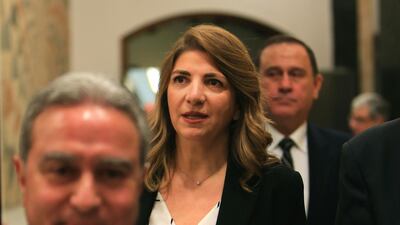

Lebanon’s central bank is not “above all supervision and all control” warned caretaker justice minister Marie-Claude Najm on Thursday after weeks of a power struggle between the bank and the country’s caretaker government.
The government wants to push ahead with a crucial audit to uncover the reasons for the country’s financial collapse, but the central bank argues that it would violate Lebanon's 1956 banking secrecy law should it fully cooperate with the audit.
"To argue that information cannot be delivered because of banking secrecy laws means that the state does not have the possibility to know the figures of its own central bank," Mrs Najm told The National by phone.
On August 31, Lebanon’s Finance Ministry commissioned three international consultancy firms to audit the Banque du Liban (BDL), nearly one year after banks implemented stringent capital controls and suspended transactions abroad.
But BDL only transferred 42 per cent of the documents requested by Alvarez & Marsal, the firm contracted to carry out the forensic audit, rendering its work impossible.
On November 5, the government, which argues that it's accounts at the BDL are not subject to banking secrecy, gave the BDL a 3 month-extension to hand over the documents.
-
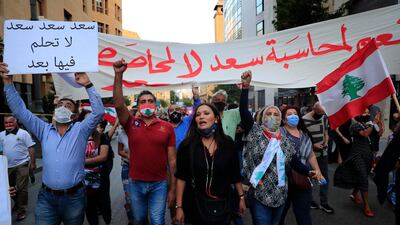
Anti-government protesters shout slogans during a protest to denounce the naming of former premier Saad Hariri as a potential candidate as the country's new prime minister, in downtown Beirut, Lebanon. AP Photo -
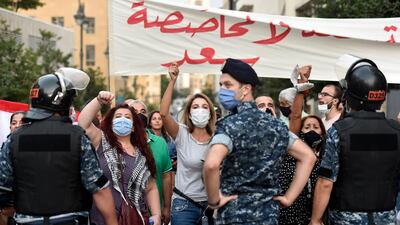
Anti-government protesters shout slogans during a protest against former Prime Minister Saad Hariri in downtown Beirut. EPA -
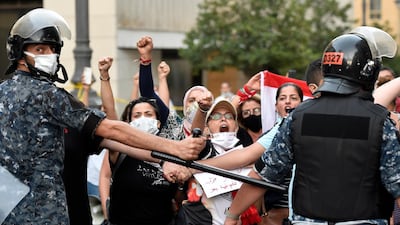
Anti-government protesters shout slogans during a protest against former Prime Minister Saad Hariri in downtown Beirut. EPA -
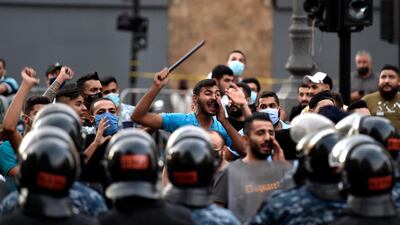
Supporters of former Lebanese Prime Minister Saad Hariri shout slogans against anti-government protesters during a protest against former Prime Minister Saad Hariri in downtown Beirut. EPA -
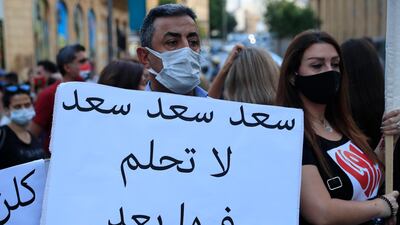
An anti-government protester holds an Arabic placard that reads: "Saad don't dream on it any more," during a protest to denounce the naming of former Prime minister Saad Hariri as a potential candidate as the country's new prime minister, in downtown Beirut. AP Photo -

Anti-government protesters carry a national flag during a protest against former Prime Minister Saad Hariri in downtown Beirut. EPA -
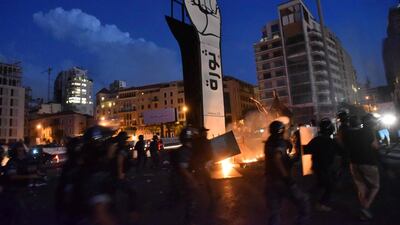
Members of the Lebanese security forces intervene after the ‘Revolution fist’, symbol of Lebanon’s October 2019 uprising, was set on fire during clashes between anti-government protesters and supporters of former prime minister Saad Hariri, in the capital Beirut's central Martyr's square. AFP -
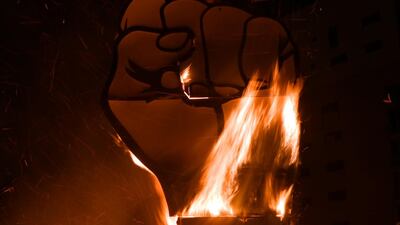
The symbol of the October revolution is set on fire allegedly by supporters of former Prime Minister Saad Hariri at Martyr's square. EPA -
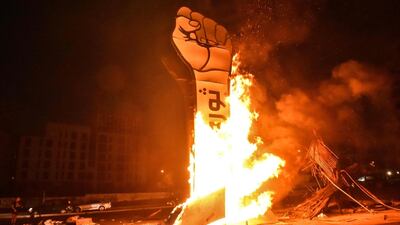
The ‘Revolution fist’, symbol of Lebanon’s October 2019 uprising, burns after it was set on fire during clashes between anti-government protesters and supporters of former prime minister Saad Hariri, in the capital Beirut's central Martyr's square. AFP -

A Lebanese man raises a national flag as the ‘Revolution fist’, symbol of Lebanon’s October 2019 uprising, burns after being torched during clashes between anti-government protesters and supporters of former prime minister Saad Hariri, in the capital Beirut's central Martyr's square. AFP


The grace period is a “little long,” said Mrs Najm, but not unheard of in the case of forensic audits.
The audit of the central bank was one of the key reforms demanded by France, which has led an international effort to help salvage Lebanon’s economy, in exchange for a financial aid package. All political parties say they support France’s demands for reforms but have yet to implement them.
The International Monetary Fund estimated the BDL’s accumulated losses at $49 billion, the Financial Times reported in June this year. The central bank argues that its losses are lower but does not publish profits and loss accounts.
One solution to the forensic audit dispute would be for Parliament to amend Lebanon's banking secrecy law.
“All political blocks say that they are with France’s initiative,” said Mrs Najm, a lawyer by training and former professor of law at Université Saint Joseph in Beirut. “If MPs believe that the law should be changed to exclude banking secrecy from the forensic audit, all they must do is change it. But I persist in saying that this is beside the point.”
Alvarez & Marsal representatives told Lebanese officials during a meeting attended by Mrs Najm that they managed to conduct forensic audits of private Lebanese companies in the past, despite banking secrecy laws, by keeping the names of bank account holders anonymous.
“The ball is in [the BDL’s] court,” said Mrs Najm.
There is little hope of an improvement in Lebanon’s finances via international aid without an audit of the BDL.

The economic crisis, which began in the summer of 2019 with a shortage of US dollars and has been exacerbated by the coronavirus pandemic, has pushed over half the Lebanese into poverty. The IMF projects that the economy will contract by 25 per cent in 2020.
In addition to its financial woes, Lebanon’s capital Beirut was devastated by the explosion of 2,750 tonnes of ammonium nitrate on August 4, killing 204 people. Over three months later, the investigation has yet to pinpoint responsibilities in what is widely viewed as an accident caused by state negligence.
Mrs Najm said that investigative judge Fadi Sawan had told her that one of the reasons for the delay is that Lebanon is waiting for technical reports from France, which is co-operating in the investigation. The French embassy in Beirut said it could not comment an ongoing investigation.
Mrs Najm declined to give a deadline for the investigation. “Political authorities cannot ask the judiciary to work within a specific amount of time. What we can say is that we want it to go as fast as possible,” she said.

