


Rain ground Lebanon’s protests to a halt on Saturday but activists prepared for what they say will be mass rallies on Sunday in order to keep the pressure on politicians to quickly form a new government after the prime minister stepped down after two weeks of nationwide anger.
Roads were open on Saturday, the state-run National News Agency reported. Most schools and universities have been closed for the past two weeks despite Education Minister Akram Chehayeb's announcement they would re-open following the resignation of Prime Minister Saad Hariri on Tuesday as protests briefly picked up again.
Small clashes have taken place in recent days. Four protesters in Beirut were arrested on Friday after they tried to storm the Lebanese Association of Banks. Despite the current unpopularity of banks, the attack was the first incident of this kind.
-
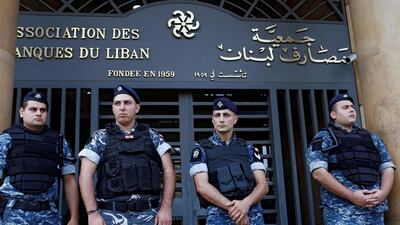
Lebanese police stand outside the entrance of the Association of Banks in downtown Beirut, Lebanon on November 1, 2019. Reuters -
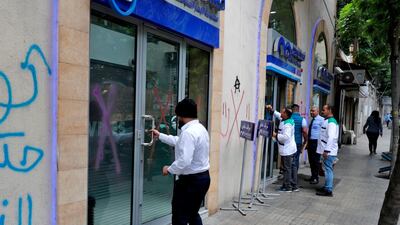
A Lebanese man enters a bank in Beirut on November 1, 2019. AFP -
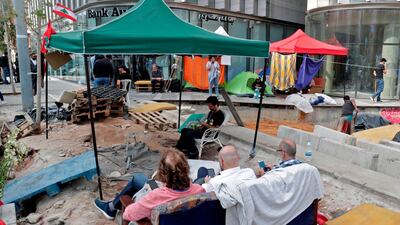
Protesters camp at the entrance of a bank in Beirut on November 1, 2019. AFP -
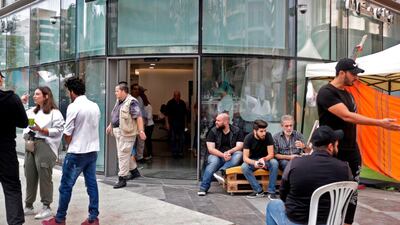
Lebanese protesters camp at the entrance of a bank in Beirut on November 1, 2019. AFP -

Lebanese policemen walk in front of the building of the Lebanese Association of Banks after anti-government protesters locked the main entrance by a chain and lock during ongoing protests against the banks' policies and the government in downtown Beirut, Lebanon. EPA -
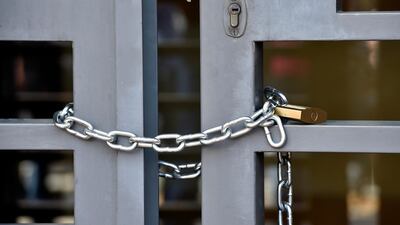
The main entrance building of the Lebanese Association of Banks locked with a chain by anti-government protesters during ongoing protests against the banks' policies and the government in downtown Beirut, Lebanon. EPA -
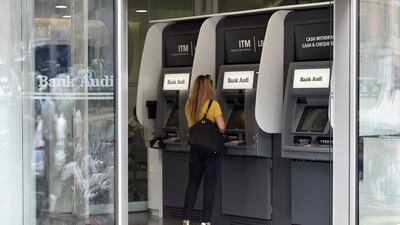
A woman uses an ATM at a local bank in Beirut, Lebanon. EPA -
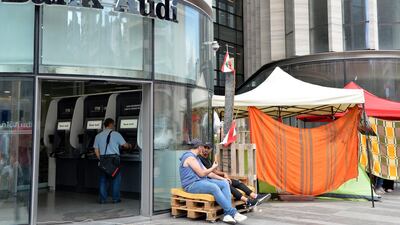
A man uses an ATM at a local bank as protesters sit near their tents in Beirut, Lebanon. EPA


Protesters accuse lenders, and particularly the central bank, of collusion with politicians and of being responsible for the country’s financial woes, which triggered mass protests on October 17.
Banks re-opened on Friday for the first time since protests began without a much-feared dollar run, though withdrawals were capped at $2,000 or $2,500, depending on banks.
Salim Sfeir, head of the Association of Banks in Lebanon, told Reuters that lenders did not witness "any extraordinary movement" of money.
The NNA reported that in the Southern city of Tyre, security forces cordoned off the building of a local bank, the MEAB, after a bomb scare. The author of the threats, identified only by his initials T.M., was later arrested.
In the neighbouring city of Sidon, local media reported that five people were injured on Friday evening after the army forcibly re-opened one of the city’s squares that had been occupied by protesters.
Demonstrators told The National that an important demonstration was to be expected in Beirut on Sunday, dubbed "the Sunday of the million", in reference to the number of people that they hope will take to the streets.
A counter-protest for supporters of President Michel Aoun in front of the presidential palace in Baabda is also scheduled for the early afternoon.
At the height of the anti-government protests mid-October, analysts said that roughly one-third of the country joined demonstrations around the country – between 1 and 2 million people. There are no official statistics.
But protest fatigue, combined with promises of a new government and violent attacks from Hezbollah and Amal supporters, have caused numbers to dwindle.
One exception has been the northern city of Tripoli, where protests continued this week. People booed and whistled the speech of President Michel Aoun on Thursday night and continued chanting slogans such as “the people want the fall of the regime.”
However, the city’s Al Nour square appeared less busy than the previous week.
According to local media reports, a new Prime Minister – widely expected to again be Mr Hariri or one of his close allies – could be appointed in upcoming days.
One of the demands of protesters is that the new government be composed of non-party-affiliated technocrats who will rapidly implement economic reforms.
Many also expect their new leaders to begin the transition to a civic state and abolish sectarian power-sharing.
Interior Minister Raya El Hassan attempted to put an end to rumours that she might succeed Mr Hariri in an interview with CNN on Thursday.
“Hariri, the outgoing, should be the ingoing prime minister. Frankly, I strongly believe that. I’m not seeking that position,” she said.
In his speech on Thursday, Mr Aoun promised that new ministers would be selected for their “competence” and not to “please leaders.”

