

Prime Minister Hassan Diab on Wednesday announced that Lebanon would be halting flights to and from several countries to try to curb the spread of coronavirus, moments before the World Health Organisation officially declared it a pandemic.
“All air, sea and land travel will be stopped to and from the following countries: Italy, South Korea, Iran, and China,” Mr Diab said, without specifying when flights would be suspended.
Lebanon will also suspend flights "from countries that have witnessed an important spread of the virus: France, Egypt, Syria, Iraq, Germany, Spain and Britain, by air, land or sea,” he said.
-
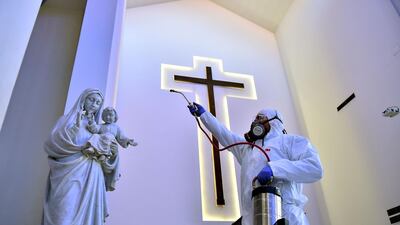
Sanitary workers disinfect a church in Beirut. AFP -
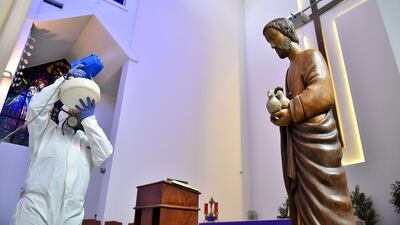
Lebanon's health minister said hospitals were ready to deal with any further spread of the novel coronavirus Covid-19 in the country. AFP -

Sanitary workers disinfect a church in Beirut. AFP -

Sanitary workers disinfect the desks and chairs of the Lebanese Parliament in central Beirut. AFP -
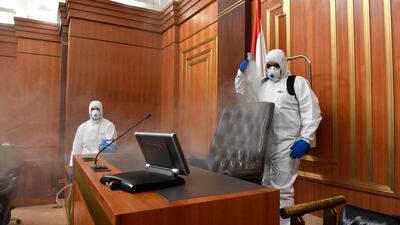
A Lebanese Health Ministry official said on Tuesday that a man has died from the coronavirus, marking the first known death from the Covid-19 illness in the country. Lebanese Parliament Media Office -
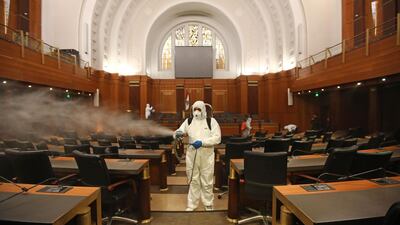
Sanitary workers disinfect the desks and chairs of the Lebanese Parliament in central Beirut. AFP -
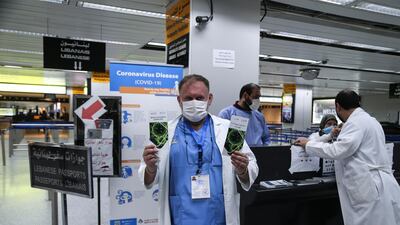
Lebanese doctor holds awareness brochures on coronavirus to be distributed on arriving passengers at Rafic Hariri international airport in Beirut. EPA -
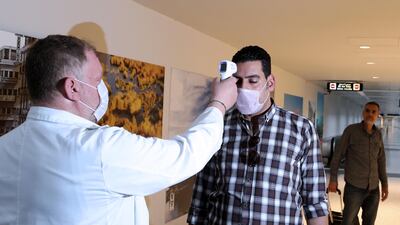
A Lebanese doctor checks the temperature of a passenger as a precautionary measure against the coronavirus, upon his arrival at the Rafic Hariri International Airport in Beirut. EPA


Mr Diab said Lebanese nationals, their family members who do not hold Lebanese nationality, diplomats and UN peacekeeping members would be exempt.
“They have four days to return to Lebanon,” he said.
Non-residents had been barred from entering Lebanon from Iran, the Middle East’s worst-affected country, since late February.
Mr Diab said public venues such as malls and restaurants would be closed, and he warned against public gatherings.
“In order to preserve the public’s health, I ask public administrations and municipalities to alternate shifts with a minimum number of employees,” he said.
Schools and universities have been closed since late February, shortly after a woman, 45, became the first coronavirus case to be announced in Lebanon.
The woman travelled to Lebanon from Iran and was the first in the country to fully recover from the coronavirus.
She was discharged on Wednesday afternoon.
There are now 61 recorded cases of coronavirus in Lebanon, which had its second death on Tuesday.
Two private hospitals started receiving patients on Wednesday. People who earlier tested positive were all treated at a government hospital in Beirut.
Lebanese media reported that staff at Rafik Hariri hospital were due to go on strike on Thursday morning to protest against “dangers, difficulties and harsh conditions”.
Lebanon’s hospitals were under stress before the outbreak of coronavirus, with a severe economic crisis that led hundreds of thousands to the streets last October.

