

Lebanon’s parliament on Thursday passed a state of emergency giving the military sweeping powers to stop any action deemed a threat to national security in the wake of last week's blast in Beirut.
Civilians strongly criticised the order as trying to legitimise a crackdown on the protest movement demanding the removal of the political class. Anti-government demonstrators who have taken to the streets to demand change since the explosion that killed 171 and wounded more than 6,000.
The disaster struck after the state defaulted on its foreign debt in March and the currency lost enormous value over the last year.
The state of emergency allows the army to close down assembly points and prohibit gatherings deemed threats to national security, and expands the jurisdiction of military courts over civilians.
-
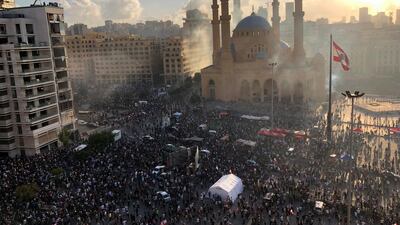
Demonstrators take part in a protest following Tuesday's blast in Beirut, Lebanon. Reuters -
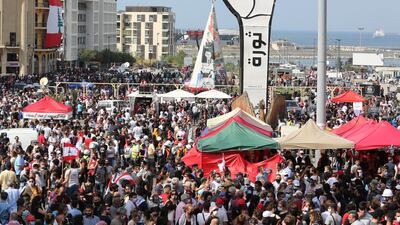
Lebanese people gather around a fist-shaped banner reading 'Revolution' as people gathered to protest against the political leaders and to call for those responsible over the explosion to be held accountable. EPA -
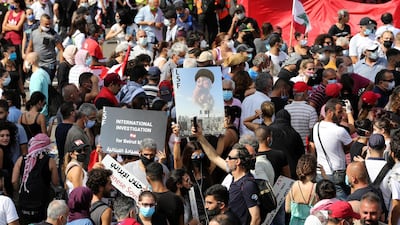
The Lebanese Health Ministry said at least 158 people were killed, and more than 5,000 injured, in the Beirut blast that devastated the port area. EPA -
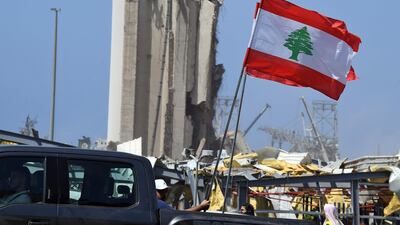
Lebanese people carry the national flag as they drive past the blast site four days after a monster explosion. AFP -

An anti-government protester carries a Lebanese flag as he protects himself behind an iron barrel during a protest outside of the Lebanese Parliament. EPA -
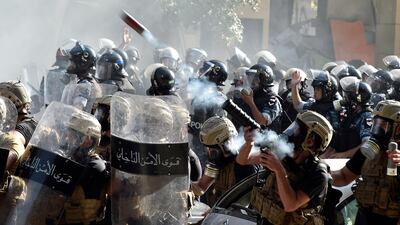
Riot police fire tear gas against anti-government protesters during a protest outside of the Lebanese Parliament. EPA -
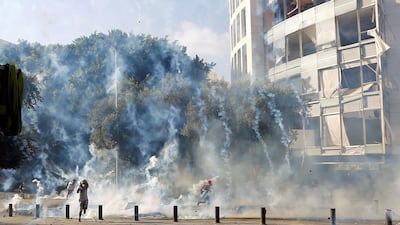
Demonstrators run to take cover from tear gas fired by police. Reuters -
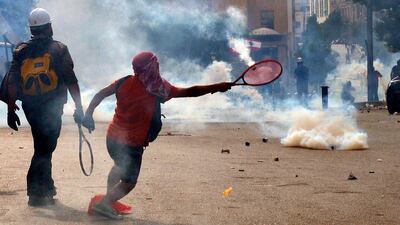
An anti-government protester uses a tennis racket to return a tear gas canister at riot police. EPA -
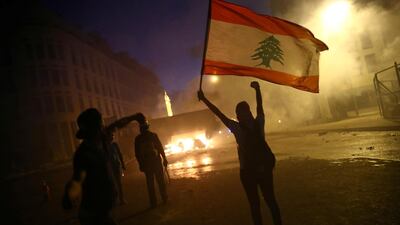
A demonstrator holds a Lebanese flag as another hurls stones during. Reuters -
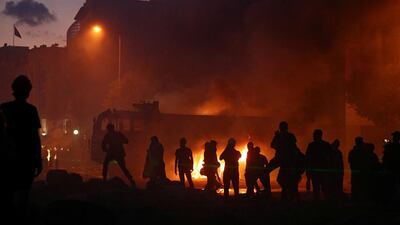
People gather as a truck is seen on fire during the protest in Martyr's Square. Reuters -
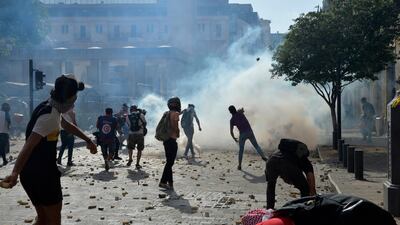
Anti-government protesters clash with Lebanese riot police during a protest outsid Lebanese Parliament. EPA -
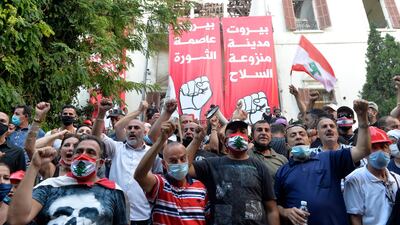
Protesters shout slogans next to banners reading in Arabic (left) 'Beirut capital of revolution' and (right) 'Beirut capital without weapons' as they enter the foreign ministry headquarters during a protest in Beirut, Lebanon. EPA


The army can also raid homes at any time and impose house arrest on anyone engaged in activities considered to threaten security, the watchdog said.
“Parliament is convening to decide on a state of emergency, meaning arbitrary arrests and the smothering of liberties,” shouted a protester with a megaphone outside the session held in Unesco palace in west Beirut.
“The excuse is national security, but the purpose is to cover up for the Beirut massacre," she shouted. “Retribution is for the regime. Justice is for the victims."
The government declared a two-week state of emergency on August 5 but as the measure lasts more than eight days, Lebanese law requires that it be approved by parliament, according to human rights watchdog The Legal Agenda.
French Defence Minister Florence Parly arrived in Beirut on Thursday, a week after President Emmanuel Macron met senior Lebanese politicians and residents of Beirut on a brief visit to the capital.
She will meet the crew of a French military vessel due to arrive in Beirut to help in the international aid effort.
Ineptitude exposed by the explosion has revived the protest movement after the government crushed it in January.
A senior US state department official also arrived in Lebanon for a two-day trip on Thursday, promising the FBI would join Lebanese and international investigators in the probe into the blast.
US Under Secretary for Political Affairs David Hale said the participation in the probe is one of the ways the US is helping Lebanon in dealing with the aftermath of the drastic explosion.
The authorities allowed a large shipment of ammonium nitrate fertiliser to lie for years in a warehouse at the port, despite repeated warnings.
Protests have taken to the streets of central Beirut on successive nights leading to scuffles with security forces who have used tear gas and rubber bullets to disperse the crowds.
Prime Minister Hassan Diab's government stepped down on Monday after several ministers said they would quit over the explosion.
Speaker Nabih Berri had said Thursday’s session would be to question ministers on the explosion but with Cabinet's resignation it was no longer possible.
-
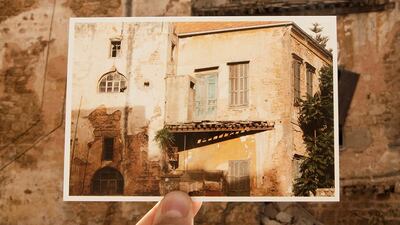
Joseph Khoury and his partner, Gabriela Cardozo, have revisited buildings they photographed in 2016 as part of Bouyout Beirut, a postcard series that aimed to highlight the facades of buildings found in Gemmayzeh and Mar Mikhael. All photos courtesy Joseph Khoury -
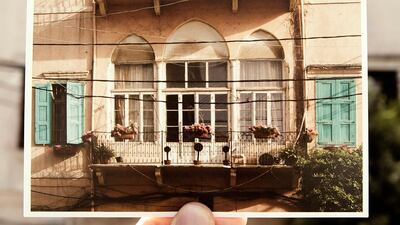
'It was sad, seeing all that destruction,' Khoury says. -

Khoury and Cardozo left postcards on the building facades. 'It was a gesture of hope that we can still rebuild,' Khoury says. -

A photo in the series shows a blue building in Gemmayzeh, Beirut, with a mix of arch-topped windows and rectangular ones with white slatted doors. -

There’s a chance that the Bouyout Beirut series may contribute to the restoration of the photographed buildings after people asked if they could see the originals. -

Joseph Khoury and Gabriela Cardozo have now decided to start a fundraising campaign by selling large-format prints and postcards of the Bouyout Beirut series and donating proceeds to the Lebanese Red Cross. -
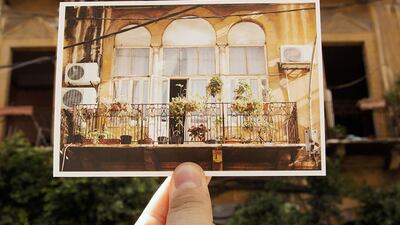
Another snapshot taken as part of Bouyout Beirut. -
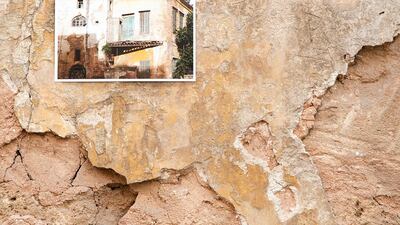
'It was a personal project for me,' says Khoury of Bouyout Beirut.


MPs met as politicians jockey over the next government and blame for the disaster.
Mr Berri claimed there was a plot against parliament but did not provide specifics.
"Over the past two weeks, a plot has been hatched involving the resignation of MPs and over the government's willingness to question parliament,” he said.
Parliament accepted the resignation of seven MPs and began discussions on passing a state of emergency in the wake of the explosion.
MP Simon Abi Ramia told reporters on his way in that he was hesitant to attend. “We are living in institutional chaos,” he said.
– additional reporting by agencies

