
Israel's plan to annex nearly a third of the occupied West Bank is a vision of "21st-century apartheid", a large group of independent United Nations experts warned on Tuesday.
The experts said the annexation would be a "serious violation" of the United Nations charter and the Geneva Conventions, and would only intensify human rights violations in the West Bank.
Israeli Prime Minister Benjamin Netanyahu aims to begin a process of annexing West Bank settlements and the Jordan Valley from July 1, as part of a US peace initiative.
The experts said the 53-year Israeli occupation of the occupied West Bank had been the source of "profound human rights violations" against the Palestinians, chiefly the denial of the right of self-determination among a long list of other alleged violations.
"These human rights violations would only intensify after annexation," the experts said.
"What would be left of the West Bank would be a Palestinian Bantustan, islands of disconnected land completely surrounded by Israel and with no territorial connection to the outside world.
"Israel has recently promised that it will maintain permanent security control between the Mediterranean and the Jordan River.
"Thus, the morning after annexation would be the crystallisation of an already unjust reality: two peoples living in the same space, ruled by the same state, but with profoundly unequal rights. This is a vision of a 21st-century apartheid."
-
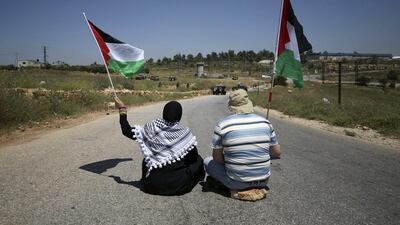
Palestinian protesters wave flags as Israeli troops take position during a protest against Jewish settlements in the West Bank village of Nabi Saleh, near Ramallah. Reuters -
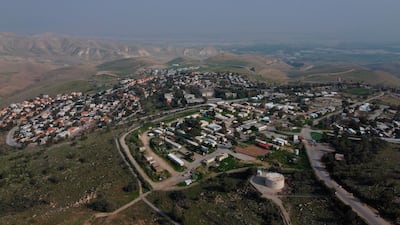
Now that Prime Minister Benjamin Netanyahu has secured a new term in office, there’s little to prevent him from annexing large parts of the West Bank as early as this summer. AP -

An Israeli soldier stands guard during a tour made by Israeli parliament members in the Jordan Valley near the Jewish settlement of Maale Efrayim. Reuters -
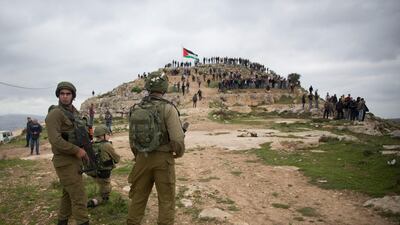
Israeli soldiers take position as Palestinian demonstrators gather during a protest against expansion of Israeli settlements in the West Bank. AP -
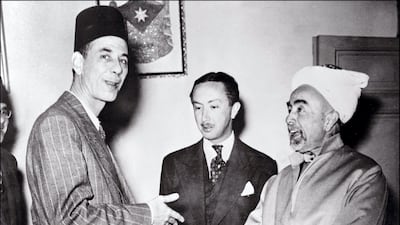
King Abdullah (r) of Transjordan on May 13, 1948 in Amman with Abed Al Rahman Azzam, the secretary general of the Arab League and Abd Al Elah Ibn Ali, the Prince Regent of Iraq, the day before the beginning of the first Arab-Israeli War. AFP -
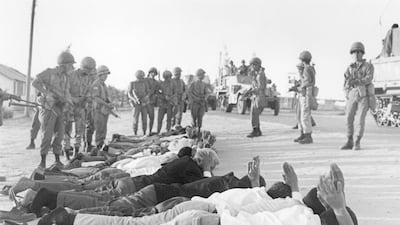
Palestinians surrender to Israeli soldiers in June 1967 in the occupied territory of the West Bank after Israel launched a pre-emptive attack on Egypt and Syria and seized the Gaza Strip, Sinai Peninsula and the Golan Heights in Syria as well as the West Bank and Arab East Jerusalem. AFP -
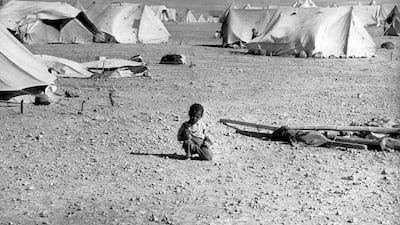
A Palestinian child plays in a refugee camp in Jordan on June 23, 1967. AFP -
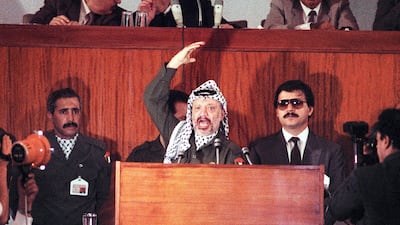
PLO chairman Yasser Arafat delivers a speech to the Palestine National Council meeting to make the historic proclamation of a Palestinian state in the Israeli-occupied territories and to recognize Israel in the Palace of Nations conference hall on November 12, 1988, in Algiers. AFP -

US President Bill Clinton stands between PLO leader Yasser Arafat and Israeli Prime Minister Yitzahk Rabin as they shake hands for the first time on September 13, 1993 at the White House. AFP -
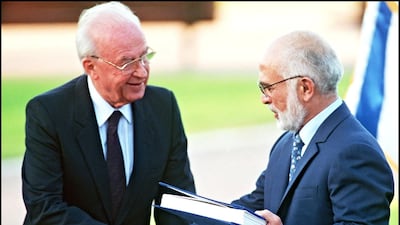
Hussein Ibn Talal, King of Jordan and Israeli Premier Yitzhak Rabin shake hands after they exchanged the documents of the Peace Treaty at Beit Gabriel conference centre on November 10, 1994 on the southern shore of the Sea of Galilee. AFP -
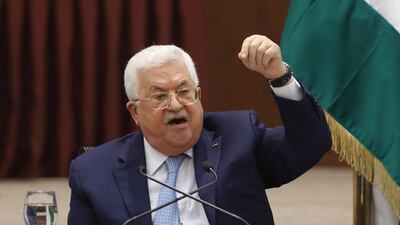
Palestinian President Mahmoud Abbas speaks during the Palestinian leadership meeting and threatened to end security coordination with Israel and the United States, saying Israeli annexation would ruin chances for peace. AFP -
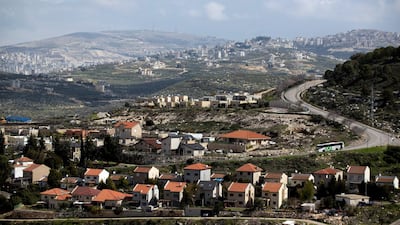
Houses in the Israeli settlement of settlement of Kedumim are seen in the foreground as part of the Palestinian city of Nablus is seen in the background (far left) in the Israeli-occupied West Bank. Reuters -
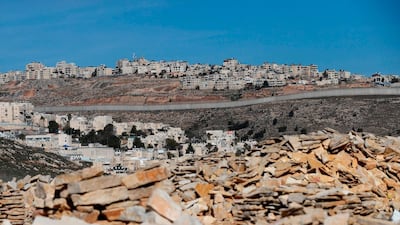
Israel's controversial concrete barrier (C) separating the Jewish settlement of Neve Yaakov (foreground) in the northern part of east Jerusalem and the Palestinian area of al-Ram (background) in the occupied West Bank. AFP -

An Israeli activist holds a banner during a protest against the US peace plan for the Middle East, in front of the US ambassador's residence in Jerusalem, on May 15, 2020, as Palestinians commemorate the 72nd anniversary of the 1948 Nakba or "catastrophe". AFP -
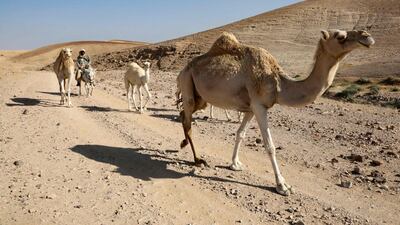
A Palestinian shepherd tends to his camels on arid land considered to be in "Area C" (under Israeli security and administrative control), southeast of Yatta town in the southern West Bank district of Hebron. AFP -
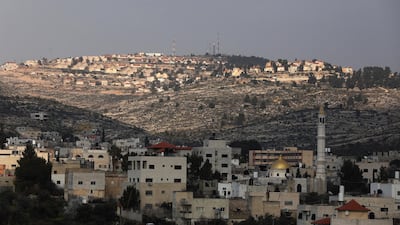
A general view of the Israeli settlement of Elon Moreh, as seen from the Palestinian village of Azmout near the West Bank City of Nablus. EPA -
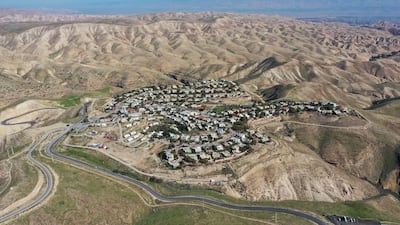
The West Bank Jewish settlement of Maale Michmash. AP


The more than 40 independent special rapporteurs along with a range of UN working groups on various rights issues who signed the statement do not speak for the UN but report their findings to it.
The experts said that Israel's annexation of East Jerusalem in 1980 and the Syrian Golan Heights in 1981 saw condemnation but no meaningful response from the international community.
"This time must be different," they said.
"The lessons from the past are clear: Criticism without consequences will neither forestall annexation nor end the occupation."
There was no immediate reaction from the government of Netanyahu.
US President Donald Trump has unveiled a peace plan that includes Israel keeping its settlements and the Palestinians establishing a state under stringent conditions.
Palestinians have rejected the proposal and voiced outrage at Israel's proposed annexation.
The experts voiced "great regret" about Washington's role in "supporting and encouraging Israel's unlawful plans", saying the United States should be "ardently opposing" an imminent breach of international law "rather than actively abetting its violation".
"The United Nations has stated on many occasions that the 53-year-old Israeli occupation is the source of profound human rights violations against the Palestinian people," the experts' statement said.
Violations have included land confiscation, settler violence, home demolitions, excessive use of force and torture, restrictions on the media and freedom of expression, and "a two-tier system of disparate political, legal, social, cultural and economic rights based on ethnicity and nationality", it said.
"These human rights violations would only intensify after annexation," it added.

