

A statement by Israel that it was normalising relations with Sudan has been met with confusion from the Sudanese Cabinet and people.
The Cabinet said it had not been told of a reported meeting this week between Israeli Prime Minister Benjamin Netanyahu and Gen Abdel Fattah Al Burhan, leader of Sudan’s Sovereignty Council, in the Ugandan city of Entebbe.
The meeting was said to have happened a day after Sudan announced that US President Donald Trump’s administration has invited Gen Al Burhan to visit Washington.
But Sudan’s Cabinet met yesterday, saying it had not been informed about the meeting.
It also came days after the Arab League, of which Sudan is a member, rejected Mr Trump’s much-criticised plan to solve the Palestinian-Israeli conflict.
The lack of clarity around the meeting and the US invitation had some analysts speculating that Sudan could be restoring communication with Israel to have its name removed from a US list of state sponsors of terrorism.
That would allow Khartoum to gain access to financial aid from international donors to help overhaul its ailing economy .
Israel’s claim to be improving ties could also be of benefit to Mr Netanyahu before his March 2 re-election bid.The meeting took place at a time when Arabs are seething over what they see as a US Middle East plan heavily biased in favour of Israel.
Palestinian President Mahmoud Abbas described the plan, which sets near-impossible conditions for the creation of a Palestinian state, as nonsense.
The Palestinians also reacted fiercely to news of a possible Sudanese-Israeli rapprochement.
Saeb Erekat, secretary general of the Palestine Liberation Organisation, said it would be a “stab in the back”.
But experts were sceptical of the prospect of blossoming ties between Israel and Sudan, long divided over Khartoum’s ties with Iran, or that it would be welcomed in the country and the Arab world.
“In the big picture, normalised relations between Sudan and Israel make little difference,” said Mohammed Salem of the Egyptian Council of Foreign Affairs, a former resident of Sudan.
Sudan has won a prominent place in the annals of the Arab-Israeli conflict when it hosted Arab leaders after the June 1967 war against Israel, in which the Israelis captured Egypt’s Sinai, the West Bank and Jerusalem and Syria’s Golan Heights.
The summit’s resolution defined the next stage of the conflict, categorically rejecting peace and negotiations with Israel or recognising it in what has become popularly known as Khartoum’s “three nos.”
Sudan also provided a haven for squadrons of the Egyptian air force and academy to shield them from Israel’s air superiority after the 1967 defeat.
In 1973, Sudanese troops fought alongside the Egyptians in what has become Egypt’s last war against Israel. Egypt signed a peace treaty with Israel in 1979.
-
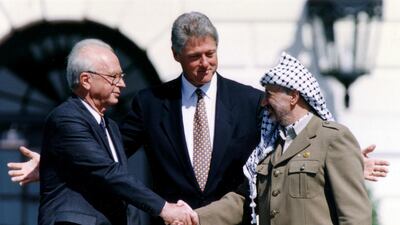
PLO chairman Yasser Arafat shakes hands with Israeli prime minister Yitzhak Rabin, as US president Bill Clinton stands between them, after the signing of the Israeli-PLO peace accord, at the White House September 13, 1993. Reuters -

United States' special envoy Dennis Ross looks on as Saeb Erekat, left, the chief Palestinian negotiator, and Dan Shomron, the chief Israeli negotiator, initial the documents that bring to a conclusion the long-delayed and overdue Israeli troop redeployment in the West Bank city of Hebron. Reuters -
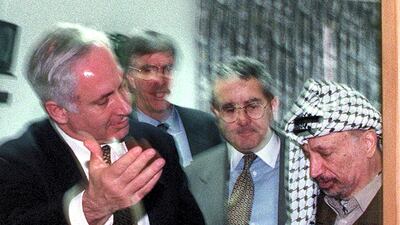
Palestinian president Yasser Arafat and Israeli Prime Minister Benjamin Netanyahu both gesture for the other to leave a meeting December 24 1996 in the Israeli Civil Administration headquarters located along the Israeli - Gaza Strip border area. The two leaders met for for over three hours in a bid to clinch the agreement on the long-delayed Israeli troop redeployment in Hebron. Although no agreement was reached US envoy Dennis Ross said that "real progress" was made towards the long-elusive accord. Reuters -

Israeli Prime Minister Benjamin Netanyahu shakes hands with a smiling Palestinian Authority president Yasser Arafat at a meeting at the Erez crossing between Israel and the Gaza Strip Wednesday Jan 15, 1997. Israel and the PLO concluded a long-elusive agreement on extending Palestinian rule to Hebron in the West Bank. Reuters -
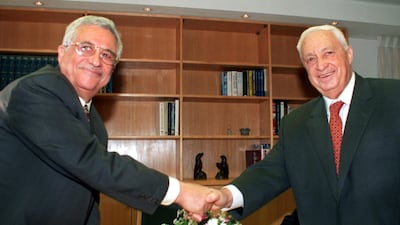
Mahmoud Abbas, left, and Ariel Sharon turn to the cameras and smile as they shake hands at the start of their meeting in Sharon's office November 18. The two met to review the work of all the Israeli-Palestinian peace committees and to set a date for the resumption of final status talks. Reuters -
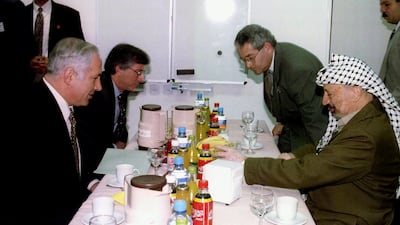
Israeli Prime Minister Benjamin Netanyahu and Palestinian president Yasser Arafat during their meeting at Erez crossing point, northern Gaza Strip, December 24, 1996. Arafat and Netanyahu met here in search of an agreement to end the Israeli occupation of Hebron and revive the peace process. In the background at left is US mediator Dennis Ross. Reuters -

PLO chairman Yasser Arafat holds the second phase of the Oslo peace accords after the initialling of the document, September 24, 1995, as Israeli Foreign Minister Shimon Peres looks on. Israel and the PLO will officially sign the agreement in Washington later this week. Reuters -
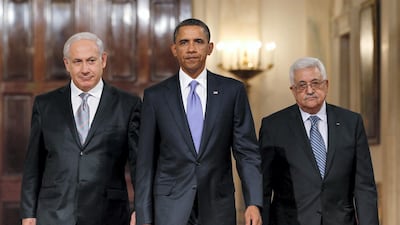
US President Barack Obama arrives with Israeli Prime Minister Benjamin Netanyahu, left, and Palestinian President Mahmoud Abbas to make a statement on Middle East Peace talks in the East Room of the White House, September 1, 2010. Reuters -

Israeli Prime Minister Ehud Barak jokingly pushes Palestinian president Yasser Arafat into the Laurel cabin on the grounds of Camp David as US President Bill Clinton watches during peace talks, July 11, 2000. Arafat and Barak were insisting that the other proceed through the door first. Camp David is the venue where Egypt and Israel made peace in September 1978, and the Laurel cabin was the site of many of the meetings. Reuters -

France's President Nicolas Sarkozy, centre, shakes hands with Palestinian President Mahmoud Abbas, left and Israel's prime minister Ehud Olmert after a joint news briefing at the Elysee Palace July 13, 2008. Reuters -

Palestinian President Yasser Arafat shakes hands with Israeli Prime Minister Benjamin Netanyahu after US special envoy Dennis Ross, centre, spoke, early January 15, 1997 after the two leaders met and agreed on the term for an Israeli troop redeployment in Hebron. The talks lasted less than two hours and concluded months of negotiations. Reuters -
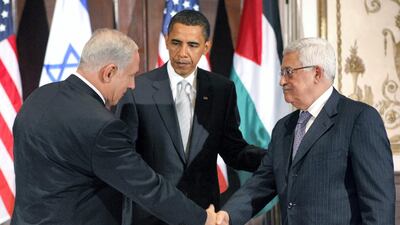
US President Barack Obama watches Israeli Prime Minister Benjamin Netanyahu, left, and Palestinian President Mahmoud Abbas shake hands during a trilateral meeting in New York September 22, 2009. Reuters -
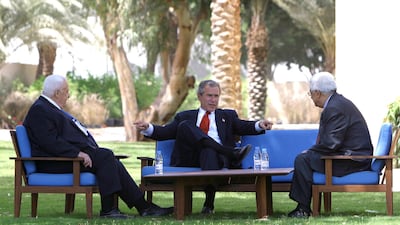
US President George W. Bush discusses the Middle East peace process with prime minister Ariel Sharon of Israel, left, and Palestinian Prime Minister Mahmoud Abbas in Aqaba, Jordan, June 4, 2003. Reuters -

Palestinian and Israeli top negotiators Abu Ala, left, and Uri Savir shake hands after signing the second phase of the Oslo peace accords September 24 1995. PLO chairman Yasser Arafat is in the middle speaking to team member Sait Barecat, (L), after eight days of talks. Reuters -

Israel's Prime Minister Ehud Olmert, right, greets Palestinian President Mahmoud Abbas during their meeting in Jerusalem September 16, 2008. Reuters -
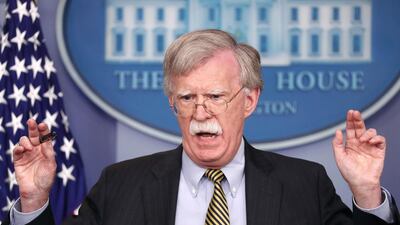
US National Security Advisor John Bolton answers a question from a reporter about how he refers to Palestine during a news conference in the White House briefing room in Washington, U.S., October 3, 2018. Reuters


In 2009, Israel’s warplanes were reported to have struck an arms convoy inside Sudan that was destined for the militant Palestinian group Hamas in the Gaza Strip.
But there is a new political order in Sudan after the military’s removal last April of longtime dictator Omar Al Bashir.
Sudan is no longer close to Iran, Israel’s arch-enemy, and there is little stomach in the country now for Hamas, chiefly over its links to the Muslim Brotherhood, of which Al Bashir was a follower.
A 39-month transitional period began in August last year when the military and leaders of the opposition signed a power-sharing agreement.
As part of that pact, Gen Al Burhan has taken over the helm of the 11-member Sovereignty Council for 18 months before a civilian from the left-leaning opposition movement replaces him.
"No one thought this could ever happen," pro-democracy activist Sulaima Shareef told The National from Khartoum.
“People are divided in Sudan over the meeting. Some say it will lift US sanctions linked to the list of state sponsors of terrorism.
"Others believe that lifting the sanctions is a legitimate right for which no price should have been paid. I personally have mixed feelings. It was a total surprise that I wasn’t prepared for.”
Hany Raslan, a Sudan expert at Cairo’s Al Ahram Centre for Political and Strategic Studies, believes that the idea of Sudan forging normalised relations with Israel was unlikely to become a disputed policy or dominate the national conversation.
But he warned that Al Bashir’s supporters could use such a move to rally opposition to the new regime in Sudan and even incite homegrown militants to react violently.
“The new regime in Sudan wants to turn the page of Al Bashir’s era and end the country’s international isolation," Mr Raslan said.
"It realises that the gateway to the international community is for Sudan’s name to be lifted from the list of state sponsors of terrorism. This is of paramount interest to Sudan as its economic woes ominously deepen."

