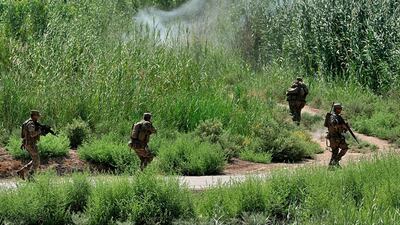
Iraqi forces during a search operation in Taramiyah, 50 kilometres north of Baghdad, April 30, 2020. AP

ISIS attacks surge as region deals with coronavirus


  • English
  • Arabic

The man wearing an explosive vest emerged from a car and calmly marched toward the gates of the intelligence building in Iraq’s northern city of Kirkuk. When he ignored their shouts to halt, guards opened fire, and he blew himself up, wounding three security personnel in the first week of Ramadan.

Days later, a three-pronged co-ordinated attack killed 10 Iraqi militia fighters in the northern province of Salahaddin — the deadliest and most complex operation in many months.

The assaults are the latest in a resurgence of attacks by the ISIS in northern Iraq. The first was a brazen suicide mission not seen in months. The second was among the most complex attacks since the group’s defeat in 2017. In neighbouring Syria, ISIS attacks on security forces, oil fields and civilian sites have also intensified.

Up to 10 Egyptian soldiers were killed and three wounded on Thursday when a bomb hit an armoured vehicle south of Bir Al Abd city in the northern Sinai region in attack later claimed by ISIS.

The renewed mayhem is a sign that the militant group is taking advantage of governments absorbed in tackling the coronavirus pandemic and the ensuing slide into economic chaos. The virus is compounding longtime concerns among security and UN experts that the group would stage a comeback after its “caliphate,” which once encompassed a third of Iraq and Syria, was brought down last year.

In Iraq, militants also exploit security gaps at a time of an ongoing territorial dispute and a US troop drawdown.

“It’s a real threat,” said Qubad Talabani, deputy prime minister of the northern Kurdish region of Iraq. “They are mobilising and killing us in the north and they will start hitting Baghdad soon.” He said ISIS was benefiting from a “gap” between Kurdish forces and federal armed forces caused by political infighting.

Intelligence reports say the number of ISIS fighters in Iraq is believed to be 2,500-3,000.

In northeast Syria, Kurdish-dominated police have become a more visible target for ISIS as they patrol the streets to implement anti-virus measures, said Mervan Qamishlo, a spokesman for US-allied Kurdish-led forces.

ISIS fighters in late March launched a campaign of attacks in government-held parts of Syria, from the central province of Homs all the way to Deir Ezzour to the east, bordering Iraq.

_____________

Coronavirus around the Middle East

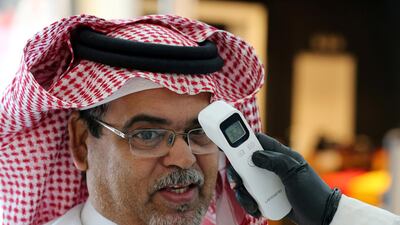
  • A security guard checks the temperature of a man at a shopping mall after the Saudi government eased a curfew and allowed stores to open. Reuters
    A security guard checks the temperature of a man at a shopping mall after the Saudi government eased a curfew and allowed stores to open. Reuters
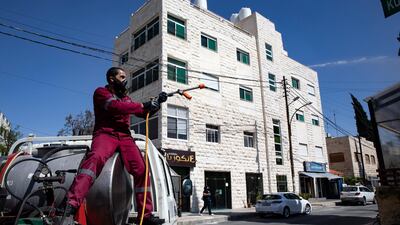
  • After some seven weeks of lockdown, then full curfews on weekends, hairdressers, textile, shoes and some other businesses of Jordan were allowed on the last week of April to reopen their shops. EPA
    After some seven weeks of lockdown, then full curfews on weekends, hairdressers, textile, shoes and some other businesses of Jordan were allowed on the last week of April to reopen their shops. EPA
  • Lebanese nationals who were stranded abroad due to the coronavirus Covid-19 pandemic arrive from Cairo at Beirut international airport. EPA
    Lebanese nationals who were stranded abroad due to the coronavirus Covid-19 pandemic arrive from Cairo at Beirut international airport. EPA
  • Lebanese nationals who were stranded abroad due to the coronavirus pandemic arrive from Cairo at Beirut international airport, Lebanon. EPA
    Lebanese nationals who were stranded abroad due to the coronavirus pandemic arrive from Cairo at Beirut international airport, Lebanon. EPA
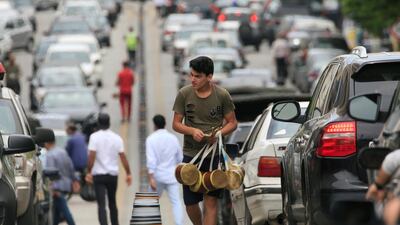
  • A street vendor walks along a road during a countrywide lockdown to prevent the spread of the coronavirus disease in Sidon, Lebanon. Reuters
    A street vendor walks along a road during a countrywide lockdown to prevent the spread of the coronavirus disease in Sidon, Lebanon. Reuters
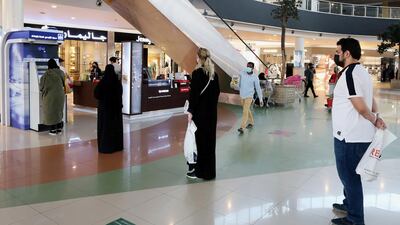
  • People line up while social distancing to use an ATM at a shopping mall in Saudi Arabia. Reuters
    People line up while social distancing to use an ATM at a shopping mall in Saudi Arabia. Reuters
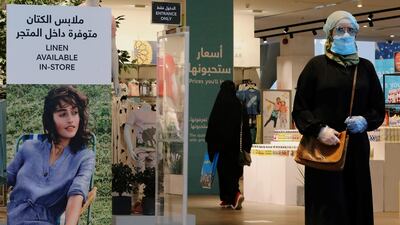
  • A woman wearing a protective mask walks at a shopping mall after the Saudi government eased a curfew and allowed stores to open, following the outbreak of the coronavirus disease. Reuters
    A woman wearing a protective mask walks at a shopping mall after the Saudi government eased a curfew and allowed stores to open, following the outbreak of the coronavirus disease. Reuters
  • A woman stands on a social distancing marker at a shopping mall after the Saudi government eased a curfew. Reuters
    A woman stands on a social distancing marker at a shopping mall after the Saudi government eased a curfew. Reuters
  • Mayor of the municipality of Tunis Souad Abderrahim distributes free masks in front of the central market in Tunis. EPA
    Mayor of the municipality of Tunis Souad Abderrahim distributes free masks in front of the central market in Tunis. EPA
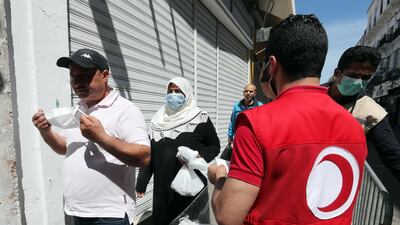
  • A Tunisian Red Crescent member distributes free masks in front of the central market in Tunis. EPA
    A Tunisian Red Crescent member distributes free masks in front of the central market in Tunis. EPA
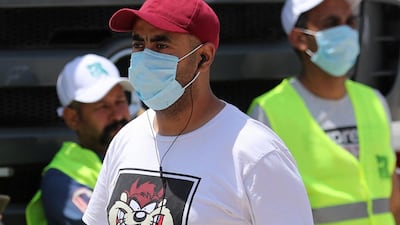
  • Men wearing protective face masks are pictured in downtown Cairo, amidst concerns about the spread of the coronavirus disease. Reuters
    Men wearing protective face masks are pictured in downtown Cairo, amidst concerns about the spread of the coronavirus disease. Reuters
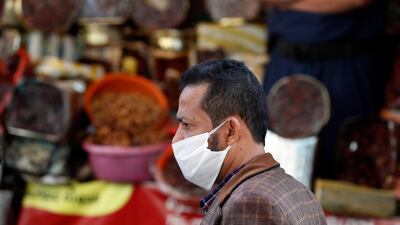
  • A Yemeni wearing a protective face mask passes the shops of dates, a popular appetizer for breaking the fast during Ramadan, at a market in Sanaa. EPA
    A Yemeni wearing a protective face mask passes the shops of dates, a popular appetizer for breaking the fast during Ramadan, at a market in Sanaa. EPA
  • A Yemeni wears a protective face mask while attending a meeting on coronavirus awareness amid the ongoing coronavirus Covid-19 pandemic in Sanaa. EPA
    A Yemeni wears a protective face mask while attending a meeting on coronavirus awareness amid the ongoing coronavirus Covid-19 pandemic in Sanaa. EPA

_____________

Some 500 fighters, including some who had escaped from prison, recently slipped from Syria into Iraq, helping fuel the surge in violence there, Iraqi intelligence officials said.

ISIS is shifting from local intimidation to more complex attacks, three Iraqi military officials and experts said. Operations previously focused on assassinations of local officials and less sophisticated attacks. Now the group is carrying out more IED attacks, shootings and ambushes of police and military. The officials spoke on condition of anonymity because they were not authorised to talk to the media.

Multiple factors help the militants. The number of Iraqi military personnel on duty has dropped 50 per cent because of virus prevention measures, the military officials said.

Also, territorial disputes between Baghdad and authorities from the northern Kurdish autonomy zone have left parts of three provinces without law enforcement. The rugged landscape is difficult to police.

The uptick also coincides with a pullout of US-led coalition forces from bases in western Iraq, Nineveh and Kirkuk provinces in line with a drawdown conceived in December.

“Before the emergence of the virus and before the American withdrawal, the operations were negligible, numbering only one operation per week,” said a senior intelligence official. Now, he said, security forces are seeing an average of 20 operations a month. He spoke on condition of anonymity because he was not authoried to brief the media.

Coalition spokesman Col Myles B Caggins III said ISIS attacks were increasing in reaction to operations against its hideouts in the mountains and rural areas of north-central Iraq.

Iraqi military officials believe the improved, organised nature of the attacks serves to cement the influence of new ISIS leader Abu Ibrahim Al Hashimi Al Quraishi, who was named after his predecessor was killed in a US raid late last year. One military official said more operations are expected during Ramadan to demonstrate the new leader’s strength.

In Syria, one of the most significant attacks occurred April 9, when ISIS fighters attacked government positions in and near the town of Sukhna. The government brought in reinforcements for a counterattack backed by Russian airstrikes.

Two days of fighting left 32 troops and 26 ISIS gunmen dead, according to the Britain-based Syrian Observatory for Human Rights, which tracks the country’s nine-year war.

Days later, the government said that because of the security situation in the desert several gas wells in the fields of Shaer and Hayan were damaged, leading to a 30 per cent drop in electricity production.

Back in Iraq, the green pastures of the northern village of Kujalo conceal a hidden enemy that keeps resident Nawzad up at night. His farming community lies in a disputed territory that has witnessed a sharp increase in attacks, including a nearby ambush earlier this month that killed two peshmerga officers.

He said the militants have local collaborators. “They know everything about each farm in Kulajo and they know to whom each house belongs,” he said, asking to be identified only by his first name, fearing reprisals.

The militants also receive shelter, supplies, food and transport from local sympathisers, said Kurdish Brig Kamal Mahmoud. His peshmerga forces are based on part of the front lines there, but can’t operate in other parts run by government troops — and there, he said, the overstretched security forces control only main roads with no presence in villages and towns.

On April 1, a federal police officer was killed, and a battalion commander and brigadier general wounded in a security operation in the Makhoul mountain range in Diyala. Two days later, an IED attack targeted a patrol of a commando regiment of the Diyala Operations Command in the outskirts of Maadan village.

Sartip, a Kujalo resident, said he fears the militants’ improved capabilities.

“ISIS has been carrying out attacks in Kurdish areas for a long time, but now they are more organised and have more people,” he said


Ferrari 12Cilindri specs

Engine: naturally aspirated 6.5-liter V12

Power: 819hp

Torque: 678Nm at 7,250rpm

Price: From Dh1,700,000

Available: Now

In numbers: PKK’s money network in Europe

Germany: PKK collectors typically bring in $18 million in cash a year – amount has trebled since 2010

Revolutionary tax: Investigators say about $2 million a year raised from ‘tax collection’ around Marseille

Extortion: Gunman convicted in 2023 of demanding $10,000 from Kurdish businessman in Stockholm

Drug trade: PKK income claimed by Turkish anti-drugs force in 2024 to be as high as $500 million a year

Denmark: PKK one of two terrorist groups along with Iranian separatists ASMLA to raise “two-digit million amounts”

Contributions: Hundreds of euros expected from typical Kurdish families and thousands from business owners

TV channel: Kurdish Roj TV accounts frozen and went bankrupt after Denmark fined it more than $1 million over PKK links in 2013 

Porsche Taycan Turbo specs

Engine: Two permanent-magnet synchronous AC motors

Transmission: two-speed

Power: 671hp

Torque: 1050Nm

Range: 450km

Price: Dh601,800

On sale: now

MATCH INFO

What: India v Afghanistan, first Test
When: Starts Thursday
Where: M Chinnaswamy Stadium, Bengalaru

Results

2.15pm: Maiden (PA) Dh40,000 1,200m

Winner: Maqam, Fabrice Veron (jockey), Eric Lemartinel (trainer).

2.45pm: Maiden (PA) Dh40,000 1,200m

Winner: Mamia Al Reef, Szczepan Mazur, Ibrahim Al Hadhrami.

3.15pm: Handicap (PA) Dh40,000 2,000m

Winner: Jaahiz, Fabrice Veron, Eric Lemartinel.

3.45pm: Handicap (PA) Dh40,000 1,000m

Winner: Qanoon, Szczepan Mazur, Irfan Ellahi.

4.15pm: Sheikh Hamdan bin Rashid Cup Handicap (TB) Dh200,000 1,700m.

Winner: Philosopher, Tadhg O’Shea, Salem bin Ghadayer.

54.45pm: Handicap (PA) Dh40,000 1,700m

Winner: Jap Al Yassoob, Fernando Jara, Irfan Ellahi.

TEACHERS' PAY - WHAT YOU NEED TO KNOW

Pay varies significantly depending on the school, its rating and the curriculum. Here's a rough guide as of January 2021:

- top end schools tend to pay Dh16,000-17,000 a month - plus a monthly housing allowance of up to Dh6,000. These tend to be British curriculum schools rated 'outstanding' or 'very good', followed by American schools

- average salary across curriculums and skill levels is about Dh10,000, recruiters say

- it is becoming more common for schools to provide accommodation, sometimes in an apartment block with other teachers, rather than hand teachers a cash housing allowance

- some strong performing schools have cut back on salaries since the pandemic began, sometimes offering Dh16,000 including the housing allowance, which reflects the slump in rental costs, and sheer demand for jobs

- maths and science teachers are most in demand and some schools will pay up to Dh3,000 more than other teachers in recognition of their technical skills

- at the other end of the market, teachers in some Indian schools, where fees are lower and competition among applicants is intense, can be paid as low as Dh3,000 per month

- in Indian schools, it has also become common for teachers to share residential accommodation, living in a block with colleagues

MATCH INFO

Watford 1 (Deulofeu 80' p)

Chelsea 2 (Abraham 5', Pulisic 55')

Ten tax points to be aware of in 2026

1. Domestic VAT refund amendments: request your refund within five years

If a business does not apply for the refund on time, they lose their credit.

2. E-invoicing in the UAE

Businesses should continue preparing for the implementation of e-invoicing in the UAE, with 2026 a preparation and transition period ahead of phased mandatory adoption. 

3. More tax audits

Tax authorities are increasingly using data already available across multiple filings to identify audit risks. 

4. More beneficial VAT and excise tax penalty regime

Tax disputes are expected to become more frequent and more structured, with clearer administrative objection and appeal processes. The UAE has adopted a new penalty regime for VAT and excise disputes, which now mirrors the penalty regime for corporate tax.

5. Greater emphasis on statutory audit

There is a greater need for the accuracy of financial statements. The International Financial Reporting Standards standards need to be strictly adhered to and, as a result, the quality of the audits will need to increase.

6. Further transfer pricing enforcement

Transfer pricing enforcement, which refers to the practice of establishing prices for internal transactions between related entities, is expected to broaden in scope. The UAE will shortly open the possibility to negotiate advance pricing agreements, or essentially rulings for transfer pricing purposes. 

7. Limited time periods for audits

Recent amendments also introduce a default five-year limitation period for tax audits and assessments, subject to specific statutory exceptions. While the standard audit and assessment period is five years, this may be extended to up to 15 years in cases involving fraud or tax evasion. 

8. Pillar 2 implementation 

Many multinational groups will begin to feel the practical effect of the Domestic Minimum Top-Up Tax (DMTT), the UAE's implementation of the OECD’s global minimum tax under Pillar 2. While the rules apply for financial years starting on or after January 1, 2025, it is 2026 that marks the transition to an operational phase.

9. Reduced compliance obligations for imported goods and services

Businesses that apply the reverse-charge mechanism for VAT purposes in the UAE may benefit from reduced compliance obligations. 

10. Substance and CbC reporting focus

Tax authorities are expected to continue strengthening the enforcement of economic substance and Country-by-Country (CbC) reporting frameworks. In the UAE, these regimes are increasingly being used as risk-assessment tools, providing tax authorities with a comprehensive view of multinational groups’ global footprints and enabling them to assess whether profits are aligned with real economic activity. 

Contributed by Thomas Vanhee and Hend Rashwan, Aurifer

TOURNAMENT INFO

Women’s World Twenty20 Qualifier

Jul 3- 14, in the Netherlands
The top two teams will qualify to play at the World T20 in the West Indies in November

UAE squad
Humaira Tasneem (captain), Chamani Seneviratne, Subha Srinivasan, Neha Sharma, Kavisha Kumari, Judit Cleetus, Chaya Mughal, Roopa Nagraj, Heena Hotchandani, Namita D’Souza, Ishani Senevirathne, Esha Oza, Nisha Ali, Udeni Kuruppuarachchi

Stormy seas

Weather warnings show that Storm Eunice is soon to make landfall. The videographer and I are scrambling to return to the other side of the Channel before it does. As we race to the port of Calais, I see miles of wire fencing topped with barbed wire all around it, a silent ‘Keep Out’ sign for those who, unlike us, aren’t lucky enough to have the right to move freely and safely across borders.

We set sail on a giant ferry whose length dwarfs the dinghies migrants use by nearly a 100 times. Despite the windy rain lashing at the portholes, we arrive safely in Dover; grateful but acutely aware of the miserable conditions the people we’ve left behind are in and of the privilege of choice. 

Recent winners

2002 Giselle Khoury (Colombia)

2004 Nathalie Nasralla (France)

2005 Catherine Abboud (Oceania)

2007 Grace Bijjani  (Mexico)

2008 Carina El-Keddissi (Brazil)

2009 Sara Mansour (Brazil)

2010 Daniella Rahme (Australia)

2011 Maria Farah (Canada)

2012 Cynthia Moukarzel (Kuwait)

2013 Layla Yarak (Australia)              

2014 Lia Saad  (UAE)

2015 Cynthia Farah (Australia)

2016 Yosmely Massaad (Venezuela)

2017 Dima Safi (Ivory Coast)

2018 Rachel Younan (Australia)

City's slump

L - Juventus, 2-0
D - C Palace, 2-2
W - N Forest, 3-0
L - Liverpool, 2-0
D - Feyenoord, 3-3
L - Tottenham, 4-0
L - Brighton, 2-1
L - Sporting, 4-1
L - Bournemouth, 2-1
L - Tottenham, 2-1

What is an FTO Designation?

FTO designations impose immigration restrictions on members of the organisation simply by virtue of their membership and triggers a criminal prohibition on knowingly providing material support or resources to the designated organisation as well as asset freezes. 

It is a crime for a person in the United States or subject to the jurisdiction of the United States to knowingly provide “material support or resources” to or receive military-type training from or on behalf of a designated FTO.

Representatives and members of a designated FTO, if they are aliens, are inadmissible to and, in certain circumstances removable from, the United States.

Except as authorised by the Secretary of the Treasury, any US financial institution that becomes aware that it has possession of or control over funds in which an FTO or its agent has an interest must retain possession of or control over the funds and report the funds to the Treasury Department.

Source: US Department of State

11 cabbie-recommended restaurants and dishes to try in Abu Dhabi

Iqbal Restaurant behind Wendy’s on Hamdan Street for the chicken karahi (Dh14)

Pathemari in Navy Gate for prawn biryani (from Dh12 to Dh35)

Abu Al Nasar near Abu Dhabi Mall, for biryani (from Dh12 to Dh20)

Bonna Annee at Navy Gate for Ethiopian food (the Bonna Annee special costs Dh42 and comes with a mix of six house stews – key wet, minchet abesh, kekel, meser be sega, tibs fir fir and shiro).

Al Habasha in Tanker Mai for Ethiopian food (tibs, a hearty stew with meat, is a popular dish; here it costs Dh36.75 for lamb and beef versions)

Himalayan Restaurant in Mussaffa for Nepalese (the momos and chowmein noodles are best-selling items, and go for between Dh14 and Dh20)

Makalu in Mussaffa for Nepalese (get the chicken curry or chicken fry for Dh11)

Al Shaheen Cafeteria near Guardian Towers for a quick morning bite, especially the egg sandwich in paratha (Dh3.50)

Pinky Food Restaurant in Tanker Mai for tilapia

Tasty Zone for Nepalese-style noodles (Dh15)

Ibrahimi for Pakistani food (a quarter chicken tikka with roti costs Dh16)

Our legal columnist

Name: Yousef Al Bahar

Advocate at Al Bahar & Associate Advocates and Legal Consultants, established in 1994

Education: Mr Al Bahar was born in 1979 and graduated in 2008 from the Judicial Institute. He took after his father, who was one of the first Emirati lawyers

Tips for taking the metro

- set out well ahead of time

- make sure you have at least Dh15 on you Nol card, as there could be big queues for top-up machines

- enter the right cabin. The train may be too busy to move between carriages once you're on

- don't carry too much luggage and tuck it under a seat to make room for fellow passengers

The 15 players selected

Muzzamil Afridi, Rahman Gul, Rizwan Haider (Dezo Devils); Shahbaz Ahmed, Suneth Sampath (Glory Gladiators); Waqas Gohar, Jamshaid Butt, Shadab Ahamed (Ganga Fighters); Ali Abid, Ayaz Butt, Ghulam Farid, JD Mahesh Kumara (Hiranni Heros); Inam Faried, Mausif Khan, Ashok Kumar (Texas Titans

Mercer, the investment consulting arm of US services company Marsh & McLennan, expects its wealth division to at least double its assets under management (AUM) in the Middle East as wealth in the region continues to grow despite economic headwinds, a company official said.

Mercer Wealth, which globally has $160 billion in AUM, plans to boost its AUM in the region to $2-$3bn in the next 2-3 years from the present $1bn, said Yasir AbuShaban, a Dubai-based principal with Mercer Wealth.

Within the next two to three years, we are looking at reaching $2 to $3 billion as a conservative estimate and we do see an opportunity to do so,” said Mr AbuShaban.

Mercer does not directly make investments, but allocates clients’ money they have discretion to, to professional asset managers. They also provide advice to clients.

“We have buying power. We can negotiate on their (client’s) behalf with asset managers to provide them lower fees than they otherwise would have to get on their own,” he added.

Mercer Wealth’s clients include sovereign wealth funds, family offices, and insurance companies among others.

From its office in Dubai, Mercer also looks after Africa, India and Turkey, where they also see opportunity for growth.

Wealth creation in Middle East and Africa (MEA) grew 8.5 per cent to $8.1 trillion last year from $7.5tn in 2015, higher than last year’s global average of 6 per cent and the second-highest growth in a region after Asia-Pacific which grew 9.9 per cent, according to consultancy Boston Consulting Group (BCG). In the region, where wealth grew just 1.9 per cent in 2015 compared with 2014, a pickup in oil prices has helped in wealth generation.

BCG is forecasting MEA wealth will rise to $12tn by 2021, growing at an annual average of 8 per cent.

Drivers of wealth generation in the region will be split evenly between new wealth creation and growth of performance of existing assets, according to BCG.

Another general trend in the region is clients’ looking for a comprehensive approach to investing, according to Mr AbuShaban.

“Institutional investors or some of the families are seeing a slowdown in the available capital they have to invest and in that sense they are looking at optimizing the way they manage their portfolios and making sure they are not investing haphazardly and different parts of their investment are working together,” said Mr AbuShaban.

Some clients also have a higher appetite for risk, given the low interest-rate environment that does not provide enough yield for some institutional investors. These clients are keen to invest in illiquid assets, such as private equity and infrastructure.

“What we have seen is a desire for higher returns in what has been a low-return environment specifically in various fixed income or bonds,” he said.

“In this environment, we have seen a de facto increase in the risk that clients are taking in things like illiquid investments, private equity investments, infrastructure and private debt, those kind of investments were higher illiquidity results in incrementally higher returns.”

The Abu Dhabi Investment Authority, one of the largest sovereign wealth funds, said in its 2016 report that has gradually increased its exposure in direct private equity and private credit transactions, mainly in Asian markets and especially in China and India. The authority’s private equity department focused on structured equities owing to “their defensive characteristics.”