
Iraq's Cabinet on Saturday approved Prime Minister Adel Abdul Mahdi's decision to step down following a call from the country's top Shiite cleric for parliament to consider changing the government.
Mr Abdul Mahdi called an extraordinary meeting of the Cabinet on Saturday morning to "discuss the resignation of His Excellency and the Government and submit it to the House of Representatives", a statement from the prime minister's office said.
"The prime minister calls on the House of Representatives to find appropriate solutions at its next session, and called on members of the government to continue their work until the formation of the new government," it said.
Mr Abdul Mahdi announced his intention to resign on Friday, saying he would submit a formal letter to parliament "requesting my resignation" in keeping with the wishes expressed by Grand Ayatollah Ali Al Sistani in his Friday sermon.
His decision did little to appease Iraqis who have staged anti-government protests since early October. Demonstrations continued in Baghdad and across the south on Saturday, with protesters insisting that "all corrupted people" must step down.
In Nasiriyah, the prime minister's birthplace, demonstrators set tyres ablaze on three bridges spanning the Euphrates River as hundreds more converged in the main protest camp in the flashpoint city's centre.
Security and hospital officials said two protesters were killed and 15 wounded in the city of Najaf early on Saturday when security forces fired live rounds at them. Protesters in the holy city set fire to the entrance of a shrine while police fired tear gas to disperse them.
In Baghdad, at least 11 protesters were wounded near the Ahrar Bridge when security forces fired live ammunition and tear gas to disperse them, the officials said.
Parliament is scheduled to meet on Sunday but it is not clear when Mr Abdul Mahdi will present his resignation letter. Two of the largest groups in parliament have indicated they would heed Mr Al Sistani's suggestion to change the government.
However, some Iraqis question why the prime minister said he was handing his resignation to parliament rather than the country’s president as would be the norm. Some questioned if Mr Abdul Mahdi was showing unwillingness to leave office by demanding that parliament take a vote on the matter to force him out.
As yet there has been no government roadmap for what will happen next.
The protests in Nasiriyah have continued despite a bloody crackdown by security forces that killed more than 40 people in the city since Thursday.
The violence was unleashed after protesters stormed and set fire to Iran's consulate in Najaf on Wednesday night, accusing Iraq's neighbour of propping up the Baghdad government.
Security forces and armed men in civilian clothes tried to snuff out rallies in the aftermath of the consulate torching, leaving more than 20 protesters dead, medics said.
-
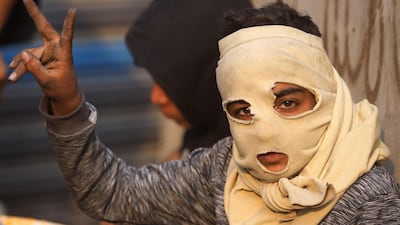
An Iraqi boy wearing a makeshift mask flashes the victory gesture during clashes between anti-government protesters and security forces in the Iraqi capital Baghdad's Rasheed street near al-Ahrar bridge. AFP -
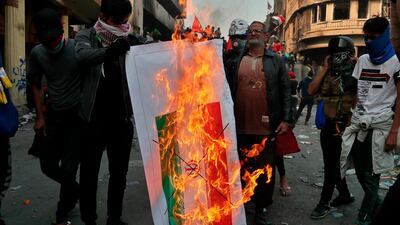
Iraqi anti-government protesters burn an Iranian flag during ongoing protests in Baghdad, Iraq. AP Photo -

River police try to disperse the demonstrators during ongoing protests in Baghdad, Iraq. AP Photo -
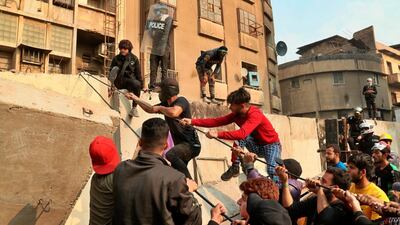
Anti-government protesters try to pull down concrete walls during clashes with security forces in Baghdad. AP Photo -

A protester is helped after Riot police fired tear gas during clashes on Rasheed Street in Baghdad. AP Photo -
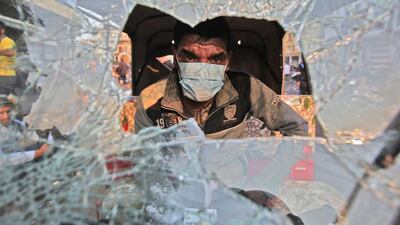
A tuktuk (motorised rickshaw) driver sits behind his broken windshield in his vehicle during clashes between anti-government protesters and security forces in the Iraqi capital Baghdad's Rasheed street near al-Ahrar bridge. AFP -
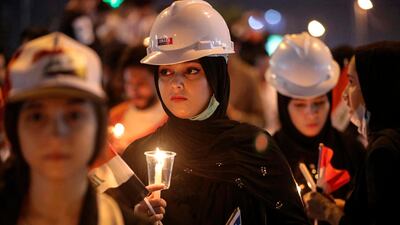
Iraqi women light candles for slain anti-government protesters during ongoing protests in Basra, Iraq. AP Photo -
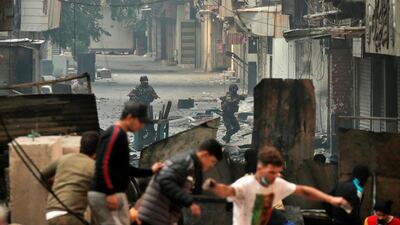
Security forces try to disperse anti-government protesters during clashes in Baghdad. AP Photo -
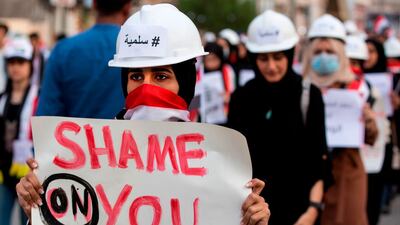
An Iraqi woman protester wearing a construction helmet adorned with the word "#Peaceful" in Arabic marches with a sign during an anti-government demonstration in the southern Iraqi city of Basra. AFP -

Iraqi protesters march with national flags and a Shiite Muslim flag reading in Arabic "oh martyr Hussein" during an anti-government demonstration in the southern Iraqi city of Basra. AFP -

Anti-government protesters carry a symbolic coffin during ongoing protests in Baghdad. AP Photo -

Iraqi women carry the Iraqi national flag shortly after the resignation of Iraqi Prime Minister Adel Abdel-Mahdi, as they take part in the ongoing protests at the Al Tahrir square in central Baghdad. EPA


Five of them were shot dead by men in civilian clothes who fired on young protesters approaching a revered religious tomb or political party headquarters.
The city Karbala was rocked by overnight clashes between young protesters and security forces trading firebombs until the early hours of Saturday.
And in Diwaniyah, thousands hit the streets early to demand "the downfall of the regime".
"We'll keep up this movement. Mr Abdul Mahdi's resignation is only the first step, and now all corrupt figures must be removed and judged," one protester said.
The grassroots movement is the largest Iraq has seen in decades and also the deadliest, with more than 420 people killed and 15,000 wounded in Baghdad and the Shiite-majority south.
The rising deaths have sparked global criticism, with the United Nations mission in Iraq saying the deaths "cannot be tolerated" and the French foreign ministry saying it "strongly condemns the excessive and disproportionate use of force against protesters".
The head of the UN mission in Iraq, Jeanine Hennis-Plasschaert, had a meeting with Mr Abdul Mahdi on Saturday, the prime minister's office said.

