
Iran’s top general swept into Iraq after the protests began, meeting security officials in the place of the country's prime minister.
The day after anti-government protests erupted on October 1 Iranian General Qassem Soleimani flew into Baghdad late at night and took a helicopter to the heavily fortified Green Zone, where he surprised a group of top security officials by chairing a meeting in place of the prime minister.
“We in Iran know how to deal with protests,” Gen. Soleimani told the Iraqi officials, according to two senior officials familiar with the meeting who spoke on condition of anonymity to discuss the secret gathering. “This happened in Iran and we got it under control.”
Protesters in the cities of Baghdad and Karbala, as well as most of southern Iraq are calling for an end to corruption, more employment opportunities and access to basic services like water and electricity.
Since protests spontaneously began on October 1, young people are showing increasing anger towards outside influence in the country - chants of “Iran, out out!” rang out around the protests this week.
Protesters reported seeing men in black clothing and masks stood in front of Iraqi soldiers, facing off with protesters and firing tear gas. Residents said they did not know who they were, with some speculating they were Iranians.
-

Demonstrators disperse after Iraqi security forces fired tear gas during a protest over corruption, lack of jobs, and poor services, in Baghdad, Iraq. REUTERS -

A general view of Tahrir square as demonstrators take part in a protest over corruption, lack of jobs, and poor services, in Baghdad, Iraq. REUTERS -
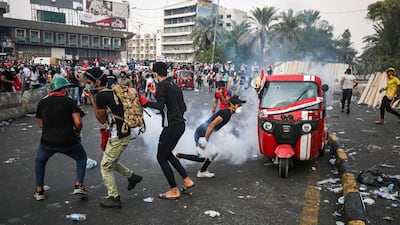
An Iraqi protester runs with a tear gas canister amidst clashes with security forces in the capital Baghdad between Tahrir Square and al-Jumhuriya bridge which connects to the high-security Green Zone, hosting government offices and foreign embassies during the ongoing anti-government protests. AFP -

Demonstrators are seen at Al Jumhuriya bridge during a protest over corruption, lack of jobs, and poor services, in Baghdad, Iraq. REUTERS -

An Iraqi protester wearing a gas mask walks holding up a national flag and a plastic bottle during a demonstration by al-Jumhuriya bridge leading to the capital Baghdad's high-security Green Zone, which hosts government offices and foreign embassies. AFP -
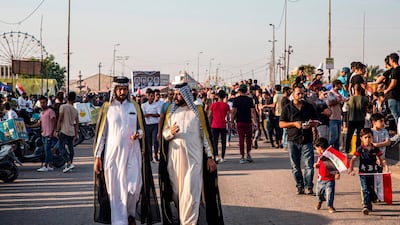
Iraqi men dressed in traditional clothing walk together during an anti-government demonstration outside the local government headquarters in the southern city of Basra. AFP -
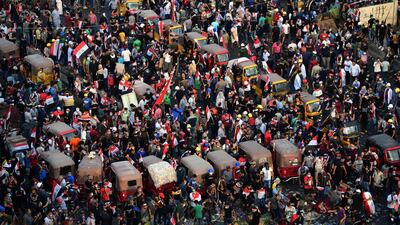
Iraqi protesters gather during a protest at al-Tahrir square, central Baghdad, Iraq. EPA -
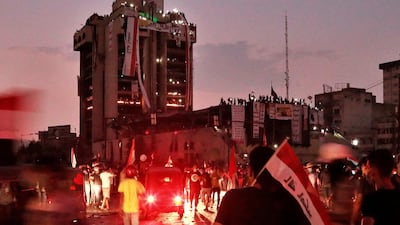
Anti-government protesters gather during a demonstration at sunset in Baghdad, Iraq. AP Photo -
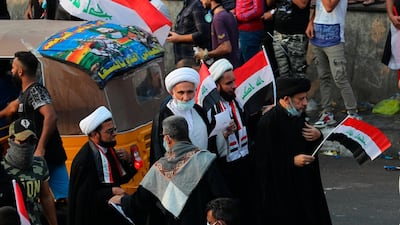
Shiite clerics take part in an anti-government protest during a demonstration in Tahrir Square in Baghdad, Iraq. AP Photo -

Iraqi protesters raise national and religious Shiite flags as they gather during an anti-government demonstration outside the local government headquarters in the southern city of Basra. AFP


“Iran is afraid of these demonstrations because it has made the most gains in the government and parliament through parties close to it” since the US-led invasion of Iraq in 2003, said Hisham al-Hashimi, an Iraqi security analyst. “Iran does not want to lose these gains. So it has tried to work through its parties to contain the protests in a very Iranian way.”
The Iranians aren’t the only outsiders visiting the country, though. Special Representative of the UN Secretary-General for Iraq, Jeanine Hennis Plasschaert, visited the main protest site Tahrir Square on Wednesday and was met by an angry group of protesters. Security officials escorted her along the square and shielded her from the demonstrators.
The EU has also called for an end to the “instances of excessive use of violence”.
"Despite the many calls for restraint, the last days have seen further deplorable loss of many lives and a great number of injured protestors, as well as the destruction of public and private property," Maja Kocijancic, EU spokesperson for foreign policy, told a news conference Wednesday.
Iraq’s semi-official human rights commission said 100 people have been killed and over 5,000 injured since Friday. The deaths bring to the overall number of people killed this month to almost 250 as security forces crackdown on the growing protest movement.
News of Gen Soleimani’s visit came as an Iraqi soldier was killed in a rocket strike on the Green Zone and a protester killed by a tear canister striking his chest on Thursday morning.
The government met for a fourth consecutive day on Thursday to try and find a way to sate the protesters.
President Barham Saleh held closed-door talks to decide the Prime Minister Mr Abdul Mahdi's ouster with Iraq's main political figures, a source in the president's office said.
"Things are heading towards a resolution," another senior Iraqi official told AFP.
Hadi Al Amiri, who leads a parliamentary alliance of Iran-backed Shiite militia and cleric Moqtada Al Sadr, who leads the parliament's largest bloc, asked Mr Abdul Mahdi to step down. However, the move is not thought to be a popular one with protesters.
"We want a total change of government, we don't want one or two officials fired and replaced with other corrupt ones. We want to completely uproot the government," said protester Hussein, who did not give a last name, in Tahrir Square.
"They think we will protest for one or two days then go home. No, we are staying here until the government is uprooted."
Jaber Al Jaberi, an MP representing Anbar in parliament so “no one believed that the situation would get to this level. It has gotten out of hand”.
“The government and its backers are insisting on carrying out their crackdown on demonstrators”
“Everything is out of control,” he said.
Iran had stayed largely silent on the protests until Wednesday, when Supreme Leader Ayatollah Ali Khamenei accused the US and its regional allies of fomenting unrest in both Iraq and Lebanon.
Mr Khamenei, speaking at Iran’s Air Defense Academy, was quoted as saying that US and Western intelligence services “are making chaos” in the region. He urged Iraq and Lebanon to prioritise national security and respect for the law while also saying the protesters’ demands are “right.”
Earlier, Foreign Ministry spokesman Abbas Mousavi offered Tehran’s “deep regret” about the scores of protesters killed in Iraq.
“We are sure that the Iraqi government, nation and clerics can overcome these problems,” he said.

