


This is the second time Esra’a Zakour has fled a barrage of bombs rained down by the Syrian regime and its backers in Moscow and Tehran.
A year ago, as government forces pushed on the Ghouta area just outside Damascus, the 33-year old widowed mother of four fled north to Idlib province, leaving the body of her husband behind.
"We thought we would be able to rest from bombs and I could raise my children decently," she told The National. It was peaceful for a short time when we first arrived here last year but the bombs kept falling and now they are almost the same intensity as the campaign against Ghouta."
This week, she was displaced again.
Russian and Syrian jets bombarded targets, which have included hospitals, across Idlib for the sixth day in a row on Monday. The UN estimates that 323,000 people have been in the region since September last year despite a de-escalation agreed in that month between Russia and Turkey to avoid an all-out offensive.
The regime and Russia say they are attempting to stop the increase in raids by hardline militant groups who have come to control much of the northern province.
The UN says that the bombardment has seen the worst use of barrel bombs by the regime in 15 months. The crude containers packed with explosives and shrapnel are pushed out of planes and helicopters onto houses and buildings below.
Esra’a, like thousands of others, have run for cover near the Turkish border. But, fearing that tens of thousands of the 3 million civilians in the last rebel-held territory could overwhelm Turkish authorities, the frontier is closed and snipers have shot and killed those trying to make the crossing.
-
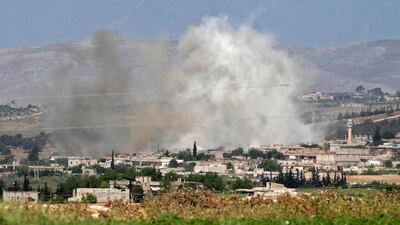
Smoke billows above buildings during shelling by government and allied forces, in the town of Hbeit in the southern countryside of the rebel-held Idlib province. AFP -
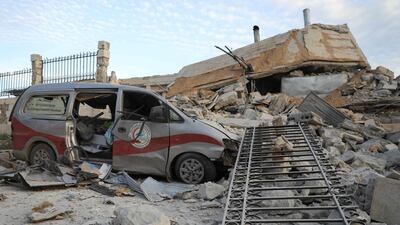
The destroyed entrance of a hospital in the village of Kafr Nabl, south of Idlib. AFP -
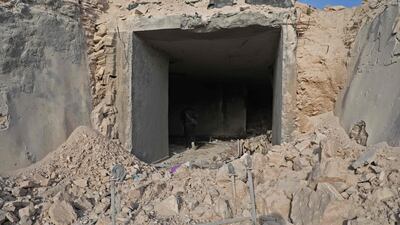
The entrance of an underground hospital on the outskirts of the town of Hass, Idlib, is in ruins. AFP -
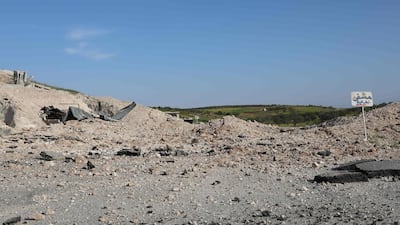
A sign shows the way to a heavily damaged underground hospital in Hass. AFP -
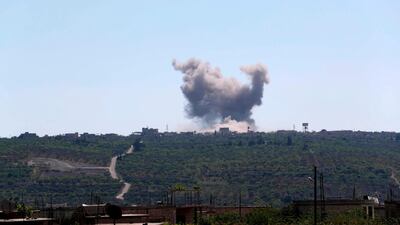
Smoke billows following bombardment by regime forces on the village of Ibdita, Idlib. AFP -
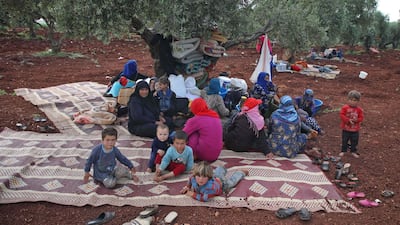
Displaced Syrians gather under the shade of a tree in a field near a camp in the village of Atme. AFP -

A member of the Syrian Civil Defence, also known as the White Helmets, walks amidst the debris of homes following bombardment by regime forces on the village of Basamis, Idlib. AFP -
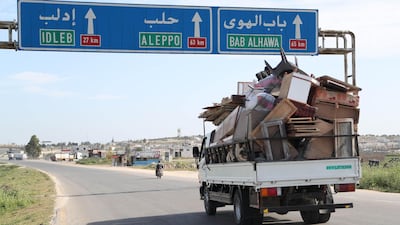
Residents flee Idlib with their belongings during shelling by government and allied forces. AFP -
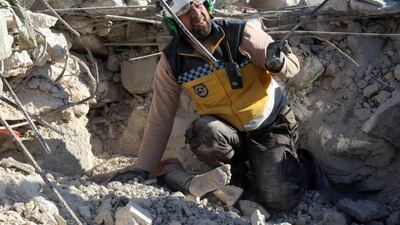
A member of the Syrian Civil Defence prepares to help remove the body of a woman burried under the rubble of a building in Rakaya Sijneh, Idlib. AFP -
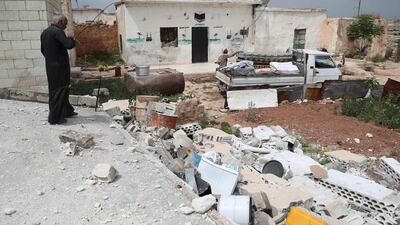
Syrians prepare to leave their houses in the village of Rabaa Jour, Idlib. AFP


"In the past months, and especially the last week, the air strikes and barrel bombs have barely stopped,” she said as she sat among other displaced families on Harem mountain near the Al Khair camp in Idlib.
“Last Wednesday morning, while I was packing few clothes in case we were to leave, air strikes hit right behind my house,” she said.
“I found, one of my children, nine-year-old Jamel, under the window covered with blood, he was unconscious, I was screaming for help and my three sons came around me and were shouting outside until neighbours came and took him to hospital and us to a tent in the farms," Esra’a added.
When her family was settled, she went to see Jamel who was still unconscious. The doctors told her he would survive but had lost a lot of blood from the gash across his stomach. They pulled glass and shrapnel from the young boy’s wounds.
"I do not know what to do; I am trapped between wounded son, and three children left behind in farm tent, and bombs that might kill us all when this,” Esra’a said.
“[There are] no answers, no future for us and no one cares.”
Sitting in the desolate landscape of scrubby shrubs, fallow farms and orchards, Mustafa Farhan sat on a carpet next to the few possessions he had left. With him were his wife, two children and elderly parents.
“The rockets were falling everywhere,” he said. “It was horrendous.”
“It might sound like an exaggeration to some people, but we swear that the bomb and airstrikes have been relentless since last week and here we are, out in [the middle of] nowhere.”
He said in the three days since he fled with his family from the town of Latamna they have not had any food, water or bread, and medical assistance is inaccessible.
One of his sons was injured in a mortar explosion on Monday and he said that the hospitals were so overwhelmed that there was no one who could help.
“The situation will be beyond catastrophic,” the 42-year old said.
David Swanson, the UN regional spokesman for Syria based in the Jordanian capital of Amman told The National that the intensity of the deadly barrages has been increasing.
“This is the heaviest fighting in the area since it was declared a demilitarised zone in September last year,” he said. “The use of barrel bombs, reported in recent days, is also the most intense in the past 15 months.”
He said the UN was “alarmed” at the upsurge in violence and the displacement it has caused. He said that at least three health facilities in Idlib have been destroyed in the last week.
“The UN reiterates that a full-scale escalation of hostilities in the area must be averted at all costs. Failure to do so will bring about humanitarian suffering at a scale not yet seen in the conflict," he added.
Dr Hosam Mohammed, the director of Harem hospital – one of the last functioning medical facilities in north-western Syria – said that they only have the capacity for a small number of patients at a time. This week, he said, the hospital’s ambulances haven’t stopped bringing more wounded people to the centre.
“I don’t want to exaggerate,” he said, “but it has been like judgment day.”
He said they have been treating people as quickly as they can and for those that need longer-term care they try and get safe passage for them to the Turkish border to be transferred to a facility across the frontier.
He said if his hospital is hit like the others this week, he fears a “massacre”.
He said he believes that Russia and the regime are intentionally targeting hospitals – as they have in other areas of Syria – ahead of a ground offensive. Russia denies that it has bombed medical centres.
Mahmoud Khaled, 31, is a first responder with the Violet Organization NGO for relief and development. While speaking to The National he was receiving frantic calls to respond to the aftermath of an air strike.
“The rescue workers aren’t able to hold their families and make sure they’re okay,” he said. “Instead they're answering calls from all across north Syria to help as many civilians as possible."
But, he said, “it's been impossible to help them all”.
“Someone should stop this madness,” he said.

