

It’s no surprise that, now that he is back in Beirut, Lebanese prime minister Saad Hariri has placed his resignation on hold pending negotiations with President Michel Aoun and other allies of Hizbollah. This represents a vital opportunity to pull Lebanon back from the brink of crisis, given that all Lebanese parties and the country would suffer if the delicate political balance that had allowed Mr Hariri to cohabitate politically with Hizbollah, which stands accused of assassinating his father Rafiq in 2005, collapses.
All major Lebanese actors are beholden to foreign patrons, in Mr Hariri’s case Saudi Arabia and with Hizbollah serving Iran’s interests. Riyadh almost certainly approved both Mr Hariri’s resignation, which was made by video from Saudi Arabia, and now his return to Beirut and offer of negotiations with his rivals.
Riyadh has been a major formal and informal source of vital support and foreign exchange to the Lebanese state and economy. But Hizbollah’s destabilising regional role has continuously expanded, especially after the fall of Aleppo in January of this year. It now includes not only a crucial role in supporting Iran and Bashar Al Assad in Syria, but also Iran's proxies in Iraq, Yemen and Bahrain. Saudi Arabia appears to have decided that it is no longer willing to continue to fund and underwrite the base that Hizbollah uses to extend its tentacles across the region on behalf of a growing Iranian hegemony.
__________
Read more:
Lebanon PM Hariri says resignation on hold pending talks
Saad Hariri in Egypt as anticipation builds ahead of Lebanon return
__________
Matters reached a crisis three weeks ago when Houthi rebels in Yemen fired a missile – allegedly supplied by Iran and probably overseen by Hizbollah – at Riyadh’s international airport, and pro-Iran forces seized control of crucial areas along the Syrian-Iraqi border that make an Iranian “land bridge” to Beirut and the Mediterranean Sea an emerging reality rather than an aspiration.
Some commenters argue that Riyadh overreached in Lebanon and elsewhere in response, but the Saudi message has effectively communicated to all the Lebanese. Even Hizbollah seemed deeply rattled, as evinced by an uncharacteristically conciliatory speech by its leader Hassan Nasrallah in response to Mr Hariri’s resignation announcement.
-
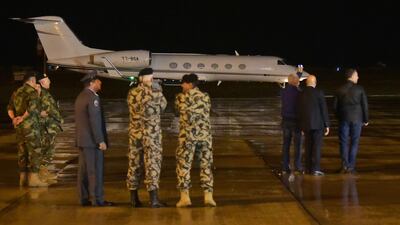
The private jet of Lebanese prime minister Saad Al Hariri lands on the tarmac at Beirut International Airport. Fadel Itani / AFP Photo -

Hariri was greeted by members of the security forces as he disembarked from a jet at Beirut airport, live footage of his arrival showed. Wael Hamzeh / EPA -
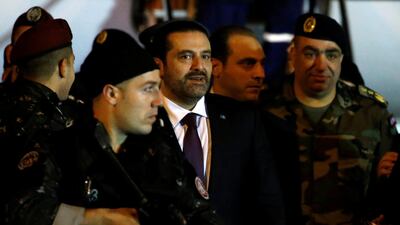
Fireworks were heard in Beirut as Mr Hariri’s supporters celebrated his return. More celebrations are planned for Wednesday, when Mr Hariri is expected to attend Lebanon's independence day parade in the capital. Mohamed Azakir / Reuters -

Hariri will meet President Michel Aoun, who has said he would not accept his resignation until he received it in person..Fadel Itani / AFP Photo -

Saad Al Hariri, who announced his resignation as Lebanon's prime minister from Saudi Arabia, is seen at the grave of his father, assassinated former Lebanese prime minister Rafik Al Hariri, in downtown Beirut. Jamal Saidi / Reuters -
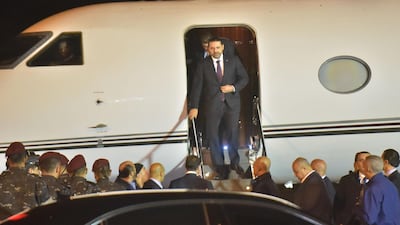
Lebanese Prime Minister Saad Hariri steps off his plane after arriving from Cyprus. Fadel Itani / AFP Photo -

Supporters of Lebanese Prime Minister Saad Hariri wave the Future Movement flags as they celerate his return. Fadel Itani / AFP Photo


Riyadh has yet to deploy its biggest weapons in Lebanon: withdrawing at least US$860 million (Dh3.16 billion) in deposits with the Lebanese central bank and blocking vital remittances from hundreds of thousands of Lebanese expats working in Saudi Arabia and other Gulf countries. Such moves would devastate Lebanon’s economy, currency and political equilibrium, and the whole country has been warned.
Yet how much can be accomplished by pressuring other Lebanese to reign in Hizbollah is questionable, given their relative weakness. The real battlegrounds against Iranian hegemony are Syria and Iraq, where it will take much more than this to shift Hizbollah, not Lebanon and Yemen.
Mr Hariri might convince Hizbollah to stop aiding the Houthis, a major imperative for Riyadh. But rolling back Iran in Iraq and, especially, Syria will require coordination between Arab countries, the United States, Russia, Turkey, and even Israel. Beirut simply can’t and won’t be a key factor in reshaping the regional landscape, despite the key role Hizbollah is playing in Iran’s expanding imperial project.

