

Scientists at a Gaza city laboratory are busy with bone samples, taken from patients shot during border protests, as they battle drug-resistant infections which have hit the Palestinian enclave since March 2018.
Sat beside a pile of Petri dishes, supervisor Hanan Ramadan remembers the race to send samples to Israel before Gaza opened its own facility to prevent amputations and give Gazans the chance — although it’s not guaranteed — to walk again.
“There was a very high risk that we might lose these samples, just waiting at the border, waiting for the soldiers to allow the passengers to go through,” the 49-year-old said.
After taking bone and tissue samples from a patient in Gaza, medics had just 16 hours to reach a processing laboratory in Tel Aviv, on Israel’s coast, before they were spoilt.
“You have another option which is not good, which is to start processing the samples within the car of (medical charity) MSF en route to Tel Aviv, with a high possibility of contamination,” said Ms Ramadan.
Sending medical samples to Tel Aviv was impractical and became unsustainable, as cases mounted of patients suffering from antibiotic-resistant infections.
Drug-resistant bacteria is not new to Gaza, but the problem has come to the fore with the thousands of people shot by Israeli forces during border protests. More than 8,000 people have been wounded by live fire since the latest demonstrations began, according to figures from the United Nations' humanitarian agency (Ocha).
-
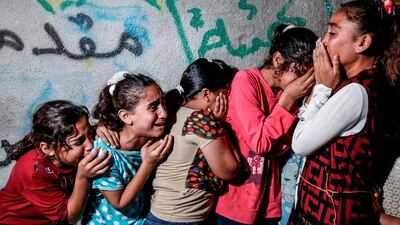
Young relatives of 28-year-old Alaa Hamdan, who was killed by Israeli fire during clashes along the Gaza border, mourn during his funeral in Beit Hanoun in the northern Gaza Strip. AFP -

Distraught relatives of Hamdan grieving at his funeral in the northern Gaza Strip. Reuters -
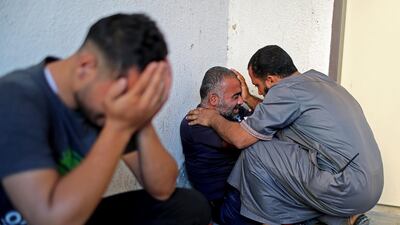
Relatives of a Palestinian who was killed at the Israeli-Gaza border fence hear the grim news at a hospital in the northern Gaza Strip. Reuters -
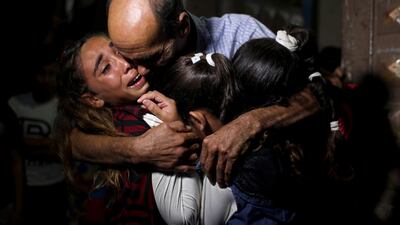
Mourning at Hamdan's funeral. Reuters -
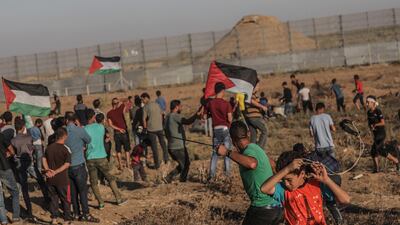
Palestinian protesters attend weekly Friday protests near the border between Israel and Gaza Strip. EPA -

A Palestinian protester uses a slingshot to hurl stones at Israeli forces across the border as clashes erupt after a demonstration along the fence with Israel, east of Gaza city. AFP -
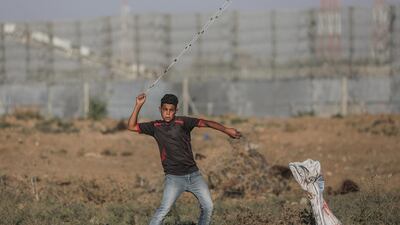
A young Palestinian man fires stones with a slingshot during Friday protests near the border between Israel and Gaza Strip. EPA -
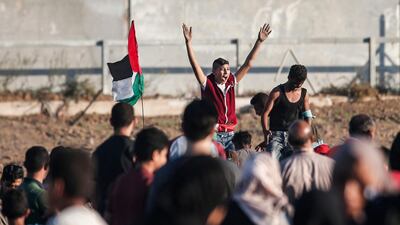
A young protester chants as others wave Palestinian flags during a demonstration at the border fence with Israel, east of Gaza city. AFP -

Violence breaks out at the border fence. AFP -
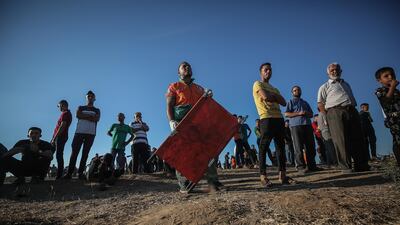
A Palestinian medic waits to the stricken after violent clashes at the border fence. EPA


Many are shot in the lower limbs by Israeli snipers aiming to maim protesters and increase pressure on Gaza's gasping medical services, according to healthcare providers, who say the system can't keep up with the number of injuries, leaving many at risk of infection or death.
“A bullet is never sterile so a lot of bacteria are getting into the bone and are causing an infection,” said Bettina Poepping, 60, a German laboratory manager for Doctors Without Borders (MSF).
“A lot of resistant bacteria are spread all over the world, but especially in countries where you can buy your antibiotics actually on the street or without any prescription,” such as Gaza, she added.

The mounting need to curb antibiotic resistance prompted MSF and the territory’s health ministry to establish a new laboratory space within a Gaza city hospital, where bone samples sit in red-topped plastic containers.
Dressed in long white coats, the laboratory team points to a bottle of murky liquid which indicates the small piece of bone inside has antibiotic-resistant bacteria. A fridge is filled with Petri dishes used to help process the samples, while across the room a Bunsen burner flame flickers.
Due to Gaza's chronic electricity shortages, there is a generator to keep the equipment running when the power goes out. But the laboratory work is slowed by the lack of automatic systems and limited access to medical equipment.
“Ghada always needs to wash and clean everything which at home would go directly into the waste bin, so here it is a lot more work,” Ms Poepping said.
Ghada Hasan Saleh, a lab technician from the health ministry, explained the complex work involved in identifying the type of bacteria — and the level of antibiotic resistance — before doctors can determine treatment.
“Sometimes we have a lot of multi-drug resistance and we need more toxic treatment, and sometimes we need isolation for patients,” said the 38-year-old.
More than a thousand gunshot victims in Gaza have severe bone infections, many of which are resistant to antibiotics, according to a September report by MSF.
After receiving the results doctors can try different combinations of antibiotics, some of which have stronger side effects and are costly. MSF has not yet registered any patients in Gaza with infections that are resistant to all classes of antibiotics, but elsewhere such cases have a very high mortality rate.
One of those patients is Abdullah Amer Jindiya, a 12-year-old boy who said he was shot at the border last year.
“I couldn’t go to school … my friends were coming to my house. I wasn’t going outside,” he said, a large metal frame attached to his right leg.
Sat in an MSF clinic, the boy’s father proudly showed off mobile phone photos of his eldest child playing football before he was wounded.
The Israeli military accuses Gaza rulers Hamas of systematically using children as human shields at the fence "as a cover for other terror activities". The army told The National it sets "restrictions regarding the use of force against minors," without giving details.
“Unfortunately, since the beginning of weekly violent riots at the Gaza border nearly two years ago, some Palestinians have been unintentionally harmed by live ammunition, including minors,” the army said in a statement.
Jindiya, who hopes to play football again, is on the road to recovery after being treated for an antibiotic-resistant infection. There are plans for him to travel to Luxembourg for further treatment, although the trip is not guaranteed.

In December, Israeli authorities approved 64 per cent of applications for patients to cross the border for treatment according to a report from the World Health Organisation.
But since the border demonstrations began, just 17 per cent of those wounded in the protests have been approved. Most have been delayed, while 28 per cent were denied, the report said.
Cogat, the Israeli liaison agency to the Palestinian territories, said in recent years it has seen a “significant increase in the scope of applications for permits for medical and humanitarian reasons” from Gaza residents.
More than 30,000 such permits were issued last year, the agency said without detailing how many were rejected.
In a statement, Cogat accused Gaza "terror organisations" of exploiting the permit system to try to smuggle explosive materials and funds out of the enclave. The National reached out to the Palestinian Health Ministry for comment but received no reply.
-

Palestinian amputees Mohammed Eliwa, 17, and Ahmed al-Khoudari, right, 20, play on the beach in Gaza City. All photos by AFP -

Mohammed and Ahmed have lost their legs during clashes on the border with Israel. -

Mohammed and play football on the beach. -

Mohammed and play football on the beach. -

Eliwa plays football on the beach. -

Mohammed and Ahmed talk to people on the beach. -

Mohammed plays football on the beach.


Adam Abu Ghnaimah, a 24-year-old patient, was able to leave Gaza through the Egyptian border for one of three operations needed on his right leg, after being shot twice at the border in 2017.
Sat on a bed surrounded by a blue curtain, Mr Ghnaimah said he was kept in isolation while doctors dealt with the drug-resistant bacteria. The latest results indicate the new antibiotics are working, but he is uncertain what his future will hold.
“I’m hoping that I can walk again,” he said, before rolling down his trousers to cover the deep scars.
The healthcare system has been hit by both the Israeli blockade, which has been in place for more than a decade, and other factors including the split between Hamas and the Palestinian Authority, which is based in the West Bank.
Ghada Majadle, from the Physicians for Human Rights Israel organisation, said the volume of injuries in border protests “has left the healthcare system struggling to meet the needs of the people.”
The weekly border demonstrations, in which 204 people were shot dead according to UN figures, were halted at the end of 2019 and the next protest is planned for March.
But Ms Majadle sees no chance of Gaza’s healthcare infrastructure recovering in the next few months.
“We have no reason at all to anticipate any improvement,” she said. “We really hope it’s not going to deteriorate more, because the situation looks very bad.”

