• Lebanese President Michel Aoun receives French Foreign Minister Jean-Yves Le Drian at the presidential palace in Baabda, east of the capital Beirut, on July 23, 2020. AFP
    Lebanese President Michel Aoun receives French Foreign Minister Jean-Yves Le Drian at the presidential palace in Baabda, east of the capital Beirut, on July 23, 2020. AFP
  • President Michel Aoun holds talks with French Foreign Minister Jean-Yves Le Drian at the presidential palace in Baabda. AFP
    President Michel Aoun holds talks with French Foreign Minister Jean-Yves Le Drian at the presidential palace in Baabda. AFP
  • President Michel Aoun chairs a meeting with French Foreign Minister Jean-Yves Le Drian at the Lebanese presidential palace in Baabda. Reuters
    President Michel Aoun chairs a meeting with French Foreign Minister Jean-Yves Le Drian at the Lebanese presidential palace in Baabda. Reuters
  • Lebanese Prime Minister Hassan Diab, right, welcomes French Foreign Minister Jean-Yves Le Drian in Beirut. AP Photo
    Lebanese Prime Minister Hassan Diab, right, welcomes French Foreign Minister Jean-Yves Le Drian in Beirut. AP Photo
  • Prime Minister Hassan Diab and French Foreign Minister Jean-Yves Le Drian hold talks at the governmental palace in Beirut. AFP
    Prime Minister Hassan Diab and French Foreign Minister Jean-Yves Le Drian hold talks at the governmental palace in Beirut. AFP
  • Prime Minister Hassan Diab chairs a meeting with French Foreign Minister Jean-Yves Le Drian. AFP
    Prime Minister Hassan Diab chairs a meeting with French Foreign Minister Jean-Yves Le Drian. AFP
  • French Foreign Minister Jean-Yves Le Drian arrives at Baabda Palace to meet Lebanon’s President Michel Aoun. Reuters
    French Foreign Minister Jean-Yves Le Drian arrives at Baabda Palace to meet Lebanon’s President Michel Aoun. Reuters
  • French Foreign Minister Jean-Yves Le Drian wears a face mask as he arrives at Baabda Palace to meet Lebanon’s President Michel Aoun. Reuters
    French Foreign Minister Jean-Yves Le Drian wears a face mask as he arrives at Baabda Palace to meet Lebanon’s President Michel Aoun. Reuters

French foreign minister: 'No alternative' to IMF bailout for Lebanon


Sunniva Rose
  • English
  • Arabic

French Foreign Minister Jean-Yves Le Drian on Thursday urged Lebanon to relaunch negotiations for an International Monetary Fund bailout and reiterated France’s support for Lebanon in the face of its worst economic crisis

Mr Le Drian arrived in the cash-strapped country on Wednesday evening for a 36-hour visit aimed at discussing ways out of the crisis.

Speaking alongside his Lebanese counterpart Nassif Hitti, Mr Le Drian said that "there is no alternative" to an IMF bailout for Lebanon to recover from its economic crisis. "My message to Lebanon is: help us to help you," he said, repeating a statement he made in the French Senate in early July.
Negotiations with the IMF started in May but have stalled in the past weeks. IMF Managing Director Kristalina Georgieva said Lebanon needed more "unity of purpose", and that the situation "breaks her heart."
"I am here to confirm France's support for Lebanon and the Lebanese people. There is a shared history between us and Lebanon," said Mr Le Drian, referring to France's 1920-1943 mandate over Lebanon.

“I came to bring you a message,” continued the French minister, according to Lebanon’s state-run National News Agency. “The time is critical ... We want to avoid a crisis that would change social co-existence in Lebanon.”

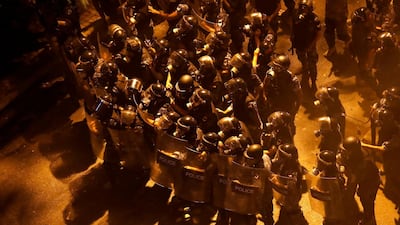
  • Riot police advance to push back demonstrators from a square near the government house in downtown Beirut, Lebanon. AP Photo
    Riot police advance to push back demonstrators from a square near the government house in downtown Beirut, Lebanon. AP Photo
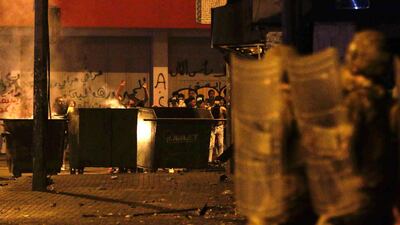
  • Lebanese security forces advance as anti-government protesters gather behind rubbish containers during a demonstration against dire economic conditions in the northern city of Tripoli. AFP
    Lebanese security forces advance as anti-government protesters gather behind rubbish containers during a demonstration against dire economic conditions in the northern city of Tripoli. AFP
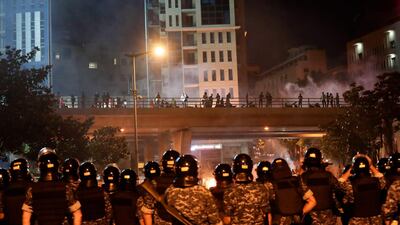
  • Anti-government protesters gather on the Fuad Shehab bridge, known as the Ring, as Lebanese security forces stand guard below, during a demonstration against dire economic conditions in the capital Beirut. AFP
    Anti-government protesters gather on the Fuad Shehab bridge, known as the Ring, as Lebanese security forces stand guard below, during a demonstration against dire economic conditions in the capital Beirut. AFP
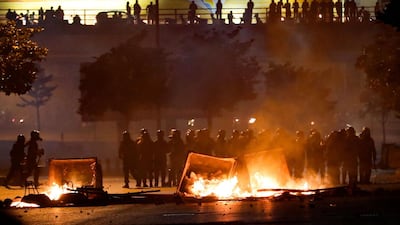
  • People watch from a bridge as Lebanese security forces gather behind rubbish containers set ablaze by anti-government protesters, during a demonstration against dire economic conditions in the downtown district of the capital Beirut. AFP
    People watch from a bridge as Lebanese security forces gather behind rubbish containers set ablaze by anti-government protesters, during a demonstration against dire economic conditions in the downtown district of the capital Beirut. AFP
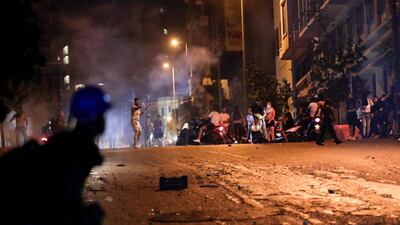
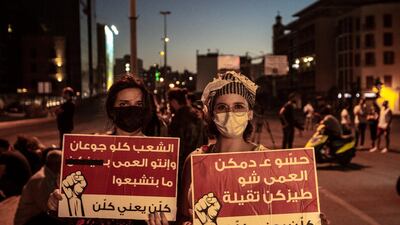
  • Lebanese anti-government protesters clash with security forces during a demonstration against dire economic conditions in the capital Beirut. AFP
    Lebanese anti-government protesters clash with security forces during a demonstration against dire economic conditions in the capital Beirut. AFP
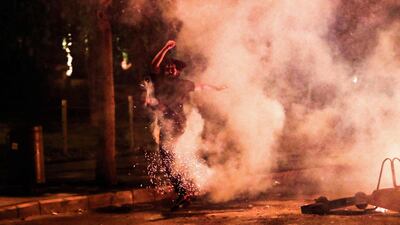
  • A Lebanese anti-government protester reacts as he runs in a cloud of smoke and sparks, during a demonstration against dire economic conditions in the downtown districtof the capital Beirut. AFP
    A Lebanese anti-government protester reacts as he runs in a cloud of smoke and sparks, during a demonstration against dire economic conditions in the downtown districtof the capital Beirut. AFP
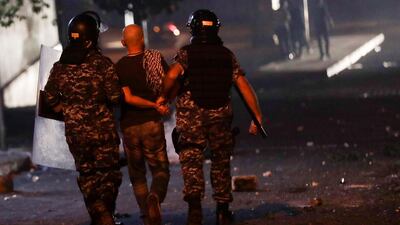
  • Lebanese security forces arrest a man during an anti-government demonstration against dire economic conditions in the downtown district of the capital Beirut. AFP
    Lebanese security forces arrest a man during an anti-government demonstration against dire economic conditions in the downtown district of the capital Beirut. AFP
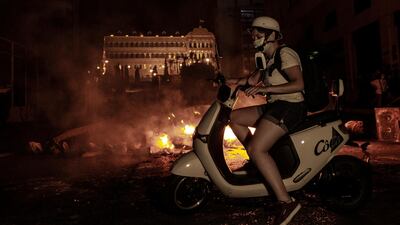
  • An Anti-government protester on her motorcycle returns where burn tires block the road near the government palace, during a protest against the economic condition, the collapsing Lebanese pound currency and and increasing prices in Beirut. EPA
    An Anti-government protester on her motorcycle returns where burn tires block the road near the government palace, during a protest against the economic condition, the collapsing Lebanese pound currency and and increasing prices in Beirut. EPA
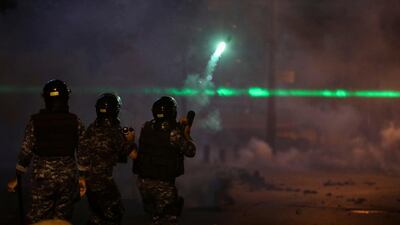
  • A member of the Lebanese riot police fires tear gas towards demonstrators during a protest against the fall in pound currency and mounting economic hardship, in Beirut. Reuters
    A member of the Lebanese riot police fires tear gas towards demonstrators during a protest against the fall in pound currency and mounting economic hardship, in Beirut. Reuters
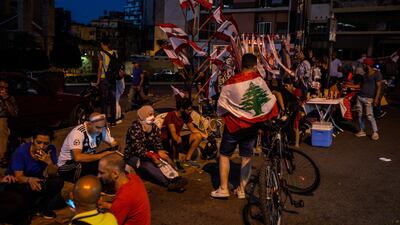
  • A man sells Lebanese flags, cold water and shisha, as anti-government protesters wait to reach the Rang area to start demonstrations in Beirut. EPA
    A man sells Lebanese flags, cold water and shisha, as anti-government protesters wait to reach the Rang area to start demonstrations in Beirut. EPA
  • Anti-government protesters gather as they try to block tabarize highway during a protest against the economic condition, the collapsing Lebanese pound currency and increasing prices in Beirut. EPA
    Anti-government protesters gather as they try to block tabarize highway during a protest against the economic condition, the collapsing Lebanese pound currency and increasing prices in Beirut. EPA
  • Anti-government protesters gather as they try to block tabarize highway during a protest against the economic condition, the collapsing Lebanese pound currency and increasing prices in Beirut. EPA
    Anti-government protesters gather as they try to block tabarize highway during a protest against the economic condition, the collapsing Lebanese pound currency and increasing prices in Beirut. EPA
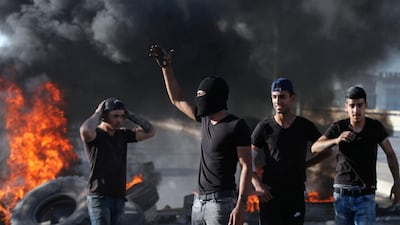
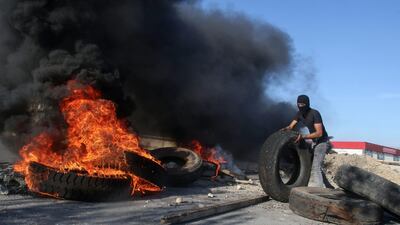
  • Lebanese protesters block a bridge with flaming tyres on the Sidon-Ghazieh highway amid demonstrations which erupted after the sharp drop of the Lebanese pound on the black market, in the southern coastal town of Ghazieh. AFP
    Lebanese protesters block a bridge with flaming tyres on the Sidon-Ghazieh highway amid demonstrations which erupted after the sharp drop of the Lebanese pound on the black market, in the southern coastal town of Ghazieh. AFP
  • A Lebanese protester takes part in blocking a bridge with flaming tyres on the Sidon-Ghazieh highway amid demonstrations which erupted after the sharp drop of the Lebanese pound on the black market, in Ghazieh. AFP
    A Lebanese protester takes part in blocking a bridge with flaming tyres on the Sidon-Ghazieh highway amid demonstrations which erupted after the sharp drop of the Lebanese pound on the black market, in Ghazieh. AFP
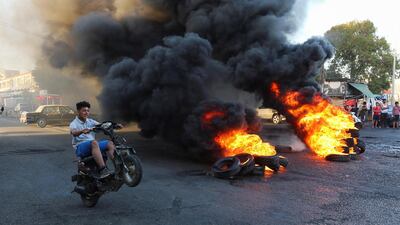
  • A young man boy rides his motorbike near burning tires during a sit-in protest against the fall in pound currency and mounting economic hardship, in Ghazieh. Reuters
    A young man boy rides his motorbike near burning tires during a sit-in protest against the fall in pound currency and mounting economic hardship, in Ghazieh. Reuters

The small Mediterranean country has a unique power-sharing system along sectarian lines. Roughly one third of its population is Christian, one third Sunni Muslim and one third Shiite Muslim.

“The solutions to fix the situation in Lebanon are found in the decisions of the Cedar conference,” said Mr Le Drian, referring to an April 2018 donor conference organised by France. The international community, including western countries and international institutions such as the World Bank, pledged more than $11 billion in grants and soft loans to Lebanon in exchange for much needed reforms. But the money remains frozen as Lebanon has yet to implement these reforms because of internal political disagreements.

Earlier on Thursday, Mr Le Drian met Lebanese President Michel Aoun, Prime Minister Hassan Diab and Parliament Speaker Nabih Berri.

President Aoun told Mr Le Drian that “Lebanon looks forward to France’s help in the process of reforms and fighting corruption”, the NNA reported.

He complained to Mr Le Drian about the repercussions of the nearly decade-long civil war in Syria, which he claimed caused losses of more than $40bn to Lebanon. More than one million Syrians fled to Lebanon and borders were closed, hindering trade.

Lebanese officials routinely blame Syrian refugees for the country’s economic woes but analysts say that responsibility also lies with Lebanon’s leaders, who have managed the country inefficiently and allowed corruption and nepotism to thrive.

President Aoun highlighted his efforts in fighting corruption, including an audit of the state’s finances. He said there had been “difficulties and obstacles facing the fight against corruption because of the presence of many people involved in it who exert strong pressures to stop [the fight]”.

He asked France to support the mandate of the United Nations Interim Force in Lebanon, which patrols the border with the country’s long-term enemy Israel, when it comes up for extension in late August. Washington has warned that it could halt funding. “French support for Lebanon is essential at this stage and is mutually beneficial to both countries,” Mr Aoun said.

Mr Le Drian conveyed a verbal message to Mr Aoun from French President Emmanuel Macron in which he confirmed that “France stands by Lebanon in these difficult circumstances as it always has done throughout history”.

Local newspaper L'Orient-Le Jour reported that Mr Diab asked Mr Le Drian for help in reforming the electricity sector.

Since the end of the 1975-1990 civil war, Lebanon has suffered from chronic electricity shortages which have worsened in the past weeks because of a fuel shortage. National electricity company Electricite du Liban costs the state nearly $2bn a year in subsidies.

Mr Diab thanked France for its recent announcements of financial aid to Lebanese francophone schools. "We hope this help will include public schools," he was quoted as saying by L'Orient-Le Jour.

Lebanon is mired in its worst economic crisis in decades, marked by a steep currency fall and high inflation that have plunged nearly half of the population into poverty.

The crisis has sparked mass protests since October against a political class accused of being incompetent and corrupt, and led to tens of thousands losing their jobs or part of their income.

After the country defaulted on its debt payments for the first time in March, the government pledged reforms and two months ago started talks with the International Monetary Fund towards securing the release of billions of dollars in aid, but the discussions have stalled.

Earlier this month, Mr Le Drian said he was "very worried" by the lack of progress on reforms required to secure foreign financial assistance.

Lebanon's government said it needed more than $20 billion in external funding.

MATCH INFO

Syria v Australia
2018 World Cup qualifying: Asia fourth round play-off first leg
Venue: Hang Jebat Stadium (Malacca, Malayisa)
Kick-off: Thursday, 4.30pm (UAE)
Watch: beIN Sports HD

* Second leg in Australia scheduled for October 10

UAE currency: the story behind the money in your pockets
Ten tax points to be aware of in 2026

1. Domestic VAT refund amendments: request your refund within five years

If a business does not apply for the refund on time, they lose their credit.

2. E-invoicing in the UAE

Businesses should continue preparing for the implementation of e-invoicing in the UAE, with 2026 a preparation and transition period ahead of phased mandatory adoption. 

3. More tax audits

Tax authorities are increasingly using data already available across multiple filings to identify audit risks. 

4. More beneficial VAT and excise tax penalty regime

Tax disputes are expected to become more frequent and more structured, with clearer administrative objection and appeal processes. The UAE has adopted a new penalty regime for VAT and excise disputes, which now mirrors the penalty regime for corporate tax.

5. Greater emphasis on statutory audit

There is a greater need for the accuracy of financial statements. The International Financial Reporting Standards standards need to be strictly adhered to and, as a result, the quality of the audits will need to increase.

6. Further transfer pricing enforcement

Transfer pricing enforcement, which refers to the practice of establishing prices for internal transactions between related entities, is expected to broaden in scope. The UAE will shortly open the possibility to negotiate advance pricing agreements, or essentially rulings for transfer pricing purposes. 

7. Limited time periods for audits

Recent amendments also introduce a default five-year limitation period for tax audits and assessments, subject to specific statutory exceptions. While the standard audit and assessment period is five years, this may be extended to up to 15 years in cases involving fraud or tax evasion. 

8. Pillar 2 implementation 

Many multinational groups will begin to feel the practical effect of the Domestic Minimum Top-Up Tax (DMTT), the UAE's implementation of the OECD’s global minimum tax under Pillar 2. While the rules apply for financial years starting on or after January 1, 2025, it is 2026 that marks the transition to an operational phase.

9. Reduced compliance obligations for imported goods and services

Businesses that apply the reverse-charge mechanism for VAT purposes in the UAE may benefit from reduced compliance obligations. 

10. Substance and CbC reporting focus

Tax authorities are expected to continue strengthening the enforcement of economic substance and Country-by-Country (CbC) reporting frameworks. In the UAE, these regimes are increasingly being used as risk-assessment tools, providing tax authorities with a comprehensive view of multinational groups’ global footprints and enabling them to assess whether profits are aligned with real economic activity. 

Contributed by Thomas Vanhee and Hend Rashwan, Aurifer

David Haye record

Total fights: 32
Wins: 28
Wins by KO: 26
Losses: 4

The burning issue

The internal combustion engine is facing a watershed moment – major manufacturer Volvo is to stop producing petroleum-powered vehicles by 2021 and countries in Europe, including the UK, have vowed to ban their sale before 2040. The National takes a look at the story of one of the most successful technologies of the last 100 years and how it has impacted life in the UAE.

Read part three: the age of the electric vehicle begins

Read part two: how climate change drove the race for an alternative 

Read part one: how cars came to the UAE

How to watch Ireland v Pakistan in UAE

When: The one-off Test starts on Friday, May 11
What time: Each day’s play is scheduled to start at 2pm UAE time.
TV: The match will be broadcast on OSN Sports Cricket HD. Subscribers to the channel can also stream the action live on OSN Play.

Friday's schedule at the Etihad Airways Abu Dhabi Grand Prix

GP3 qualifying, 10:15am

Formula 2, practice 11:30am

Formula 1, first practice, 1pm

GP3 qualifying session, 3.10pm

Formula 1 second practice, 5pm

Formula 2 qualifying, 7pm

ALRAWABI%20SCHOOL%20FOR%20GIRLS
%3Cp%3ECreator%3A%20Tima%20Shomali%3C%2Fp%3E%0A%3Cp%3EStarring%3A%C2%A0Tara%20Abboud%2C%C2%A0Kira%20Yaghnam%2C%20Tara%20Atalla%3C%2Fp%3E%0A%3Cp%3ERating%3A%204%2F5%3C%2Fp%3E%0A
Sanju

Produced: Vidhu Vinod Chopra, Rajkumar Hirani

Director: Rajkumar Hirani

Cast: Ranbir Kapoor, Vicky Kaushal, Paresh Rawal, Anushka Sharma, Manish’s Koirala, Dia Mirza, Sonam Kapoor, Jim Sarbh, Boman Irani

Rating: 3.5 stars