
The US Federal Bureau of Investigation said it will assist authorities in Lebanon investigating the cause of the explosion at Beirut port that killed 177 people.
"At the request of the government of Lebanon, the FBI will be providing our Lebanese partners assistance in their investigation into the explosions at the Port of Beirut on August 4," the FBI said in a statement on Friday.
The agency will help determine "what led to the circumstances of this explosion", the US undersecretary for political affairs, David Hale, said on Saturday.
"The FBI is arriving this weekend and they will be playing their role at the invitation of the Lebanese," Mr Hale said while touring the blast site on the final day of a visit to Lebanon.
"We need to make sure there is a thorough and transparent, credible investigation," he said.
US government agencies have not publicly released any statements or materials indicating the view of US investigators and spy agencies on the cause, or causes, of the explosion.
-
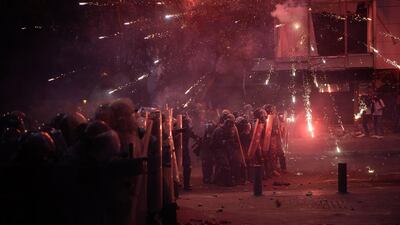
Fireworks thrown at riot police by anti-government protesters explode during clashes near the parliament building following last Tuesday's massive explosion in the seaport which devastated Beirut, Lebanon. AP Photo -
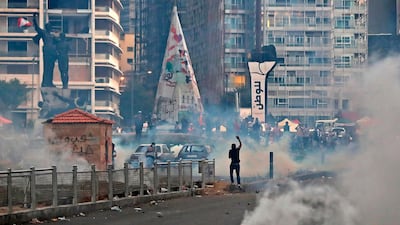
Lebanese protesters, enraged by a deadly explosion, clash with security forces at Martyrs' Square in Beirut. Lebanon's Prime Minister Hassan Diab stepped down amid fury within and outside his government over the deadly Beirut port blast he blamed on the incompetence and corruption of a decades-old ruling class. AFP -
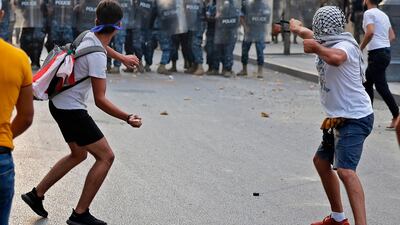
Lebanese protesters, enraged by a deadly explosion, hurl stones at security forces amid clashes in central Beirut. Lebanon's Prime Minister Hassan Diab stepped down amid fury within and outside his government over the deadly Beirut port blast he blamed on the incompetence and corruption of a decades-old ruling class. AFP -
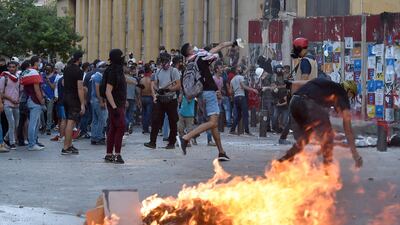
Lebanese anti-government protesters throw stones at security forces at one of the roads leading to the parliament building in Beirut, Lebanon. EPA -
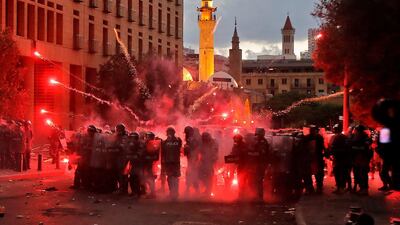
Lebanese security forces clash with protesters near the parliament building in central Beirut following a huge chemical explosion that devastated large parts of the Lebanese capital. AFP -
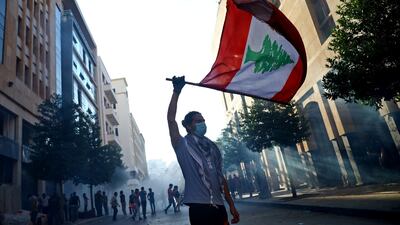
A demonstrator waves a Lebanese flag during anti-government protests that have been ignited by a massive explosion in Beirut, Lebanon. Reuters -
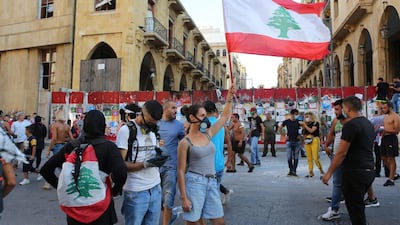
Protesters wave a Lebanese flag during demonstrations near the parliament building in Beirut, Lebanon. EPA -
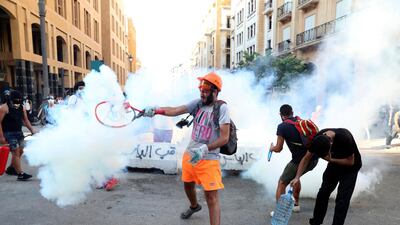
An anti-government protester uses a tennis racket to hit back a tear gas canister towards riot policemen during a protest following last Tuesday's massive explosion, which devastated Beirut, Lebanon. AP Photo -
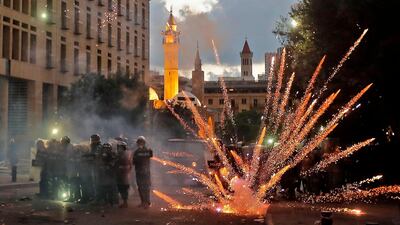
Lebanese security forces clash with protesters near the parliament in central Beirut following a huge chemical explosion that devastated large parts of the Lebanese capital. AFP -
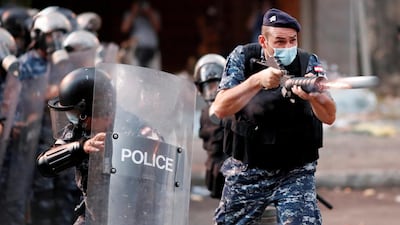
A member of Lebanese riot police fires a weapon during anti-government protests that have been ignited by a massive explosion in Beirut, Lebanon. Reuters -
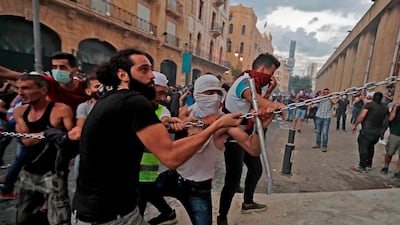
Lebanese protesters try to storm the vicinity of the parliament in central Beirut following a huge chemical explosion that devastated large parts of the Lebanese capital. AFP -
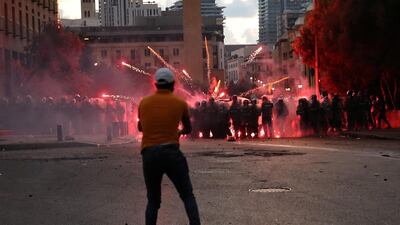
A demonstrator throws fireworks at riot police during anti-government protests that have been ignited by a massive explosion in Beirut, Lebanon. Reuters


However, US government sources privately said that based on the evidence available, its agencies believed that the explosion at the warehouse, where large quantities of potentially volatile ammonium nitrate were stored, was most likely to have been an accident.
Investigators continued to collect data, however, and still considered the possibility that the explosion could have been set off deliberately, the sources said.
Iran's most senior diplomat on Friday accused western countries of taking advantage of Beirut's misfortune to impose political changes on Lebanon.
Foreign Minister Mohammad Javad Zarif's comments came during a visit to Beirut on Friday while Mr Hale and French Defence Minister Florence Parly were also in the Lebanese capital.
Under pressure, Lebanon's government resigned on August 10. So far, there have been no formal consultations on who will replace Hassan Diab as prime minister and no likely candidate has emerged. But the flurry of diplomatic visits appeared designed to influence the forming of the new government.
Popular anger has swelled over corruption, mismanagement and political uncertainty. Western leaders said they will send aid directly to the Lebanese people and that billions of dollars will not be pumped into the country until major reforms have taken place.
After a day of meetings with Lebanese politicians and religious leaders on Friday, Mr Hale said Washington supported efforts to root out corruption, financial and economic reforms and establishing state control over ports and borders.
He urged Lebanese politicians to listen to public calls for change.
"The path forward, of course, can only be determined by the Lebanese people," Mr Hale said. "But for the longer run, we can't accept more empty promises and more dysfunctional governance."
Washington was ready to support a Lebanese government that "reflects and responds to the will of the people and genuinely commits to and acts for real change", Mr Hale said.
However, the US government is ready to work with Congress to pledge up to $30m in additional urgent funding to keep grain supplies flowing through Beirut port, he said.
It was unclear what role, if any, the militant group Hezbollah – which Washington and its allies considered a terrorist organisation – will have in the next government. US officials accused the Iran-backed group of abusing government funds. Local media speculated that Mr Hale would push for a government that exclude Hezbollah.
In a speech on Friday, Hezbollah leader Hassan Nasrallah said his group will continue have a role in government — a government of national unity, drawn from all major parliamentary blocs and with the widest possible representation.
Hezbollah and its allies dominate the parliament and any talk of a neutral government was deception, he said. "We call for a strong and capable government that has full political backing. ... Talk of a neutral government is a waste of time."
French President Emmanuel Macron, who flew to Beirut two days after the explosion, had called for a new political order.

