
Egyptian President Abdel Fattah El Sisi on Wednesday delivered a carefully-weighed response to the anger sweeping the Muslim world over French cartoons depicting the Prophet Mohammed.
He rejected the use of freedom of expression to justify the drawings but called for tolerance and calm.
“To assume a sense of superiority driven from practicing the values of freedom is itself a kind of extremism when encroaching on the rights of others,” he said during a televised ceremony marking the prophet’s birthday.
His comments, which made no direct mention of France or the caricatures, were partially a continuation of his oft-repeated narrative that Muslim clerics must do more to persuade Muslims to be more accepting of others and to discourage extremism.
The Grand Imam of Egypt's Al Azhar university, one of the world's most eminent seats of Muslim learning, also called on the international community to criminalise "anti-Muslim" actions.
Sheikh Ahmed Al Tayeb, who sits at the head of the thousand-year-old institution, also said that Al Azhar strongly rejects the use of anti-Muslim sentiment to rally votes in elections.
Protests outside French Embassy in Amman
-
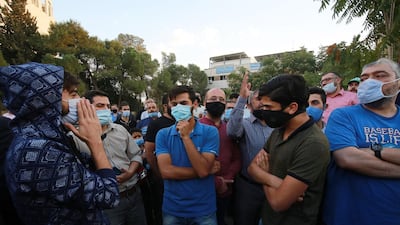
Muslims demonstrate in the Jordanian capital Amman outside the French embassy to protest French President Emmanuel Macron's defence of cartoons depicting the Prophet Mohammed. Calls to boycott French goods are growing in the Arab world and beyond, after Macron criticised Islamists and vowed not to "give up cartoons" depicting the Prophet Mohammed in recent comments that came in response to the beheading of a teacher, Samuel Paty, outside his school in a suburb outside Paris earlier this month, after he had shown cartoons of the Prophet Mohammed during a class he was leading on free speech. AFP -
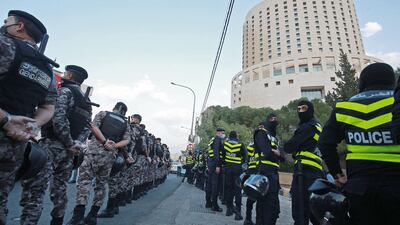
Jordanian security forces are deployed around the French embassy in Amman during a protest by Muslim citizens against French President Emmanuel Macron's defence of cartoons depicting the Prophet Mohammed. Calls to boycott French goods are growing in the Arab world and beyond, after Macron criticised Islamists and vowed not to "give up cartoons" depicting the Prophet Mohammed in recent comments that came in response to the beheading of a teacher, Samuel Paty, outside his school in a suburb outside Paris earlier this month, after he had shown cartoons of the Prophet Mohammed during a class he was leading on free speech. AFP -
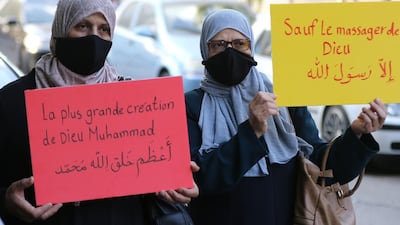
Muslim women hold up placards during a protest outside the French embassy in the Jordanian capital Amman against French President Emmanuel Macron's defence of cartoons depicting the Prophet Mohammed. Slogan in French and Arabic on yellow placard reads: "Anyone but the prophet". Calls to boycott French goods are growing in the Arab world and beyond, after Macron criticised Islamists and vowed not to "give up cartoons" depicting the Prophet Mohammed in recent comments that came in response to the beheading of a teacher, Samuel Paty, outside his school in a suburb outside Paris earlier this month, after he had shown cartoons of the Prophet Mohammed during a class he was leading on free speech. AFP -
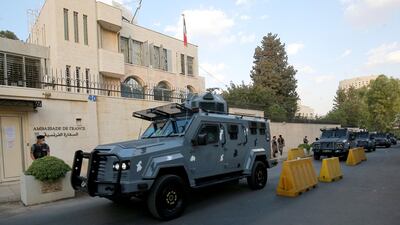
The Jordanian capital Amman witnesses the intensive presence of security forces during a protest outside the French embassy to protest French President Emmanuel Macron's defence of cartoons depicting the Prophet Mohammed. Calls to boycott French goods are growing in the Arab world and beyond, after Macron criticised Islamists and vowed not to "give up cartoons" depicting the Prophet Mohammed in recent comments that came in response to the beheading of a teacher, Samuel Paty, outside his school in a suburb outside Paris earlier this month, after he had shown cartoons of the Prophet Mohammed during a class he was leading on free speech. AFP -
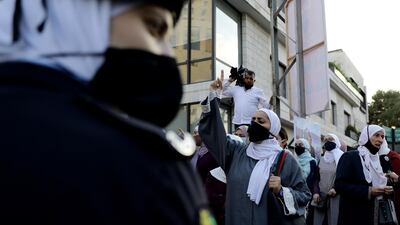
A small group of Jordanians protest against the French caricatures of Muslim's Prophet Muhammad in the area of the French embassy in Amman, Jordan. EPA -
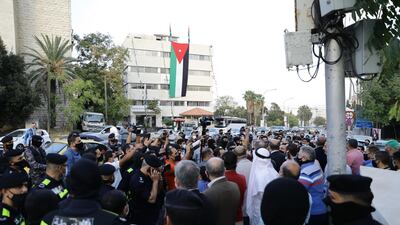
A small group of Jordanians protest against the French caricatures of Muslim's Prophet Muhammad in the area of the French embassy in Amman, Jordan. EPA -
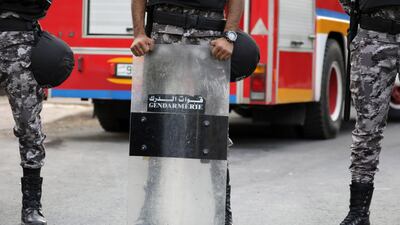
Jordanian security forces stand guard near the French embassy street as a small group of Jordanians protest against the French caricatures on Muslim's Prophet Muhammad in Amman, Jordan. EPA -
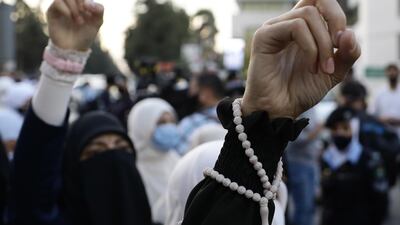
A small group of Jordanians protest against the French caricatures of Muslim's Prophet Muhammad in the area of the French embassy in Amman, Jordan. EPA -
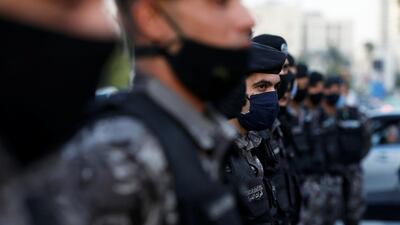
Police officers stand guard during a protest against cartoon publications of Prophet Mohammad in France and French President Emmanuel Macron's comments, near the French Embassy in Amman, Jordan.. REUTERS -
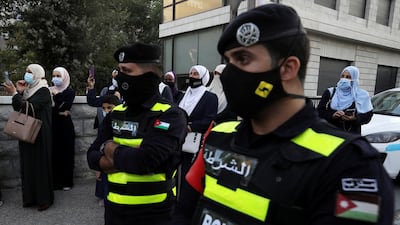
Police officers stand guard as Jordanian women attend a protest against cartoon publications of Prophet Mohammad in France and French President Emmanuel Macron's comments, near the French Embassy in Amman, Jordan. REUTERS -
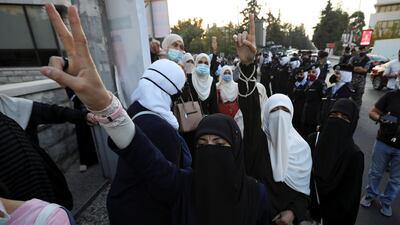
Jordanians gesture and chant slogans during a protest against cartoon publications of Prophet Mohammad in France and French President Emmanuel Macron's comments, near the French Embassy in Amman, Jordan. REUTERS


The issue of the caricatures has resurfaced after the gruesome beheading of a French teacher who showed them in class. The teacher, Samuel Paty, has been heralded as a symbol of France’s staunch secular ideals, while French President Emmanuel Macron and members of his government have insisted that the caricatures were justified under freedom of expression.
Five years ago, Al Qaeda extremists killed 12 employees of the French satirical weekly magazine Charlie Hebdo in response to its publication of caricatures depicting the Prophet Mohammed. Those cartoons also sparked mass protests in Muslim-majority countries, with some turning deadly.
Mr El Sisi’s focus on the need to persuade Muslims to embrace a moderate and more tolerant interpretation of Islamic teachings is rooted in large part in Egypt’s decades-long fight against extremists who take up arms against the government.
Egyptian security forces are currently battling a persistent insurgency by militants in the northern part of the Sinai Peninsula. They are also deployed along Egypt’s porous desert border with Libyan to prevent militants based there from infiltrating the country to stage attacks.
Mr El Sisi repeatedly airs his view that freedom of speech must not be the main focus of human rights, arguing that the right to decent housing, education and health care are equally important.
His rhetoric on religious tolerance has been put to practice in Muslim majority Egypt, where the 65-year-old Mr El Sisi has gone to great lengths to protect the country’s large Christian minority, easing centuries-old restrictions on building churches and ensuring better political representation for them.
Addressing Muslims living in societies where they are a minority, he said: “If you live in such a society, respect its values and principles … but what if the others don’t respect yours? I imagine that courtesy and good manners should prevail at the end.”
“I imagine If people have the right to express what’s on their minds, that [practice] must stop if they are offending more than 1.5 billion [Muslims]. The situation requires that all of us pause and ponder. I am not berating or blaming anyone. All I am saying is that all of us must search our souls.
“We, too, have rights. It’s our right that you don’t hurt our feelings or be contemptuous of our values… Please, stop offending us,” he pleaded in his Wednesday comments.
“On the other hand, I want to tell Muslims that if they really love the Prophet Mohammed, then they must try and be as polite as he was and to embrace his ethics.”
The Egyptian leader also sought to calm Muslims who have been protesting across much of the Muslim world outside French embassies or boycotting French products. He said the special place the Prophet Mohammed occupies in the hearts of Muslims “cannot be touched by words or actions.
France is one of Egypt’s closest European allies, with vast economic, military and strategic interests binding the two nations.
“I also want to emphasise the total rejection of any acts of violence or terror by any party under the pretext of defending the faith or its holy symbols. The essence of religion is tolerance.”

