'It was an unbelievable nightmare … I cannot forget it as long as I live. I cannot keep it away from my head as it keeps haunting me even in my sleep,' says Rayan Abou Dergham, who was working at Beirut port on the day of the blast. Courtesy Rayan Abou Dergham
'It was an unbelievable nightmare … I cannot forget it as long as I live. I cannot keep it away from my head as it keeps haunting me even in my sleep,' says Rayan Abou Dergham, who was working at Beir

Crane operator describes miraculous survival at Beirut blast site


  • English
  • Arabic

A month on from the Beirut blast, Rayan Abou Dergham is still awed by his miraculous survival after being blown upside down in the crane he was operating that day.

Positioned at Beirut Port’s wharf number 16, where he operates the 11th gantry crane, Mr Abou Dergham was inside the cockpit and 60 metres above ground level when the impact of the explosion blew him out of his seat and knocked him unconscious.

"Until now I keep getting flashbacks and cannot get it out of my head. I do not know how I survived … I keep seeing how everything overturned when the blast flew me upside down as the crane moved back and forth," the 46-year-old, who has been deemed a "living martyr" by family and friends. told The National.

Rayan Abou Dergham takes a selfie at Beirut port where he worked as a crane operator just before the blast. Courtesy Rayan Abou Dergham

Mr Abou Dergham, a father of two who hails from Kfarhim village 34 kilometres outside Beirut, had worked for years as a gantry crane operator at the Beirut Container Terminal Consortium company inside Beirut Port. That day, on August 4, he had just started his evening shift.

As he climbed into the cockpit at 5.50pm, a few minutes before the blast, he saw a fire and swirls of thick greyish smoke engulfing the area of Warehouse 12 about 150 metres away.

The operator, whose shift starts at 6pm sharp, was mesmerised by the smoke. He then used his phone to take photos of the scene, where fireworks had begun to crackle around the warehouse.

'It was an unbelievable nightmare … I cannot forget it as long as I live. I cannot keep it away from my head as it keeps haunting me even in my sleep,' says Rayan Abou Dergham, who was working at Beirut port on the day of the blast. Courtesy Rayan Abou Dergham

“At five minutes past 6, I do not know what happened. The first explosion blew up and the ground shook underneath me as if the crane was dancing and about to crumble. The second and stronger explosion blew up and I couldn’t see anything”

Mr Abou Dergham was blown back by the force and knocked unconscious for several seconds. When he regained his consciousness, chaos reigned around the cabin.

“I didn’t realise what happened. Rubble and debris were flying all over the place. I tried to stand up on my feet but I couldn’t,” says Mr Abou Dergham, who had only clicked two photos before the blast.

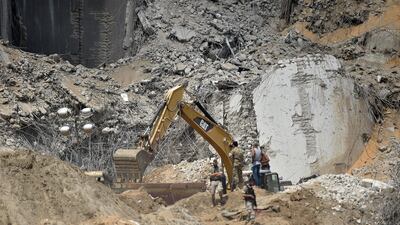
  • Greek rescue workers search amid the rubble three days after explosions that hit Beirut port. EPA
    Greek rescue workers search amid the rubble three days after explosions that hit Beirut port. EPA
  • Workers and members of Lebanese civil defense search for bodies and survivors amid the rubble. EPA
    Workers and members of Lebanese civil defense search for bodies and survivors amid the rubble. EPA
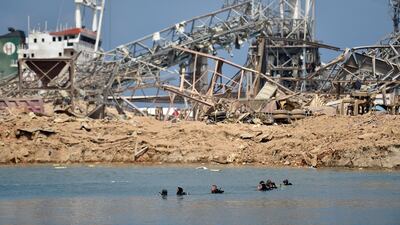
  • Divers inspect at the port waterfront. EPA
    Divers inspect at the port waterfront. EPA
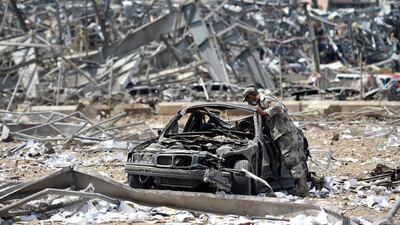
  • A Lebanese soldier looks at a damaged car. EPA
    A Lebanese soldier looks at a damaged car. EPA
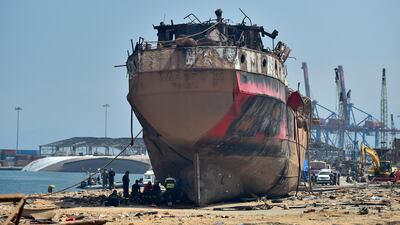
  • Workers and members of Lebanese civil defence rest next to a damaged vessel. EPA
    Workers and members of Lebanese civil defence rest next to a damaged vessel. EPA
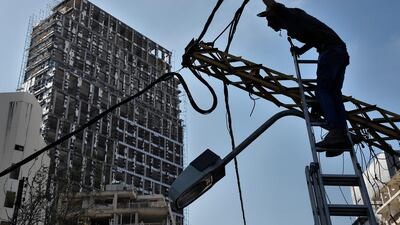
  • An electricity worker fixes power cables in front of a damaged building. AP Photo
    An electricity worker fixes power cables in front of a damaged building. AP Photo
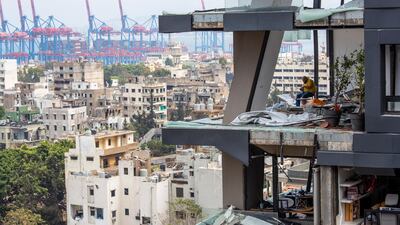
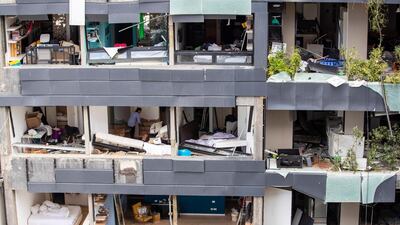
  • A man sits between debris inside his house damaged by Tuesday's explosion in the seaport of Beirut, Lebanon. AP Photo
    A man sits between debris inside his house damaged by Tuesday's explosion in the seaport of Beirut, Lebanon. AP Photo
  • A man who sustained injuries to his legs looks at the rubble. AP Photo
    A man who sustained injuries to his legs looks at the rubble. AP Photo
  • Workers remove debris from a house. AP Photo
    Workers remove debris from a house. AP Photo
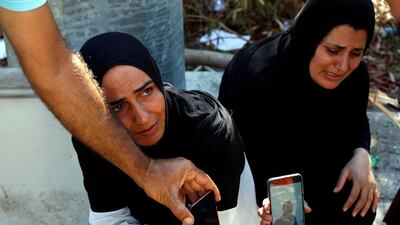
  • Zeinab Zer Eldin, left, and her sister-in-law shows a photo of her missing husband near the site of the explosion in the port of Beirut. AP Photo
    Zeinab Zer Eldin, left, and her sister-in-law shows a photo of her missing husband near the site of the explosion in the port of Beirut. AP Photo
  • Residents fix windows in a house damaged by Tuesday's explosion that hit the port of Beirut. AP Photo
    Residents fix windows in a house damaged by Tuesday's explosion that hit the port of Beirut. AP Photo

For several minutes he stayed still, feeling dizzy, and disoriented, his ears deafened by the noise of the explosion before he found a bottle of water that helped revive his senses.

Through the open window, he could see what looked like a war zone, a scene that reminded him of the Lebanese Civil War.

Amid the flying debris and burning cars, Mr Abou Dergham noticed dead and injured people lying on the ground. Warehouse 12 was completely destroyed.

“It was an unbelievable nightmare … I cannot forget it as long as I live. I cannot keep it away from my head as it keeps haunting me even in my sleep,” he says.

Realising he needed to move, the 46-year-old gathered his strength and climbed down from the cabin after finding the emergency elevator broken.

When he reached ground level he learnt that three co-workers had been killed.

Shocked that he had survived, he found his car, which was still intact unlike tens of others because he’d left the windows slightly open, allowing the heat to pass through.

“Paramedics were busy attending other heavily wounded persons and I thought I could drive myself to the nearest hospital. I was injured because of flying glass and had inhaled toxic smoke during the 15 minutes I stayed in the cockpit trying to regain my consciousness and powers,” he said.

“I jumped into my car and drove on my own although I was not feeling safe to do so. I had a headache and body ache and couldn’t hear properly or concentrate. It was a risk that I had to take to save myself,” Mr Abou Dergham recalls.

Rayan Abou Dergham had just started his shift as a crane operator at Beirut Port when the blast on August 4 threw him upside down in the cabin and knocked him unconscious. When he woke, the scene looked like a war zone, he told The National. Courtesy Rayan Abou Dergham

But with many hospitals damaged or already overwhelmed by patients injured in the blast, he couldn’t find one to admit him. Even the hospital in his village outside the city was full, many of its 200 beds occupied by victims of the explosion.

On the way there, he fainted every few kilometres and had to keep reviving himself during the journey, which took about three hours.

Eventually he found a private doctor who prescribed medication, but his symptoms persisted. “My first night at home I couldn’t sleep because of my earache and headache … I felt very sick and tired. Some solution leaked out of my ears at night.”

The next day the doctor admitted him to hospital. “I was diagnosed with brain concussion, had liquid congestion behind my eardrums and my sinuses got inflamed. My lungs were also inflamed due to smoke inhalation."

Mr Abou Dergham says he suffered "nervousness and nonstop headaches" even now.

"Sometimes I suffer of disorientation and lack of concentration.”

Mr Abou Dergham has to pay regular visits to a neurologist and is presently under a six-month medication.

But a month on, he says he could not be more grateful to God for his miraculous survival so close to the site of the blast.

“I cannot stop remembering or seeing horrendous flashbacks of what happened and how I survived.”

Six pitfalls to avoid when trading company stocks

Following fashion

Investing is cyclical, buying last year's winners often means holding this year's losers.

Losing your balance

You end up with too much exposure to an individual company or sector that has taken your fancy.

Being over active

If you chop and change your portfolio too often, dealing charges will eat up your gains.

Running your losers

Investors hate admitting mistakes and hold onto bad stocks hoping they will come good.

Selling in a panic

If you sell up when the market drops, you have locked yourself out of the recovery.

Timing the market

Even the best investor in the world cannot consistently call market movements.

The biog

Favourite book: You Are the Placebo – Making your mind matter, by Dr Joe Dispenza

Hobby: Running and watching Welsh rugby

Travel destination: Cyprus in the summer

Life goals: To be an aspirational and passionate University educator, enjoy life, be healthy and be the best dad possible.

The five pillars of Islam
If you go

The flights

The closest international airport for those travelling from the UAE is Denver, Colorado. British Airways (www.ba.com) flies from the UAE via London from Dh3,700 return, including taxes. From there, transfers can be arranged to the ranch or it’s a seven-hour drive. Alternatively, take an internal flight to the counties of Cody, Casper, or Billings

The stay

Red Reflet offers a series of packages, with prices varying depending on season. All meals and activities are included, with prices starting from US$2,218 (Dh7,150) per person for a minimum stay of three nights, including taxes. For more information, visit red-reflet-ranch.net.


How it works

Booklava works on a subscription model. On signing up you receive a free book as part of a 30-day-trial period, after which you pay US$9.99 (Dh36.70) per month to gain access to a library of books and discounts of up to 30 per cent on selected titles. You can cancel your subscription at any time. For more details go to www.booklava.com

Who's who in Yemen conflict

Houthis: Iran-backed rebels who occupy Sanaa and run unrecognised government

Yemeni government: Exiled government in Aden led by eight-member Presidential Leadership Council

Southern Transitional Council: Faction in Yemeni government that seeks autonomy for the south

Habrish 'rebels': Tribal-backed forces feuding with STC over control of oil in government territory

The biog

From: Upper Egypt

Age: 78

Family: a daughter in Egypt; a son in Dubai and his wife, Nabila

Favourite Abu Dhabi activity: walking near to Emirates Palace

Favourite building in Abu Dhabi: Emirates Palace

Getting%20there%20and%20where%20to%20stay
%3Cp%3EEtihad%20Airways%20operates%20seasonal%20flights%20from%20Abu%20Dhabi%20to%20Nice%20C%C3%B4te%20d'Azur%20Airport.%20Services%20depart%20the%20UAE%20on%20Wednesdays%20and%20Sundays%20with%20outbound%20flights%20stopping%20briefly%20in%20Rome%2C%20return%20flights%20are%20non-stop.%20Fares%20start%20from%20Dh3%2C315%2C%20flights%20operate%20until%20September%2018%2C%202022.%C2%A0%3C%2Fp%3E%0A%3Cp%3EThe%20Radisson%20Blu%20Hotel%20Nice%20offers%20a%20western%20location%20right%20on%20Promenade%20des%20Anglais%20with%20rooms%20overlooking%20the%20Bay%20of%20Angels.%20Stays%20are%20priced%20from%20%E2%82%AC101%20(%24114)%2C%20including%20taxes.%3C%2Fp%3E%0A%3Cp%3E%3C%2Fp%3E%0A
MATCH INFO

Uefa Champions League final:

Who: Real Madrid v Liverpool
Where: NSC Olimpiyskiy Stadium, Kiev, Ukraine
When: Saturday, May 26, 10.45pm (UAE)
TV: Match on BeIN Sports

How does ToTok work?

The calling app is available to download on Google Play and Apple App Store

To successfully install ToTok, users are asked to enter their phone number and then create a nickname.

The app then gives users the option add their existing phone contacts, allowing them to immediately contact people also using the application by video or voice call or via message.

Users can also invite other contacts to download ToTok to allow them to make contact through the app.


Australia tour of Pakistan

March 4-8: First Test, Rawalpindi  

March 12-16: Second Test, Karachi 

March 21-25: Third Test, Lahore

March 29: First ODI, Rawalpindi

March 31: Second ODI, Rawalpindi

April 2: Third ODI, Rawalpindi

April 5: T20I, Rawalpindi

Other IPL batting records

Most sixes: 292 – Chris Gayle

Most fours: 491 – Gautam Gambhir

Highest individual score: 175 not out – Chris Gayle (for Royal Challengers Bangalore against Pune Warriors in 2013)

Highest strike-rate: 177.29 – Andre Russell

Highest strike-rate in an innings: 422.22 – Chris Morris (for Delhi Daredevils against Rising Pune Supergiant in 2017)

Highest average: 52.16 – Vijay Shankar

Most centuries: 6 – Chris Gayle

Most fifties: 36 – Gautam Gambhir

Fastest hundred (balls faced): 30 – Chris Gayle (for Royal Challengers Bangalore against Pune Warriors in 2013)

Fastest fifty (balls faced): 14 – Lokesh Rahul (for Kings XI Punjab against Delhi Daredevils in 2018)


Ten tax points to be aware of in 2026

1. Domestic VAT refund amendments: request your refund within five years

If a business does not apply for the refund on time, they lose their credit.

2. E-invoicing in the UAE

Businesses should continue preparing for the implementation of e-invoicing in the UAE, with 2026 a preparation and transition period ahead of phased mandatory adoption. 

3. More tax audits

Tax authorities are increasingly using data already available across multiple filings to identify audit risks. 

4. More beneficial VAT and excise tax penalty regime

Tax disputes are expected to become more frequent and more structured, with clearer administrative objection and appeal processes. The UAE has adopted a new penalty regime for VAT and excise disputes, which now mirrors the penalty regime for corporate tax.

5. Greater emphasis on statutory audit

There is a greater need for the accuracy of financial statements. The International Financial Reporting Standards standards need to be strictly adhered to and, as a result, the quality of the audits will need to increase.

6. Further transfer pricing enforcement

Transfer pricing enforcement, which refers to the practice of establishing prices for internal transactions between related entities, is expected to broaden in scope. The UAE will shortly open the possibility to negotiate advance pricing agreements, or essentially rulings for transfer pricing purposes. 

7. Limited time periods for audits

Recent amendments also introduce a default five-year limitation period for tax audits and assessments, subject to specific statutory exceptions. While the standard audit and assessment period is five years, this may be extended to up to 15 years in cases involving fraud or tax evasion. 

8. Pillar 2 implementation 

Many multinational groups will begin to feel the practical effect of the Domestic Minimum Top-Up Tax (DMTT), the UAE's implementation of the OECD’s global minimum tax under Pillar 2. While the rules apply for financial years starting on or after January 1, 2025, it is 2026 that marks the transition to an operational phase.

9. Reduced compliance obligations for imported goods and services

Businesses that apply the reverse-charge mechanism for VAT purposes in the UAE may benefit from reduced compliance obligations. 

10. Substance and CbC reporting focus

Tax authorities are expected to continue strengthening the enforcement of economic substance and Country-by-Country (CbC) reporting frameworks. In the UAE, these regimes are increasingly being used as risk-assessment tools, providing tax authorities with a comprehensive view of multinational groups’ global footprints and enabling them to assess whether profits are aligned with real economic activity. 

Contributed by Thomas Vanhee and Hend Rashwan, Aurifer

Bio

Age: 25

Town: Al Diqdaqah – Ras Al Khaimah

Education: Bachelors degree in mechanical engineering

Favourite colour: White

Favourite place in the UAE: Downtown Dubai

Favourite book: A Life in Administration by Ghazi Al Gosaibi.

First owned baking book: How to Be a Domestic Goddess by Nigella Lawson.