

Bahai detainees held in Houthi prisons in Yemen are at risk of contracting the novel coronavirus, rights groups said on Thursday.
The Iran-backed rebels announced in March that they were to release Bahai leader Hamed bin Haydara and another five Bahai detainees, but they remain behind bars.
"The Houthi authorities must honour their agreement to release the Bahai prisoners. Keeping prisoners of conscience is egregious on its own terms. Refusing to release them during a pandemic to which prisoners are particularly vulnerable is a whole new level of immorality," Anthony Vance, Director of the US Bahai Office of Public Affairs, told The National.
The Bahai community said two detainees in Sanaa’s Central Prison, where the six Bahai are held, have been diagnosed with the virus.
“The Bahais should never have been imprisoned in the first place, and now it is urgent that the Houthis follow through on their promise to set them free,” Mr Vance said.
Prisons in Sanaa are “hotbeds” for coronavirus outbreaks due to their unsanitary and abysmal conditions, Diane Ala’i, the Bahai International Community’s Representative to the United Nations in Geneva, said in a statement.
-

A closed souvenir shop in front of the treasury site in the ancient city of Petra is seen empty of tourists after the government closed all tourist facilities in the country amid concerns over the spread of the coronavirus in Jordan. Reuters -

A mask-clad worker walks near a mural depicting Dubai Ruler Sheikh Mohammed bin Rashid riding a horse as a jockey, along Al Mustaqbal Street in Dubai. AFP -

Iraqi Karate-coach Asif Mohamed (right) gives a Karate lesson to a young man it his house in Baghdad, Iraq. All training centers for Karate are closed in Baghdad. EPA -

The ancient city of Petra is seen empty of tourists after the government closed all tourist facilities in Jordan. Reuters -

A mask-glad young anti-government protester faces members of the security forces during a demonstration in the southern Iraqi city of Basra, despite the ongoing threat of the coronavirus. AFP -
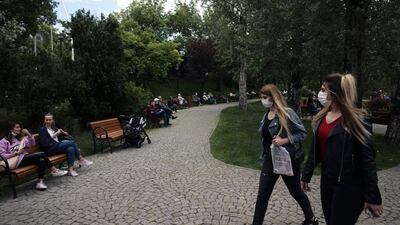
People visit Kugulu public garden, in Ankara, Turkey days after the government lifted a series of restrictions. AP Photo -
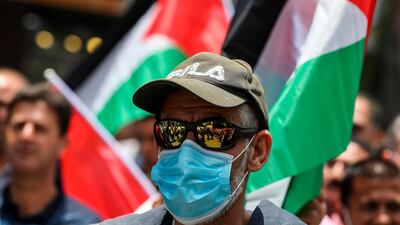
A demonstrator clad in sunglasses and mask looks on during a protest against Israeli plans to annex parts of the occupied West Bank, in the West Bank city of Nablus. AFP -
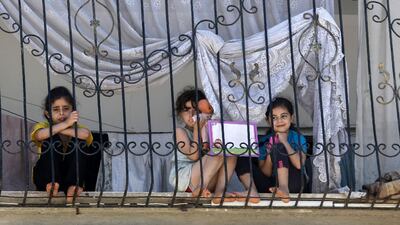
Young Palestinian girls sit at the window sill in Gaza City amid the coronavirus pandemic crisis. AFP -

Young Palestinians play at the seashore in Gaza City amid the coronavirus pandemic. AFP -

A mask-clad Palestinian boy takes part in the noon (Dhuhr) prayers along with other worshippers, at mosque in Gaza City. AFP -

Members of the Tutunamayanlar's team (The Outcasts) and Turkish actor Dogu Demirkol prepare to record an episode, in Beykoz, in the outskirts of Istanbul. Turkey is known for its obsession with TV dramas -- which are also a massive export success -- and not even the coronavirus restrictions stopped the team on Tutunamayanlar (The Outcasts) from keeping the show going. AFP -

A woman sewing colourful bedouin-styled face masks, at the city of El-Arish the capital of Egypt's North Sinai province, to be sold online to customers as part of coronavirus prevention. AFP -

Colourful bedouin-styled face masks made by women members of the association, at the city of El Arish the capital of Egypt's North Sinai province, to be sold online to customers as part of coronavirus prevention. AFP -

A man who is in contact with people who have contracted the coronavirus wears a protective face mask as he receives through iron bars the free medicines provided by the ministry of health, at a medical centre in Cairo, Egypt. Reuters -

A street vendor wearing a mask sells roses in Sidon, Lebanon. Reuters -

A shoe polisher and his son wait for customers on Hamra Street, Beirut, Lebanon. EPA -

A Yemeni volunteer wearing a protective suit sprays disinfectant at a neighborhood amid the ongoing coronavirus pandemic in Sanaa, Yemen. EPA -

An Iranian man walks in front of a pastry shop in the capital Tehran. AFP


“The six Bahais, who have been tortured and denied medical care for years, are like all the other prisoners in similar conditions: very vulnerable to the disease,” Ms Ala’i said.
“Holding these individuals in prison carries grave health risks and even death. It is inexplicable and irresponsible,” she said.
Yemen has a devastated health care system due to years of war and humanitarian catastrophes. Reports indicate that the Houthis have denied the outbreak's existence in areas under their control.
The country has recorded 419 infected cases of the disease and 95 deaths, but many say that the numbers are much higher.
The rebels “should act on their orders and avoid health risks to people who should never have been jailed by releasing the Bahai detainees immediately,” said a report by Human Rights Watch.
“Health risks to the Bahai and other detainees are acute,” the report said.
For years, human rights groups have denounced what they say is unlawful incarceration of the Bahais in Yemen and have demanded that the minority be allowed to practice its faith freely.
There has been concern about the treatment of Bahai prisoners by the rebels, who have controlled much of northern Yemen and Sanaa, the capital, since the war began in 2014.
The Bahai community says Mr bin Haydara was beaten and given electric shocks in prison and forced to sign documents while blindfolded.

