

Thousands of people in the Houthi-controlled area of Yemen are dying from the coronavirus in an epidemic that the rebels are trying to hide, it has been reported.
Doctors contacted in northern Yemen have said that they had received threats against disclosing the scale of deaths, according to a newspaper report.
The Times said the Houthis had 'reacted with paranoia to the virus, denying its spread and jailing doctors and journalists who draw attention to it'.
The growing disaster in Yemen was confirmed by Britain’s senior military officer in the Middle East who warned with the cholera outbreak, locust invasion and Covid-19, the country faced a growing human toll.
"We are really concerned about the ongoing conflict and humanitarian crisis in Yemen," Lt Gen John Lorimer told The National. "Yemenis have suffered hugely. If the fighting stops it will allow the world to engage in this humanitarian issue."
His words come as The Times reported that the capital, Sanaa, was experiencing scores of Covid-19 deaths daily in a country shattered by five years of fighting.
Speaking from Aden, Caroline Seguin, of Médecins Sans Frontières, told the paper that the true extent of death was unknown because of the lack of testing facilities. “We are totally blind,” she said. “The population is very scared. They are coming very late and so we have a high mortality.”
-
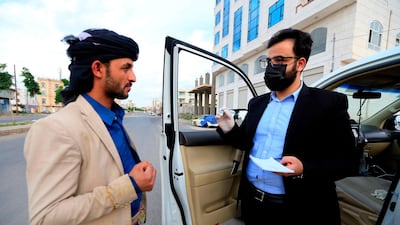
Yemeni physician Sami Yahya Al Hajj provides free medical service from his car in the capital Sanaa. AFP -

'Stop me if you need a medical consultation', reads a sticker on the rear window of Sami Yahya Al Hajj's car, alongside a cartoon figure of the bearded doctor wearing his square spectacles. AFP -
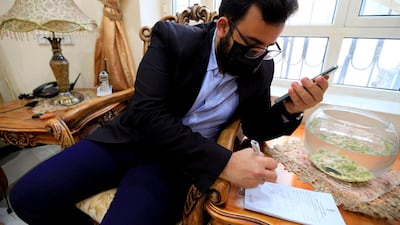
In a war-ravaged country now battling coronavirus, the Yemeni doctor has hit the road to dispense medical advice from his car, gathering a large social media following along the way. AFP -
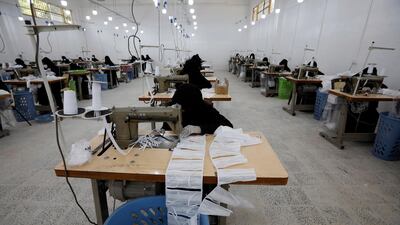
Women make protective face masks to be used to help curb the spread of the ongoing Covid-19 pandemic, at a textile factory in Sanaa. EPA -
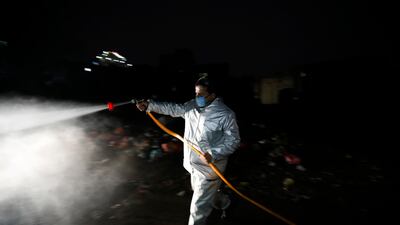
A Yemeni volunteer wearing a protective suit sprays disinfectant at a neighbourhood amid the ongoing Covid-19 pandemic in Sanaa. EPA -
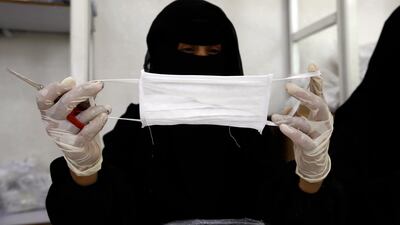
More than 160 Yemeni women work in a revitalised textile factory in Sanaa to make nearly 15,000 protective face masks per day amid a severe shortage of surgical masks. EPA -
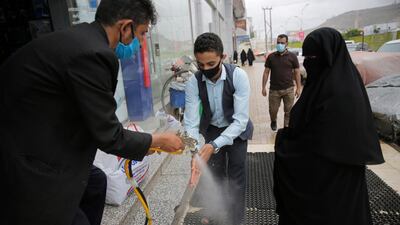
A worker disinfects a shopper's hands as a preventive measure against the spread of the new coronavirus before they enter a mall in Sanaa. AP -
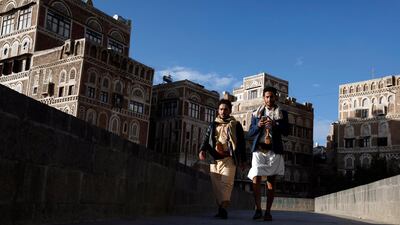
Yemenis walk past historic buildings amid the ongoing Covid-19 pandemic in the old quarter of Sanaa. EPA -
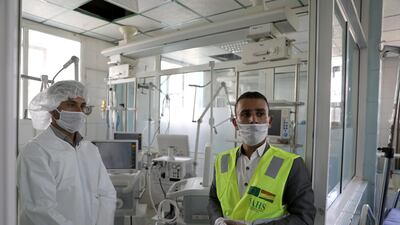
A nurse and a trainer during a lesson on how to operate ventilators recently provided by the World Health Organisation, in an intensive care ward for coronavirus patients in Sanaa. Reuters, file -
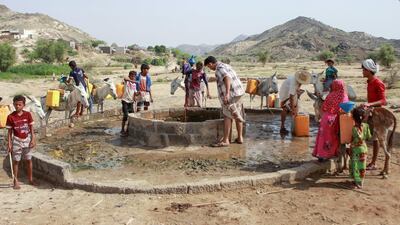
Yemenis fill their jerrycans carried by donkeys with water from a cistern at a make-shift camp for the internally displaced in the northern Hajjah province. AFP


The National reported in April that intelligence sources were warning that the coronavirus would be "catastrophic" to Yemen if it took hold, after the first cases were recorded in government-held territory. The country has a threadbare healthcare system and 18 per cent of district authorities have no doctors. "Covid is going to be an absolute disaster. Yemen has absolutely no adequate health care in place to deal with it," the source said.
While 909 infections and 248 deaths have been officially reported, the true number is understood to be vastly higher and is growing in rural areas.
The situation has further deteriorated with UN funding stretched amid a drop in international charitable donations. In addition, the April ceasefire has been consistently ignored with fighting intensifying in the past week.
The rebels are now refusing to release the number of people who have been infected or died with the virus as it “created a state of fear and anxiety”.

The World Health Organisation has reported that half of Yemen’s health facilities are no longer open.
Doctors in the north estimated that almost 600 people had died from Covid-19 in Sanaa by the end of May. Some families are reported to be buying oxygen tanks to try to save sick relatives at home.
Britain has donated nearly £900 million (Dh4.1 billion) in aid to Yemen since the conflict began in 2015 including £160m announced at a UN virtual donor conference last week.
But without an end to the fighting the country will sink further into disaster, warned Lt Gen Lorimer. “We would urge all the parties to support the peace process and engage constructively in it. A political settlement is the only way we can bring long-term stability to the region and address the human crisis. There’s no military solution to it.”
It is estimated that 100,000 people have died in the conflict between the Iranian-backed Houthis in the north and the government in the south, backed by Saudi Arabia and the UAE. A similar number have died from preventable diseases such as cholera and diphtheria but Covid-19 could significantly add to the toll.

