
For a second consecutive night in Beirut, clouds of tear gas billowed through the streets as protesters clashed with police near Parliament.
The renewed scuffles came on the eve of delayed political talks to elect a new prime minister six weeks after Saad Hariri resigned.
But President Michel Aoun announced that he had delayed discussions until Thursday after a request from Mr Hariri.
Caretaker Interior Minister Raya El Hassan ordered security forces to start a "rapid and transparent" inquiry after dozens were wounded on Saturday night when police drove protesters away from Parliament with batons, tear gas and rubber bullets.
Ms El Hassan has been criticised by demonstrators who accuse her of failing to stop gangs attacking protest camps and being responsible for police inaction as security forces beat and arrested dozens of peaceful campaigners.
Despite the violence, thousands of protesters went to central Beirut on Sunday before the parliamentary consultations due to begin on Monday to elect a new head of government.
-

A Lebanese police officer throws tear gas grenades at protesters during clashes in central Beirut. EPA -

Riot police run for cover during anti-government protests in Beirut. Reuters -
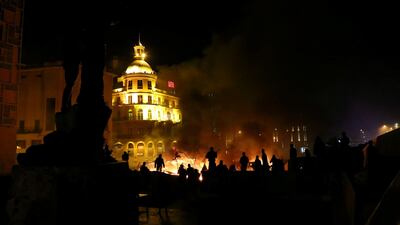
Protesters stand near burning tents during anti-government protests in Beirut. Reuters -

Protesters throw stones at riot police during clashes in central Beirut. EPA -

Protesters throw stones at riot police during clashes in central Beirut. EPA -
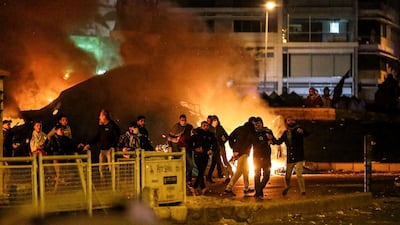
Protesters throw stones at riot police, next burning tents during clashes in central Beirut. EPA -

A protesters kicks a tear gas grenades back at riot police during clashes in central Beirut. EPA -
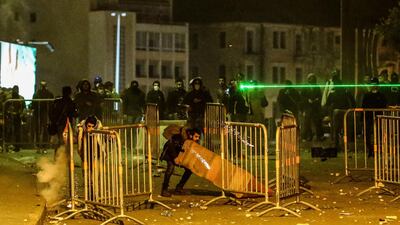
Protesters blockade the street as they throw stones at riot police during clashes in central Beirut. EPA -
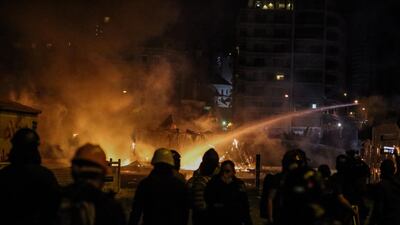
Police officers extinguish fires set in the tents of the demonstrators during clashes in central Beirut. EPA -

A protester waves the Lebanese flag and flashes a victory as he stands facing riot police during clashes in central Beirut. EPA


The rallies have swept Lebanon since October 17. Protesters are demanding an overhaul of a political system and an independent government of technocrats.
In Sunday night’s clashes, demonstrators threw water bottles and firecrackers at the security forces, who responded with tear gas and water cannon.
Groups of men descended on the city centre from the nearby Amal-majority Khandaq Al Ghamiq neighbourhood, leading to a standoff with protesters.
In recent weeks, men chanting sectarian slogans and their support for Amal leader and Parliament Speaker Nabih Berri have attacked demonstrators, burnt their protest camps and tried to drive them from the streets.
But on Sunday night, the two sides threw rocks at each other until soldiers intervened to separate them.
There were no immediate reports of casualties although the SKeyes Centre for Media and Cultural Freedom reported that Reuters photographer Mohammed Azakir was hit in the face with a rock thrown by police.
The clashes threatened to be a repeat of scenes on Saturday evening when dozens of people were hurt.
The Lebanese Civil Defence said it took 36 injured people to hospital and treated 54 more at the scene on Saturday night.
The Lebanese Red Cross said it took 15 people to hospital, while 37 others were given first aid on site.
The Red Cross said the injured included protesters and members of the security forces, with some affected by tear gas and others struck by stones.
Lebanese authorities said about 20 officers were taken to hospital.
AFP reported men in plainclothes hitting protesters on Saturday, while riot police fired rubber bullets at protesters throwing stones.
Ms El Hassan has demanded that those responsible for the most violent episode since the anti-government protests began in October be identified.
She warned against "infiltrators" seeking to use protests to provoke confrontations. On Sunday, she called for peaceful demonstrators to leave central Beirut, leading to more criticism.
-
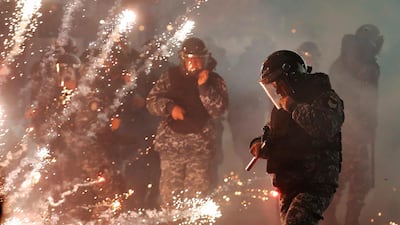
Lebanese riot policemen run from firecrackers fired by the supporters of the Shiite Hezbollah and Amal Movement groups. AP -
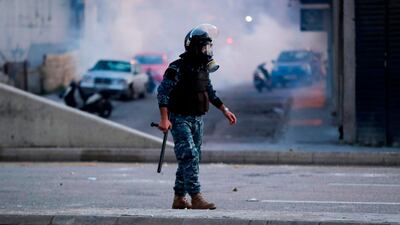
A member of the Lebanese riot police looks on after clashes with supporters of Lebanon's Shiite Hezbollah and Amal groups on December 14, 2019, in central Beirut. AFP -

Lebanese riot police react to fireworks thrown by supporters of Lebanon's Shiite Hezbollah and Amal groups during clashes on December 14, 2019 in central Beirut. AFP -
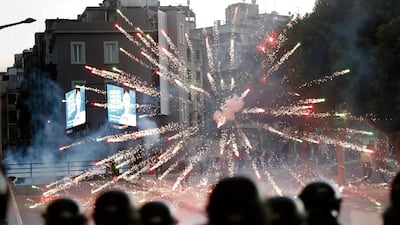
Supporters of the Shiite Hezbollah and Amal Movement groups, background, launch firecrackers at riot policemen as they try to attack anti-government protesters. AP -
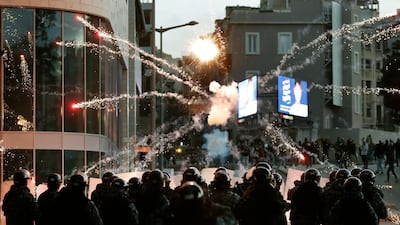
Lebanon has been facing its worst economic crisis in decades, amid nationwide protests that began on October 17 against the ruling political class that demonstrators accuse of mismanagement and corruption. AP -

A supporter of Lebanon's Shiite Hezbollah and Amal groups gestures towards riot police. AFP -
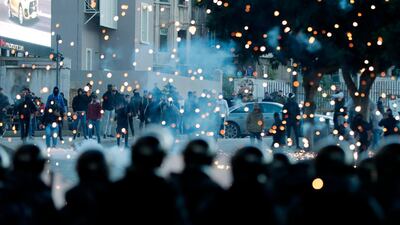
Supporters of Lebanon's Shiite Hezbollah and Amal groups (background) throw fireworks towards Lebanese riot police during clashes on December 14, 2019, in central Beirut. AFP -

A supporter of the Shiite Hezbollah and Amal Movement groups holds firecrackers to fire it at the riot police. AP -
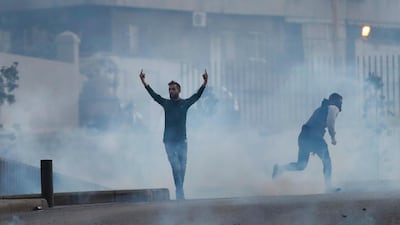
A supporter of the Shiite Hezbollah and Amal Movement groups stands in the smoke of tear gas and reacts to the riot police in downtown Beirut. AP -
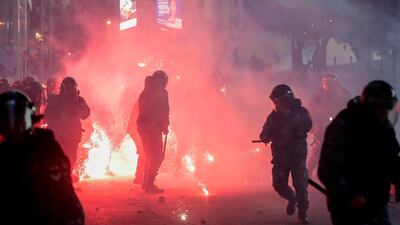
Lebanese riot police react to fireworks thrown by supporters of Lebanon's Shiite Hezbollah and Amal groups. AFP -
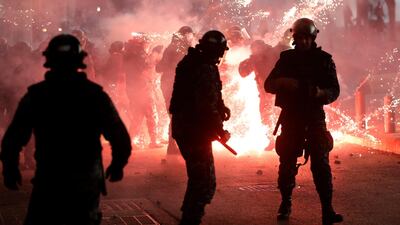
Lebanese riot policemen react to firecrackers that were fired by the supporters of the Shiite Hezbollah and Amal Movement groups. AP -
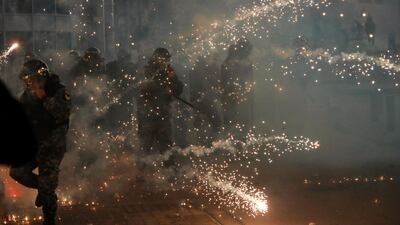
Lebanese riot policemen react to firecrackers that fired by the supporters of the Shiite Hezbollah and Amal Movement groups. AP -
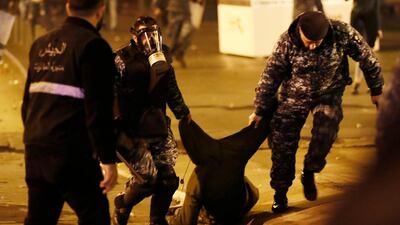
Riot police officers arrest an anti-government protesters trying to enter parliament square in downtown Beirut. AP -
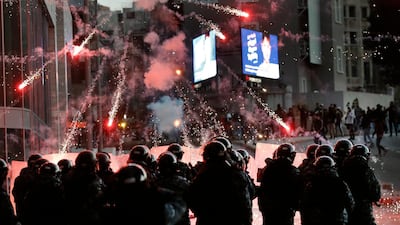
Lebanon has been facing its worst economic crisis in decades, amid nationwide protests that began on October 17 against the ruling political class which demonstrators accuse of mismanagement and corruption. AP -
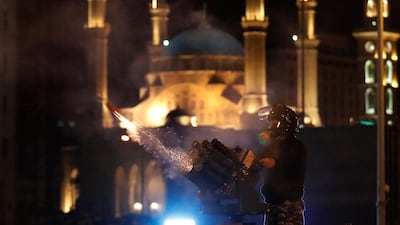
A riot police officer fires tear gas from a launcher against anti-government protesters trying to enter parliament square in downtown Beirut. AP -

Protesters wave the Lebanese flag in front of riot police during clashes in central Beirut. EPA -

Protesters flee tear gas after they threw stones at riot police during clashes in central Beirut. EPA -
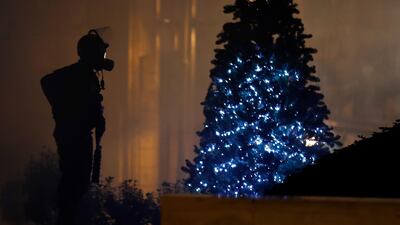
A riot police officer stands next of a Christmas tree during a protest. AP -

A riot police officer fires rubber bullets towards anti-government protesters. AP -
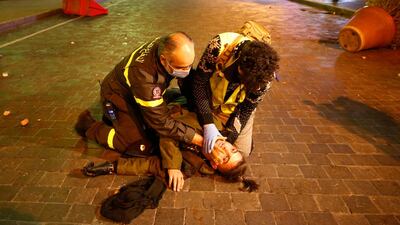
Civil defence workers treat injured protesters who were beaten by riot police. AP -
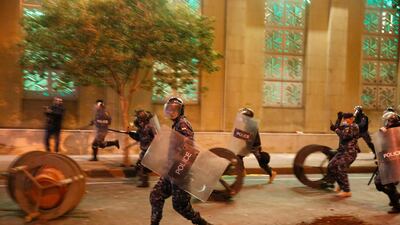
Riot policemen run after anti-government protesters trying to enter the parliament square. AP -
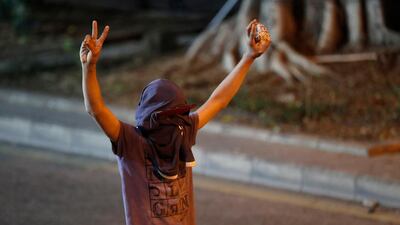
An anti-government protester holds stones, as he flashes victory signs during a protest near the parliament square. AP -
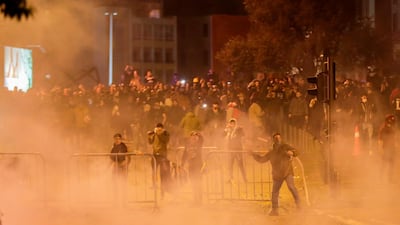
Lebanese demonstrators hurl rocks at riot police during clashes in the capital Beirut on December 14, 2019. AFP -
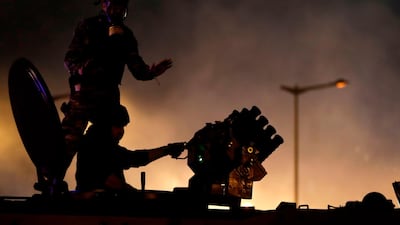
Lebanese riot police prepare to fire teargas canisters during clashes with anti-government demonstrators in the capital Beirut on December 14, 2019. AFP -

Riot police detain an anti-government demonstrator during clashes in the capital Beirut on December 14, 2019. AFP -
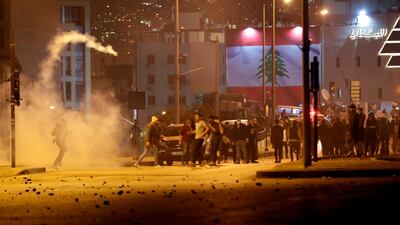
Lebanese demonstrators hurl tear-gas canisters back at riot police during clashes in the capital Beirut on December 14, 2019. AFP -
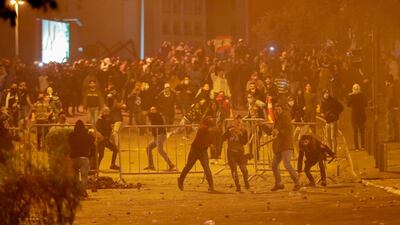
Lebanese demonstrators hurl tear-gas canisters back at riot police during clashes in the capital Beirut on December 14, 2019. AFP -
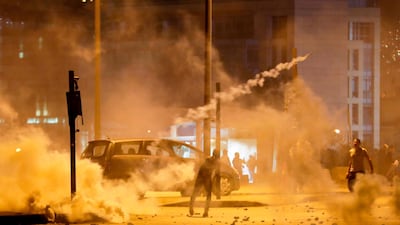
Lebanese demonstrators hurl tear-gas canisters back at riot police during clashes in the capital Beirut on December 14, 2019. AFP


Amnesty International's Diala Haidar denounced the "excessive use of force".
"The intention was clearly to prevent protesters gathering," Ms Haidar said. She said masked men in civilian clothes joined the security forces in "violently attacking protesters".
The clashes lasted until the early hours of Sunday, with demonstrators chanting slogans against Mr Hariri and Mr Berri.
The names of candidates for the next prime minister have been circulated in recent weeks but Lebanon's political parties have failed to agree.
Each candidate put forward has ruled themselves out after angry reactions from the protesters, who do not want another political appointment.
Last Sunday, the establishment threw its support behind Mr Hariri, further angering protesters.
Before talks were delayed until Thursday, Christian parties the Lebanese Forces and the Free Patriotic Movement, which was founded by Mr Aoun, indicated that they would not cast a vote.
This could derail the process because critics could then argue that the new candidate does not have cross-community support.
The UN insisted on the importance of the talks, with its Lebanon co-ordinator Jan Kubis urging politicians to "act responsibly".
"Tomorrow is the moment of truth," Mr Kubis tweeted.
"Either politicians will show at this critical moment of deep complex crisis they understand the needs of Lebanon and its people and help steer a peaceful way forward, or that they remain captive of their traditional habits and attitudes."
Sunday's demonstration in Beirut began peacefully with protesters waving Lebanese flags and chanting "Hariri will not return".
"Change needs time and patience and we will not stop until we achieve our goals and remove this regime completely," said protester Carla, 23.
"We don't want Hariri because he is a partner in corruption."
Nour, a pharmacist, said: "I am opposed to Hariri returning as head of the government and I don't understand why they can't find anyone else.
"There are many competent people who are independent."
The head of the Internal Security Forces, Maj Gen Imad Othman, spoke to protesters in Beirut on Sunday, urging them to stay peaceful and let the security forces carry out their duties.
Meanwhile, Lebanon's debt-burdened economy slides towards collapse.
The country is facing a dollar liquidity crisis, with banks limiting the withdrawal and transfer of the greenback, which has been selling for more than 2,000 Lebanese pounds on the parallel market for the first time since it was officially pegged at 1,507 in 1997.
The international community has called for a new Cabinet to be formed swiftly to carry out vital economic reforms and unlock international aid.
French Foreign Minister Jean-Yves Le Drian on Sunday urged Lebanon's leaders to resolve the crisis, warning of a "dramatic situation". – additional reporting by AFP

