• Anti-government protesters throw firecrackers at riot police during a demonstration against the new government, near Parliament Square, in Beirut, Lebanon. AP Photo
    Anti-government protesters throw firecrackers at riot police during a demonstration against the new government, near Parliament Square, in Beirut, Lebanon. AP Photo
  • Lebanese anti-corruption protesters shout slogans outside the parliament during a protest in downtown Beirut. AFP
    Lebanese anti-corruption protesters shout slogans outside the parliament during a protest in downtown Beirut. AFP
  • An anti-government protester shouts slogans during a protest against the new government, near the parliament square, in Beirut. AP Photo
    An anti-government protester shouts slogans during a protest against the new government, near the parliament square, in Beirut. AP Photo
  • An anti-government protester shows off the liquid pepper on his hand after he was sprayed by the riot police during continuous anti-government protests outside of the Lebanese Parliament building in downtown Beirut. EPA
    An anti-government protester shows off the liquid pepper on his hand after he was sprayed by the riot police during continuous anti-government protests outside of the Lebanese Parliament building in downtown Beirut. EPA
  • A Lebanese anti-government protester holds on to a police fence as riot police guard an access to the parliament during clashes with anti-government protesters in downtown Beirut. AFP
    A Lebanese anti-government protester holds on to a police fence as riot police guard an access to the parliament during clashes with anti-government protesters in downtown Beirut. AFP
  • A Lebanese policeman rides his motocycle passed a road, blocked by anti-government protesters with burning tyres, in the capital Beirut. AFP
    A Lebanese policeman rides his motocycle passed a road, blocked by anti-government protesters with burning tyres, in the capital Beirut. AFP
  • An anti-government protester is sprayed by a water cannon as he films by his mobile phone during a protest against the new government, near the parliament square, in Beirut. AP Photo
    An anti-government protester is sprayed by a water cannon as he films by his mobile phone during a protest against the new government, near the parliament square, in Beirut. AP Photo
  • An anti-government protester holds a stone as she prepares to throw it at the riot police during a protest against the new government, near the parliament square, in Beirut. AP Photo
    An anti-government protester holds a stone as she prepares to throw it at the riot police during a protest against the new government, near the parliament square, in Beirut. AP Photo
  • An anti-government protester prepares to throw stones at the riot police during a protest against the new government, near the parliament square, in Beirut. AP Photo
    An anti-government protester prepares to throw stones at the riot police during a protest against the new government, near the parliament square, in Beirut. AP Photo
  • Anti-government protesters remove barbed wire during continuous anti-government protests outside of the Lebanese Parliament building in downtown Beirut. EPA
    Anti-government protesters remove barbed wire during continuous anti-government protests outside of the Lebanese Parliament building in downtown Beirut. EPA
  • Anti-government protesters sit on chairs waving Lebanese national flags as tyres are aflame to cut off a section of the Beirut-Byblos highway in the coastal city of Byblos, as they protest the newly-announced government formed by Prime Minister Hassan Diab. AFP
    Anti-government protesters sit on chairs waving Lebanese national flags as tyres are aflame to cut off a section of the Beirut-Byblos highway in the coastal city of Byblos, as they protest the newly-announced government formed by Prime Minister Hassan Diab. AFP
  • An anti-government protester flashes the victory gesture while tyres are set aflame as demonstrators cut off a section of the Beirut-Byblos highway in Byblos, as they protest the newly-announced government formed by Prime Minister Hassan Diab. AFP
    An anti-government protester flashes the victory gesture while tyres are set aflame as demonstrators cut off a section of the Beirut-Byblos highway in Byblos, as they protest the newly-announced government formed by Prime Minister Hassan Diab. AFP

Analysis: Lebanon’s ‘one colour’ government has a daunting task


Sunniva Rose
  • English
  • Arabic

Lebanon’s new Prime Minister Hassan Diab formed a government late on Tuesday, 34 days after he was nominated.

The former university professor will have to address Lebanon’s worst economic crisis since the end of the civil war in 1990, amid nationwide protests.

Mr Diab was intent on forming a government of 18 ministers but caved in at the last minute to political pressure and added two more to his Cabinet.

Many had already taken to the streets on Tuesday to reject his government, which they consider to be of “one colour”.

This is just not what protesters were aspiring to so I don't think it's going to end well

That meant it is backed by President Michel Aoun and his allies, including Iran-aligned Hezbollah, and does not include western-supported parties such as former prime minister Saad Hariri’s Future Movement.

The National asked three Lebanon experts for their take on the new government.

“The government today is an interesting mix between specialists and others who are affiliated with political parties,” including advisers to former ministers, said Maha Yahya, director of the Carnegie Middle East Centre.

Ms Yahya said one name stood out: Foreign Affairs Minister Nassif Hitti, a Maronite Christian and formerly Lebanon’s ambassador to the Arab League.

“He is quite highly regarded and a good former diplomat,” she said.

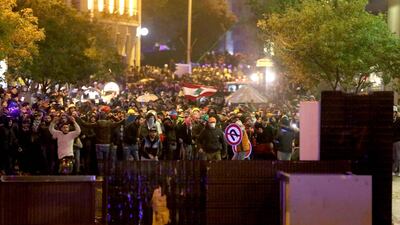
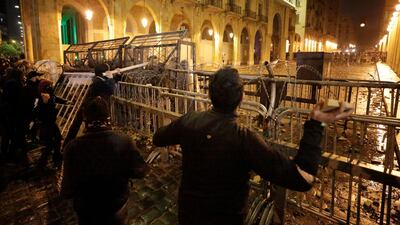
  • Lebanese protesters gather behind a barricade near a road leading to parliament in central Beirut amid ongoing anti-government demonstrations. AFP
    Lebanese protesters gather behind a barricade near a road leading to parliament in central Beirut amid ongoing anti-government demonstrations. AFP
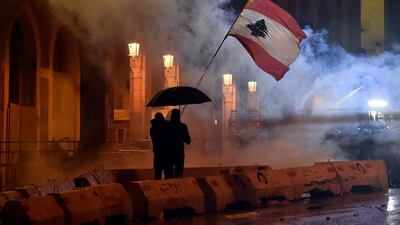
  • Two anti-government protesters wave a Lebanese national flag as they protect themselves with an umbrella during continuous protests and clashes with police outside the Lebanese Parliament building in downtown Beirut. EPA
    Two anti-government protesters wave a Lebanese national flag as they protect themselves with an umbrella during continuous protests and clashes with police outside the Lebanese Parliament building in downtown Beirut. EPA
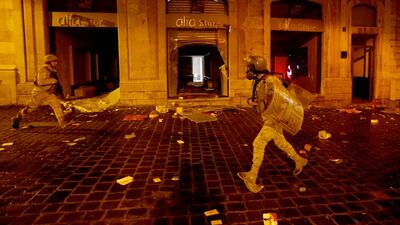
  • Lebanese army soldiers run past a damaged Alfa shop during a protest against a ruling elite accused of steering Lebanon towards an economic crisis in Beirut. REUTERS
    Lebanese army soldiers run past a damaged Alfa shop during a protest against a ruling elite accused of steering Lebanon towards an economic crisis in Beirut. REUTERS
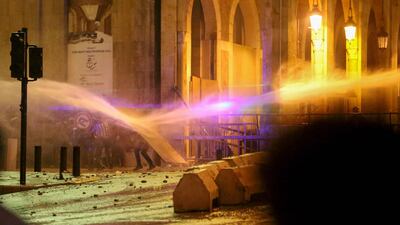
  • Lebanese riot police spray water to disperse anti-government protesters amid clashes near the parliament in central Beirut during ongoing anti-government demonstrations. AFP
    Lebanese riot police spray water to disperse anti-government protesters amid clashes near the parliament in central Beirut during ongoing anti-government demonstrations. AFP
  • Lebanese protesters use laser pointers amid clashes with riot police near the parliament in central Beirut during ongoing anti-government demonstrations. AFP
    Lebanese protesters use laser pointers amid clashes with riot police near the parliament in central Beirut during ongoing anti-government demonstrations. AFP
  • Lebanese protesters clash with riot police guarding a road leading to parliament in central Beirut amid ongoing anti-government demonstrations. AFP
    Lebanese protesters clash with riot police guarding a road leading to parliament in central Beirut amid ongoing anti-government demonstrations. AFP
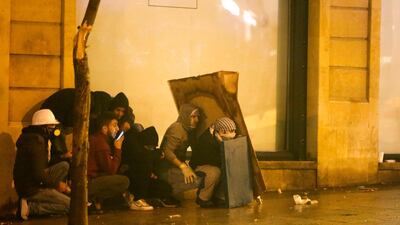
  • Lebanese protesters take cover amid clashes with riot police guarding a road leading to parliament in central Beirut. AFP
    Lebanese protesters take cover amid clashes with riot police guarding a road leading to parliament in central Beirut. AFP
  • Anti-government protesters throw stones and clash with the riot police, during ongoing protests against the political elites who have ruled the country for decades, in Beirut. AP Photo
    Anti-government protesters throw stones and clash with the riot police, during ongoing protests against the political elites who have ruled the country for decades, in Beirut. AP Photo
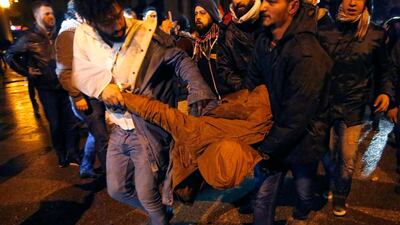
  • Anti-government protesters carry their friend who was injured by rubber bullet while clashing with the riot police, during ongoing protests against the political elites who have ruled the country since decades, in Beirut. AP Photo
    Anti-government protesters carry their friend who was injured by rubber bullet while clashing with the riot police, during ongoing protests against the political elites who have ruled the country since decades, in Beirut. AP Photo
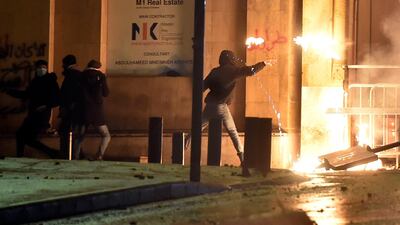
  • An anti-government protester hurls a Molotov cocktail at Lebanese riot police behind a barricade during continuous anti-government protests outside of the Lebanese Parliament building in downtown Beirut. EPA
    An anti-government protester hurls a Molotov cocktail at Lebanese riot police behind a barricade during continuous anti-government protests outside of the Lebanese Parliament building in downtown Beirut. EPA

This is the first Lebanese Cabinet to include six women, including the first female Defence Minister, Zeina Akar.

Ms Akar, a Greek-Orthodox Christian, is also the country's first female Deputy Prime Minister.

“Her appointment came out of left field. Nobody saw this coming,” Ms Yahya said. “She has never occupied a public office before.”

But she criticised the process of forming the government, which was conducted as usual through back-door negotiations between political parties.

“This is just not what protesters were aspiring to so I don’t think it’s going to end well,” Ms Yahya said.

She also said the government might not be up to the task of addressing Lebanon’s rapidly deteriorating economic situation.

“I cannot underestimate the size of the challenges that the country is facing on economic and fiscal terms, and their repercussions on society, on the standards of living, and in the medium term, on the stability of the country,” Ms Yahya said.

Karim Bitar, an international relations analyst at the Institute for International and Strategic Affairs in Paris, told The National that most ministers were completely unknown to the public, although "several highly respectable figures" were included.

Mr Bitar also pointed to Mr Hitti, and said Justice Minister Marie-Claude Najem, a Maronite, was a “highly skilled lawyer and respected professor at St Joseph University in Beirut".

"She has worked extensively on promoting an independent judiciary," he said.

"She is in favour of the unification of personal status laws which is a demand of Lebanese civil society, but will certainly face staunch opposition from the most conservative segments of the Lebanese religious establishment.”

Those laws would include the possibility of civil marriage. This is impossible in Lebanon, which only celebrates religious marriages under the rules of the country’s 18 sects.

“So, when it comes to justice reform, there are reasons to be optimistic,” Mr Bitar said.

But he said the public was cautious about the new government because people were afraid that the traditional parties, which have ruled since the end of the civil war in 1990, will use the new figures as “window dressing” while they continue making major decisions.

Mr Bitar also criticised the “considerable missteps” in the new Cabinet, such as giving the Culture and Agriculture ministries to the same person, Abbas Mortada, a Shiite.

“This is another example showing that very often these governments are not formed on the basis of competence and meritocracy, but they try at the very last minute to satisfy the various demands of stakeholders, which produces weird attributions,” he said.

Sami Nader, director of the Levant Institute for Strategic Affairs, said he had “mixed feelings” about the new government.

“It does not bode well because the same old system of power distribution among sectarian groups” has been followed, Mr Nader said.

“That said, there are at least five very good names. The question is, will they be able get rid of the old political system?

"Will they be free to act on their own and deliver good work, or will they be the hostages of the system?”