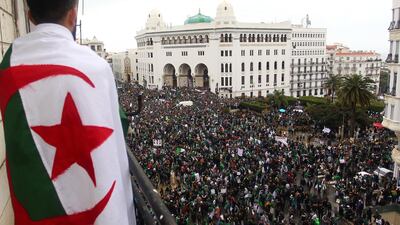
An Algerian court sentenced prominent anti-government activist Amira Bouraoui to a year in prison on Sunday amid a growing climate of repression, one of her lawyers has said.
"This conviction is unjust, there is no evidence. We are going to appeal," lawyer Mustapha Bouchachi told AFP.
Ms Bouraoui, a gynaecologist, is a prominent activist in the "Hirak" protest movement that secured the resignation of former president Abdelaziz Bouteflika last April.
The mother-of-two was convicted on six counts, including "insulting Islam", "insulting the president" Abdelmadjid Tebboune and "incitement to violate lockdown" during the coronavirus pandemic.
She was also accused of inciting illegal protests, publishing "fake news" likely to jeopardise security or public order and comments that undermine national unity.
Prosecutors had sought 18 months imprisonment.
"These kind of lawsuits, which have been going on for months, won't calm the political situation," Mr Bouchachi said.
"It's not the best way to open up towards society, activists and this peaceful revolution," he added, referring to the Hirak movement.
Ms Bouraoui, 44, was taken into custody after being arrested at her home on Wednesday.
A former activist with the Barakat or "That's Enough!" movement, she came to prominence in 2014 when she opposed Mr Bouteflika running for a fourth term.
In recent days Algerian authorities have arrested and prosecuted numerous activists in a bid to prevent protests from resuming when the coronavirus lockdown is lifted.
Most prosecutions are being carried out under a new penal code passed hastily on April 22 amid the public health crisis.
The recent wave of arrests and prosecutions has led some opposition activists to say that the rights situation in Algeria today is worse than during Mr Bouteflika's rule, particularly with regard to freedom of the press.
The North African country has gradually been relaxing its coronavirus lockdown measures since June 7.
But even though large gatherings have been banned since mid-March, hundreds of protesters turned out on Friday to resume the weekly protests that marked the political scene before the coronavirus lockdown – particularly in the northwest Kabylie region, according to local sources.
The authorities arrested nearly 500 people across the country during Friday's banned demonstrations, though most were subsequently released, said Said Salhi, vice president of the Algerian Human Rights League.
Among the nearly 100 detained on Friday, about 20 were remanded in custody on Sunday. The rest were either convicted and sentenced or freed pending trial.
Before the latest wave of arrests, the National Committee for the Liberation of Prisoners said around 60 people linked to the Hirak movement were in detention.
The movement started in February 2019, and after obtaining the resignation of Mr Bouteflika after 20 years in power, protests continued, demanding an overhaul of Algeria's political system in place since independence from France in 1962.

