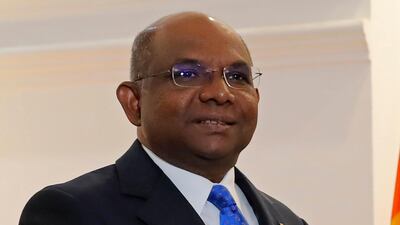
Foreign Minister Abdulla Shahid of the Maldives won election as the next president of the UN General Assembly on Monday, and pledged to push for equal access to coronavirus vaccines, a stronger and greener economic recovery, and stepped up efforts to tackle climate change.
He defeated a former Afghan foreign minister, Zalmai Rassoul, in a 143-48 vote by secret ballot, with two of the assembly’s 193 member nations not voting. Diplomats from member nations, all wearing masks because of the pandemic, were called to the front of the assembly chamber one-by-one to deposit their ballot in a large wooden box.
Turkey’s Volkan Bozkir, the current assembly president, said Mr Shahid brings to the job “extensive experience in multilateral diplomacy,” serving his Indian Ocean island nation twice as foreign minister and for 10 years before that as chief of staff to the president.
Mr Shahid has been “a strong voice in calling attention to the impact on small island developing states” by the pandemic and by climate change, which threatens people’s lives and livelihoods, Mr Bozkir said.
Mr Shahid, 59, said he was “deeply humbled” by the trust shown by the UN members and the honour given to his island nation of 26 atolls, population about 550,000, which lies in the Indian Ocean southwest of Sri Lanka and India.
Saying he has “an undying belief in multilateralism with an ardent desire to serve the international community,” Mr Shahid said his aim is to launch “a presidency of hope” and “to hit the ground running on day one in September as soon as I take my oath of office.”
“This is a crucial time for the United Nations and for the world,”Mr Shahid said. “There is very little time to spare.”
He pointed to the past year’s “disease, despair and devastation” as a result of the pandemic, along with increasing “inequality, injustice and instability” and the “suffering” of the planet from climate change.
Mr Shahid said his priorities during his year-long presidency of the 76th session of the General Assembly are to recover from the pandemic, both by making vaccines available to all people everywhere, and rebuilding economies stronger and greener and “and ensuring no country is left behind.”
He said it can also be “a super session for nature” and to “seize momentum on responding to the needs of our planet,” citing coming conferences and meetings on climate change, the oceans, biodiversity, sustainable transport and food systems as examples. This is a major priority for the Maldives, whose leaders have warned that the country’s existence is threatened by rising seas from climate change.
Mr Shahid said he will also focus on “respecting the rights of all,” revitalising the United Nations, and engaging the media and civil society.
“I will raise my voice against gender discrimination, advocate for gender equality … [and] not participate in any panels that are not gender balanced,” he said.
UN Secretary General Antonio Guterres congratulated Mr Shahid, saying the General Assembly is the UN's most representative organ, the foundation of its work, “and essential to our effectiveness as an organisation.”
“In 2021, the world needs that effectiveness more than ever,” Mr Guterres said. “We are a world in mourning for the millions of people we have lost to the Covid-19 pandemic.”
Mr Guterres said the 76th session will grapple with the impact of Covid-19 on peace, development and human rights, stressing that “until everyone, everywhere, has access to vaccine it continues to pose an enormous threat.”
While the presidency of the General Assembly is largely ceremonial, it is also prestigious.
The body controls the UN budget, adopts treaties, addresses global issues from poverty to corruption, and passes numerous resolutions that while not legally binding almost always reflect global opinion.
-

British Prime Minister Clement Attlee addresses the first session of the UN General Assembly in the Methodist Central Hall, London, 10th January 1946. Getty Images -
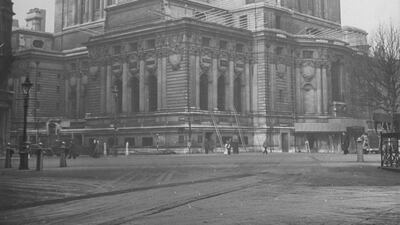
Preparations outside Central Hall for the meeting in 1946. Getty Images -

The flags of the United Nations are put up over the main entrance hall in Central Hall. Getty Images -
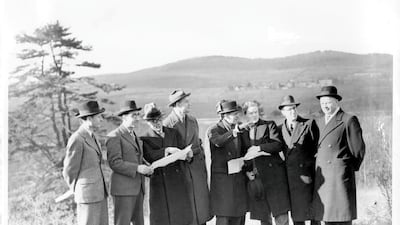
United Nations Organization site pickers inspect Archibald Rogers's estate at Hyde Park on January 11 1946. From left: Francois Briere, France; Awn el Khalidi, Iraq; Dr. Shu Hsi-hsu, China; Huntington Gilchrist, United States; Dr. Stoyan Gavrilovich, Yugoslavia; Maj. K. G. Younger, United Kingdom; Julio A. Lacarte, Uruguay; and Georgia Saksin, USSR. Getty Images -
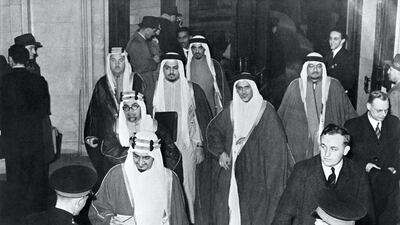
King of Saudi Arabia Faisal bin Abdulaziz Al Saud and the Saudi Arabia delegation arrive at Central Hall. AFP -

British foreign secretary Ernest Bevin and Clement Attlee at the first meeting. Getty Images -
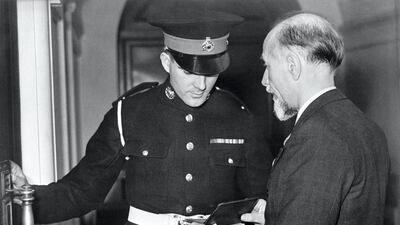
A soldier checks a delegate's identity card at Central Hall. AFP -
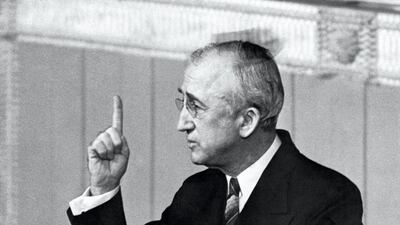
US Secretary of State James F. Byrnes delivers a speech at the United Nations first General Assembly. AFP -

Delegates in their seats at Central Hall. Getty Images


It is also the UN organ where countries large and small can speak – and the scene of the only annual gathering of world leaders, historically in person. Last year, however, there were video speeches from leaders because of the pandemic, and no announcement has been made yet of this year’s arrangements.
In recent months, the assembly has allowed in-person meetings with two representatives from each country allowed in the vast chamber, where social distancing is observed.
Mr Shahid said in response to a question on future meetings that it would be prudent to maintain a cautious approach. “But as soon as possible, yes, it should be in our interest and the interest of this organisation to come back into the normalcy if at all possible.”
The selection of the assembly president follows a regional rotation mandated by the world body, and it was the turn of Asia to preside over the next year-long session.
By tradition, the UN’s regional groups usually nominate a single candidate who is then rubber-stamped by the assembly. But this year the election was contested because Asian countries couldn’t agree on a nominee.
Mr Bozkir, Mr Shahid and Guterres paid tribute to losing candidate Mr Rassoul, who served as Afghanistan’s foreign minister in 2010-2013 and was one of the top three contenders to replace Hamid Karzai as president in 2014, losing out to Ashraf Ghani.

