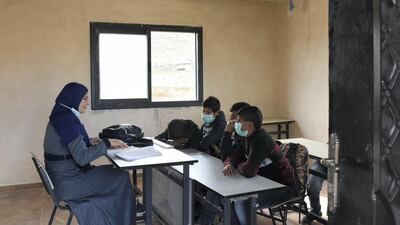
The coronavirus pandemic has prompted many schools to arrange online learning, but in Ras Al Tin, north-east of Ramallah in the occupied West Bank, the pupils must learn in person as they have no electricity or computers. Rose Scammell for The National
The coronavirus pandemic has prompted many schools to arrange online learning, but in Ras Al Tin, north-east of Ramallah in the occupied West Bank, the pupils must learn in person as they have no elec

Palestinian teachers vow to keep going despite Israeli threat to raze school


Rosie Scammell
  • English
  • Arabic

Wearing a striped uniform and face mask, 14-year-old Noor Abu Rasheed said her grades have shot up since a school opened near her West Bank home. But with an Israeli demolition order looming over the building, she and dozens of other children could soon be kicked out of the classroom.

“My top subject is maths,” said the teenager, one of about 50 pupils at the remote Ras Al Tin school. Until the five classrooms were constructed earlier this year, children from local Bedouin communities had to walk up to seven kilometres to access education.

Noor Abu Rasheed, 14, writes a mathematics equation on the board at the school in Ras Al Tin. Rose Scammell for The National

Noor said her grades were bad until recently. “When I came here all my tests improved,” she said, standing outside the single-storey school while sheep and donkeys grazed nearby.

With the long journey to school hindering pupils’ performance and attendance, herder communities got together in August and constructed their own classrooms using donated materials.

Due to limited space at the school, two grades share a classroom, in Ras a-Tin, north-east of Ramallah in the occupied West Bank. Rose Scammell for The National

But even before the academic year started, Israeli officials drove down the dirt road and confiscated building materials and equipment such as chairs and tables.

Ras Al Tin lies north-east of Ramallah, in the part of the West Bank fully controlled by Israel. Cogat, the Israeli liaison agency to the Palestinian territories, said it responds to “planning and building violations” to maintain “public order and the rule of law”.

The Ras Al Tin school has five classrooms. Israeli authorities confiscated building materials, tables and chairs during its construction because the community did not have a permit. Rose Scammell for The National

"Enforcement measures, as well as the confiscation of equipment at the location noted in your inquiry, are carried out in accordance with the authorities and procedures, and subject to priorities and operational considerations," Cogat told The National regarding Ras Al Tin.

According to the Israeli planning rights organisation Bimkom, authorities issued a demolition order for the school at Ras Al Tin on September 8.

While residents pressed on and finished the basic building work, they stopped short of installing electricity or running water over concerns such developments could prompt Israeli authorities to swiftly proceed with the demolition order.

A bathroom for the pupils remains unfinished, while a small hut a few metres from the school serves as the teachers’ toilet.

A hut close to the school serves as the teacher's toilet. A bathroom for the pupils remains unfinished and the school lacks running water. Rose Scammell for The National

The head teacher, Noora Azhari, said the team of seven teachers was coping relatively well.

“The school is working in spite of the conditions, the infrastructure and such things,” she said, as the hubbub of classes could be heard behind her.

“There’s a good spirit among the teachers, the management and the students, of perseverance and giving, and everyone is happy,” Ms Azhari added.

The school at Ras Al Tin has about 50 pupils ranging in age from six to 14. Rose Scammell for The National

Fifty-two schools in the occupied West Bank are currently under demolition orders, according to Bimkom. While Israeli authorities say they have been built without the necessary permits, the United Nations children’s agency notes such paperwork is very difficult to obtain.

"Many children in the State of Palestine face challenges claiming this right [to education], but those challenges faced by Bedouin children mean that they are potentially particularly vulnerable," Lucia Elmi, Unicef's special representative for Palestine, told The National.

With the lack of local schools or buses to take pupils elsewhere, she said some parents prefer to keep their children at home rather than risk them encountering Israeli soldiers or settlers during the long walk to school.

Residents of Ras Al Tin complained that settlers have started coming to the area and damaging their school.

“Every day they pass by, every day they come,” said Noor. “If the glass is broken and if they throw something we wait for an adult to come.”

With children attending the school from age six, there is not enough space to separate them into grades and so two levels share each classroom. While young pupils are busy fixing a paper moon and star to the wall of one room, in another Noor writes a maths equation on a whiteboard.

Most of the pupils and teachers wear face masks, a reminder of the coronavirus pandemic which has forced children around the world to take online classes.

Such remote study is impossible for the children of Ras Al Tin, said Alon Cohen Lifshitz from Bimkom.

Pupils leave the Ras Al Tin school after classes. Before the school opened, they had to walk up to seven kilometres to access education. Rose Scammell for The National

“They are not connected to the internet, of course they don’t have computers or laptops, so the only viable option for them is to build a physical school and to study here in this kind of way,” he said.

Lessons are carrying on despite the threat of the pandemic and the possibility that bulldozers may appear at any moment. The last West Bank school was demolished in 2015, according to Bimkom, although hundreds of other structures have been knocked down in recent years.

Between January and October this year, at least 111 homes in the West Bank were demolished by Israeli authorities, data from Israeli rights group B’Tselem show, in addition to 263 other structures such as storerooms.

In the largest forced displacement in more than four years, according to the UN, the homes of more than 70 Bedouins were razed on November 3.

In Ras Al Tin, Noor hopes the school will stand long enough for her to complete her education and allow other children to take her place.

The head teacher was uncertain whether the walls would stay standing, but remained determined that pupils will continue their studies even if the school is pulled down.

“We will go to another place and build a school, or we will continue in a tent,” said Ms Azhari.

“It’s impossible for us to stop, this is the children’s most basic right.”

Ten tax points to be aware of in 2026

1. Domestic VAT refund amendments: request your refund within five years

If a business does not apply for the refund on time, they lose their credit.

2. E-invoicing in the UAE

Businesses should continue preparing for the implementation of e-invoicing in the UAE, with 2026 a preparation and transition period ahead of phased mandatory adoption. 

3. More tax audits

Tax authorities are increasingly using data already available across multiple filings to identify audit risks. 

4. More beneficial VAT and excise tax penalty regime

Tax disputes are expected to become more frequent and more structured, with clearer administrative objection and appeal processes. The UAE has adopted a new penalty regime for VAT and excise disputes, which now mirrors the penalty regime for corporate tax.

5. Greater emphasis on statutory audit

There is a greater need for the accuracy of financial statements. The International Financial Reporting Standards standards need to be strictly adhered to and, as a result, the quality of the audits will need to increase.

6. Further transfer pricing enforcement

Transfer pricing enforcement, which refers to the practice of establishing prices for internal transactions between related entities, is expected to broaden in scope. The UAE will shortly open the possibility to negotiate advance pricing agreements, or essentially rulings for transfer pricing purposes. 

7. Limited time periods for audits

Recent amendments also introduce a default five-year limitation period for tax audits and assessments, subject to specific statutory exceptions. While the standard audit and assessment period is five years, this may be extended to up to 15 years in cases involving fraud or tax evasion. 

8. Pillar 2 implementation 

Many multinational groups will begin to feel the practical effect of the Domestic Minimum Top-Up Tax (DMTT), the UAE's implementation of the OECD’s global minimum tax under Pillar 2. While the rules apply for financial years starting on or after January 1, 2025, it is 2026 that marks the transition to an operational phase.

9. Reduced compliance obligations for imported goods and services

Businesses that apply the reverse-charge mechanism for VAT purposes in the UAE may benefit from reduced compliance obligations. 

10. Substance and CbC reporting focus

Tax authorities are expected to continue strengthening the enforcement of economic substance and Country-by-Country (CbC) reporting frameworks. In the UAE, these regimes are increasingly being used as risk-assessment tools, providing tax authorities with a comprehensive view of multinational groups’ global footprints and enabling them to assess whether profits are aligned with real economic activity. 

Contributed by Thomas Vanhee and Hend Rashwan, Aurifer

Mercer, the investment consulting arm of US services company Marsh & McLennan, expects its wealth division to at least double its assets under management (AUM) in the Middle East as wealth in the region continues to grow despite economic headwinds, a company official said.

Mercer Wealth, which globally has $160 billion in AUM, plans to boost its AUM in the region to $2-$3bn in the next 2-3 years from the present $1bn, said Yasir AbuShaban, a Dubai-based principal with Mercer Wealth.

Within the next two to three years, we are looking at reaching $2 to $3 billion as a conservative estimate and we do see an opportunity to do so,” said Mr AbuShaban.

Mercer does not directly make investments, but allocates clients’ money they have discretion to, to professional asset managers. They also provide advice to clients.

“We have buying power. We can negotiate on their (client’s) behalf with asset managers to provide them lower fees than they otherwise would have to get on their own,” he added.

Mercer Wealth’s clients include sovereign wealth funds, family offices, and insurance companies among others.

From its office in Dubai, Mercer also looks after Africa, India and Turkey, where they also see opportunity for growth.

Wealth creation in Middle East and Africa (MEA) grew 8.5 per cent to $8.1 trillion last year from $7.5tn in 2015, higher than last year’s global average of 6 per cent and the second-highest growth in a region after Asia-Pacific which grew 9.9 per cent, according to consultancy Boston Consulting Group (BCG). In the region, where wealth grew just 1.9 per cent in 2015 compared with 2014, a pickup in oil prices has helped in wealth generation.

BCG is forecasting MEA wealth will rise to $12tn by 2021, growing at an annual average of 8 per cent.

Drivers of wealth generation in the region will be split evenly between new wealth creation and growth of performance of existing assets, according to BCG.

Another general trend in the region is clients’ looking for a comprehensive approach to investing, according to Mr AbuShaban.

“Institutional investors or some of the families are seeing a slowdown in the available capital they have to invest and in that sense they are looking at optimizing the way they manage their portfolios and making sure they are not investing haphazardly and different parts of their investment are working together,” said Mr AbuShaban.

Some clients also have a higher appetite for risk, given the low interest-rate environment that does not provide enough yield for some institutional investors. These clients are keen to invest in illiquid assets, such as private equity and infrastructure.

“What we have seen is a desire for higher returns in what has been a low-return environment specifically in various fixed income or bonds,” he said.

“In this environment, we have seen a de facto increase in the risk that clients are taking in things like illiquid investments, private equity investments, infrastructure and private debt, those kind of investments were higher illiquidity results in incrementally higher returns.”

The Abu Dhabi Investment Authority, one of the largest sovereign wealth funds, said in its 2016 report that has gradually increased its exposure in direct private equity and private credit transactions, mainly in Asian markets and especially in China and India. The authority’s private equity department focused on structured equities owing to “their defensive characteristics.”

'Ghostbusters: From Beyond'

Director: Jason Reitman

Starring: Paul Rudd, Carrie Coon, Finn Wolfhard, Mckenna Grace

Rating: 2/5

2025 Fifa Club World Cup groups

Group A: Palmeiras, Porto, Al Ahly, Inter Miami.

Group B: Paris Saint-Germain, Atletico Madrid, Botafogo, Seattle.

Group C: Bayern Munich, Auckland City, Boca Juniors, Benfica.

Group D: Flamengo, ES Tunis, Chelsea, Leon.

Group E: River Plate, Urawa, Monterrey, Inter Milan.

Group F: Fluminense, Borussia Dortmund, Ulsan, Mamelodi Sundowns.

Group G: Manchester City, Wydad, Al Ain, Juventus.

Group H: Real Madrid, Al Hilal, Pachuca, Salzburg.

Company Fact Box

Company name/date started: Abwaab Technologies / September 2019

Founders: Hamdi Tabbaa, co-founder and CEO. Hussein Alsarabi, co-founder and CTO

Based: Amman, Jordan

Sector: Education Technology

Size (employees/revenue): Total team size: 65. Full-time employees: 25. Revenue undisclosed

Stage: early-stage startup 

Investors: Adam Tech Ventures, Endure Capital, Equitrust, the World Bank-backed Innovative Startups SMEs Fund, a London investment fund, a number of former and current executives from Uber and Netflix, among others.

88 Video's most popular rentals

Avengers 3: Infinity War: an American superhero film released in 2018 and based on the Marvel Comics story.  

Sholay: a 1975 Indian action-adventure film. It follows the adventures of two criminals hired by police to catch a vagabond. The film was panned on release but is now considered a classic.

Lucifer: is a 2019 Malayalam-language action film. It dives into the gritty world of Kerala’s politics and has become one of the highest-grossing Malayalam films of all time.

Company%20Profile
%3Cp%3E%3Cstrong%3ECompany%3A%3C%2Fstrong%3E%20Astra%20Tech%3Cbr%3E%3Cstrong%3EStarted%3A%20%3C%2Fstrong%3EMarch%202022%3Cbr%3E%3Cstrong%3EBased%3A%20%3C%2Fstrong%3EDubai%3Cbr%3E%3Cstrong%3EFounder%3A%20%3C%2Fstrong%3EAbdallah%20Abu%20Sheikh%3Cbr%3E%3Cstrong%3EIndustry%3A%3C%2Fstrong%3E%20technology%20investment%20and%20development%3Cbr%3E%3Cstrong%3EFunding%20size%3A%3C%2Fstrong%3E%20%24500m%3C%2Fp%3E%0A
Jetour T1 specs

Engine: 2-litre turbocharged

Power: 254hp

Torque: 390Nm

Price: From Dh126,000

Available: Now

The President's Cake

Director: Hasan Hadi

Starring: Baneen Ahmad Nayyef, Waheed Thabet Khreibat, Sajad Mohamad Qasem 

Rating: 4/5