
As their government struggles to tackle the pandemic, young Indians are stepping into the breach.
Many are delivering vital supplies, using social media to direct resources or setting up apps to crowdsource aid.
Her exam revision done, schoolgirl Swadha Prasad gets on with her real work: finding life-saving oxygen, drugs and hospital beds for Covid-19 patients.
Swadha works with dozens of volunteers – all aged between 14 and 19 – as part of the youth-led organisation Uncut, building online databases packed with information about medical resources available across the country.
It is a 24/7 operation, with the teenagers constantly on their phones as they verify the availability of supplies, update information in real time and field calls from frantic relatives.
"Some of us do midnight to morning shifts, because the calls don't stop at 3am," said Swadha, 17, who works a 14-hour stretch from before midday until one in the morning.
It is a long and often tiring affair, the Mumbai student said, but added: "If I can help save a life, there is no part of me that is going to say no."
-
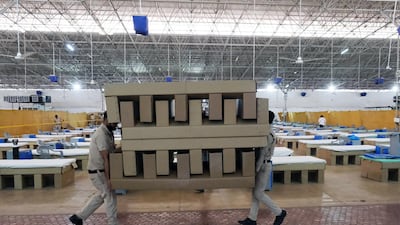
Workers carry biodegradable cardboard beds at a makeshift ward set up at Radha Soami Satsang Beas in south Delhi. Bloomberg -
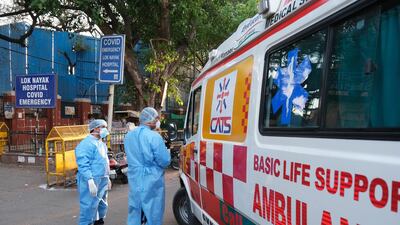
Health workers turn away an ambulance at the main entrance of Lok Nayak Jaiprakash Hospital in India's capital New Delhi. Bloomberg -
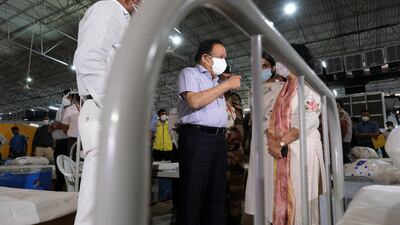
Harsh Vardhan, India's health minister, inspects a Covid-19 centre in the capital city of New Delhi. India is now the global coronavirus hotspot, setting daily new records for the world's highest number of cases. Bloomberg -
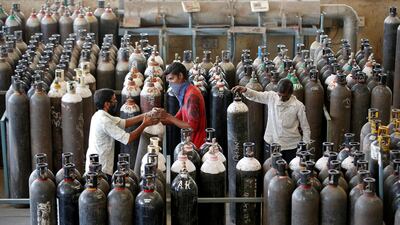
People carry oxygen cylinders after refilling them at a factory amid a surge in coronavirus cases in India's western city of Ahmedabad. Reuters -
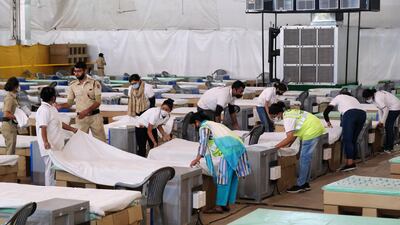
Workers prepare beds at a makeshift Covid-19 ward set up at Radha Soami Satsang Beas in south Delhi. Bloomberg -
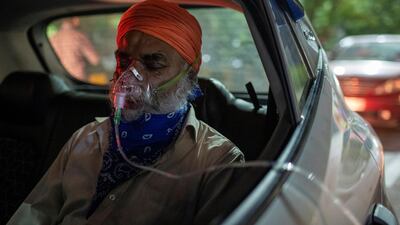
A man suffering from shortness of breath receives free oxygen inside his car at a gurudwara, Sikh temple, amid the spread of coronavirus, in northern Indian city of Ghaziabad. Reuters -
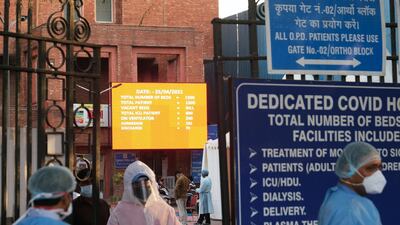
A board indicates unavailability of beds at Lok Nayak Jaiprakash Hospital in India's capital New Delhi. Bloomberg -

Relatives offer prayers before they bury the body of a Covid-19 victim in Guwahati, the capital of north-east Indian state Assam. AP Photo -
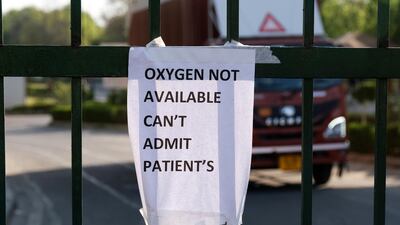
A sign indicates unavailability of oxygen at the Covid-19 care centre set up at the Commonwealth Games Village Sports Complex in New Delhi. Bloomberg -
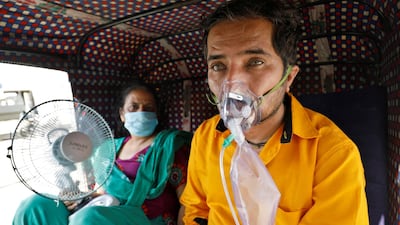
A patient wearing an oxygen mask looks on as his wife holds a battery-operated fan as they wait inside an auto-rickshaw to enter a Covid-19 hospital, in western Indian city of Ahmedabad. Reuters -
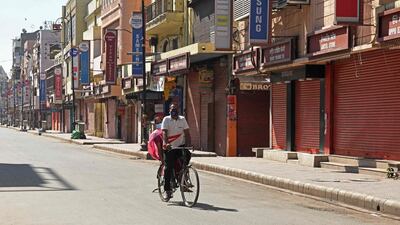
A man rides a bicycle through a deserted market area in the northern Indian city of Amritsar amid the lockdown imposed to prevent the spread of Covid-19. AFP -
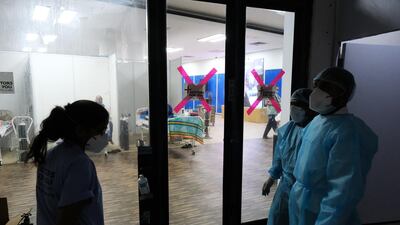
Health workers outside a Covid-19 ward set up at the Commonwealth Games Village Sports Complex in New Delhi. Bloomberg -
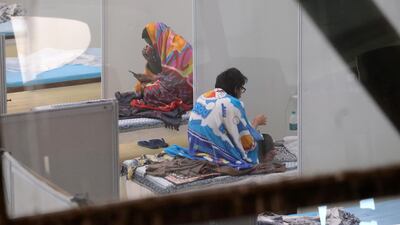
Patients inside a Covid-19 ward set up at the Commonwealth Games Village Sports Complex in New Delhi. Bloomberg


And lives have been saved, she said, pointing to a case where the team was able to find oxygen for a young Covid-19 patient in the middle of the night after an agonising two-hour wait.
"It's not only about providing resources... sometimes people just need to know they are not alone", she said.
India is an overwhelmingly young country – two thirds of its 1.3 billion people are under 35 – but its youth have never been called on to shoulder such huge responsibilities.
As India's pandemic grows ever more dystopian – with crematoriums running out of space and patients, including a former ambassador, dying in hospital car parks – many have volunteered in droves.
In the slums of Mumbai, Shanawaz Shaikh is providing free oxygen to thousands of people.
Known popularly as the "oxygen man", Mr Shaikh, 32, sold his cherished SUV last June to fund the initiative after his friend's pregnant cousin died in a rickshaw while trying to get admitted to a hospital.
"She died because she couldn't get oxygen in time," he told AFP.
He never expected to be fielding so many requests nearly a year later.
"We used to get around 40 calls a day last year, now it's more like 500," he said.
Mr Shaikh's team of 20 volunteers are also battling a massive shortage, made worse by profiteers.

"It's a test of one's faith," he said, describing how he sometimes travels dozens of kilometres to find oxygen for desperate patients.
"But when I am able to help someone, I feel like crying."
While major cities have borne the brunt so far, the limitations of technology are becoming apparent as the virus burrows into smaller towns and villages, software engineer Umang Galaiya told AFP.
Urgent requests for supplies and spare hospital beds have promoted a flood of leads on Twitter – many unconfirmed.
Mr Galaiya responded by building an app to make it easier for users to find what they are looking for and, crucially, limit their search to verified resources only.
But even so, his app is unlikely to help people outside big cities, the 25-year-old said, citing the example of his hometown in hard-hit Gujarat state where internet usage is low.
"If I look for resources in Jamnagar, there is nothing on Twitter," he said.
Ultimately the pandemic cannot be defeated without the government, he said, outlining simple measures that could have saved many lives.
For instance, officials could have created a real-time, automatically updated online registry of beds, to spare distressed patients the effort of running from one packed facility to another.
"If we can do it for movie theatres, to avoid overbooking, why can't we do it for hospitals?" he asked.
Youth-led efforts were also unsustainable, the Bangalore tech worker said, pointing out that overwhelmed volunteers would likely run out of energy themselves as the virus ravages their cities.
The trauma of confronting illness and death daily is already beginning to show.
"We work very hard but we can't save everyone," said Mumbai teenager Swadha , her voice quavering as she recalled efforts to help an 80-year-old woman who died.
Although they take breaks and arrange Zoom movie-viewing sessions to try and unwind, the stress never fully dissipates.
"My parents do worry about it," she said.
"But when their friends need help, they also turn to me."

