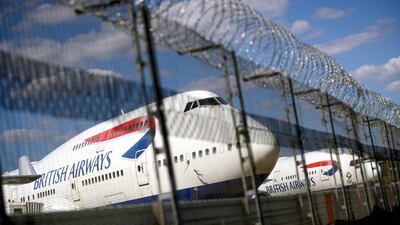
British and US airlines on Monday said they were hoping for a quick decision to restart transatlantic flights, given vaccination campaign successes and the need to maintain economic ties.
Leaders of the G7 wealthiest nations, including British Prime Minister Boris Johnson and US President Joe Biden, meet in Cornwall, south-west England, this weekend.
In an online briefing, leaders of major airlines and London's Heathrow airport said the summit was the right moment to announce that flights would restart.
"The borders have been shut down since March 2020," said Shai Weiss, chief executive of Virgin Atlantic, referring to the start of the first coronavirus lockdown in Britain.
"We're asking Prime Minister Boris Johnson and President Biden to lead the way and open the sky. They need to do that at the G7 summit."
United Airlines chief executive Scott Kirby said if that were to happen, flight capacity could be well on the way back to normal levels by the end of the month.
"We could be back and add significant capacity in a four-week period," Mr Kirby said. "It's the peak travel season. Every single day is a day lost for the recovery."
Airlines, which have taken a battering from the global health crisis due to travel restrictions, insisted that flying was safe.
Mr Weiss called for the US to be put on the UK government's "green list" of countries where travellers do not need to enter quarantine on arrival or return.
The US is an "amber" country in the UK's traffic light system, which means travellers are recommended not to undertake journeys except for emergencies.
Travellers returning to Britain have to enter quarantine for up to 10 days.
British Airways chief executive Sean Doyle said that transatlantic flights mainly catered for business travellers and tourists.
Mr Doyle said both countries have "low prevalence of infections and high vaccination rates".
Opening up would send a positive signal to the world, said American Airlines chief executive Doug Parker.
Heathrow boss John Holland-Kaye said there was "not only a political special relationship" between London and Washington, but "an economic special relationship".
Mr Johnson is due to meet Mr Biden on Thursday before the start of the summit. But the UK prime minister's spokesman refused to speculate on reports of a US-UK air corridor.
"We obviously want to, whenever safe, open using our red-amber-green system to countries that are safe to travel to," the spokesman said.
"And we're obviously in touch with a number of countries as that work continues."

The specs
- Engine: 3.9-litre twin-turbo V8
- Power: 640hp
- Torque: 760nm
- On sale: 2026
- Price: Not announced yet
Our legal consultants
Name: Hassan Mohsen Elhais
Position: legal consultant with Al Rowaad Advocates and Legal Consultants.
Final results:
Open men
Australia 94 (4) beat New Zealand 48 (0)
Plate men
England 85 (3) beat India 81 (1)
Open women
Australia 121 (4) beat South Africa 52 (0)
Under 22 men
Australia 68 (2) beat New Zealand 66 (2)
Under 22 women
Australia 92 (3) beat New Zealand 54 (1)
Ten tax points to be aware of in 2026
1. Domestic VAT refund amendments: request your refund within five years
If a business does not apply for the refund on time, they lose their credit.
2. E-invoicing in the UAE
Businesses should continue preparing for the implementation of e-invoicing in the UAE, with 2026 a preparation and transition period ahead of phased mandatory adoption.
3. More tax audits
Tax authorities are increasingly using data already available across multiple filings to identify audit risks.
4. More beneficial VAT and excise tax penalty regime
Tax disputes are expected to become more frequent and more structured, with clearer administrative objection and appeal processes. The UAE has adopted a new penalty regime for VAT and excise disputes, which now mirrors the penalty regime for corporate tax.
5. Greater emphasis on statutory audit
There is a greater need for the accuracy of financial statements. The International Financial Reporting Standards standards need to be strictly adhered to and, as a result, the quality of the audits will need to increase.
6. Further transfer pricing enforcement
Transfer pricing enforcement, which refers to the practice of establishing prices for internal transactions between related entities, is expected to broaden in scope. The UAE will shortly open the possibility to negotiate advance pricing agreements, or essentially rulings for transfer pricing purposes.
7. Limited time periods for audits
Recent amendments also introduce a default five-year limitation period for tax audits and assessments, subject to specific statutory exceptions. While the standard audit and assessment period is five years, this may be extended to up to 15 years in cases involving fraud or tax evasion.
8. Pillar 2 implementation
Many multinational groups will begin to feel the practical effect of the Domestic Minimum Top-Up Tax (DMTT), the UAE's implementation of the OECD’s global minimum tax under Pillar 2. While the rules apply for financial years starting on or after January 1, 2025, it is 2026 that marks the transition to an operational phase.
9. Reduced compliance obligations for imported goods and services
Businesses that apply the reverse-charge mechanism for VAT purposes in the UAE may benefit from reduced compliance obligations.
10. Substance and CbC reporting focus
Tax authorities are expected to continue strengthening the enforcement of economic substance and Country-by-Country (CbC) reporting frameworks. In the UAE, these regimes are increasingly being used as risk-assessment tools, providing tax authorities with a comprehensive view of multinational groups’ global footprints and enabling them to assess whether profits are aligned with real economic activity.
Contributed by Thomas Vanhee and Hend Rashwan, Aurifer
