

Sheikh Sabah, Kuwait's ruler for 14 years who died on Tuesday, was an elder statesman of the Middle East who led by example.
He was often at the centre of mediation, charting a path of reconciliation in a troubled region beset by conflict, displacement and tension. Sheikh Sabah was 91.
He and Kuwait were key partners to Saudi Arabia in mediating the 1989 Taif Accord that ended the Lebanese war and enhanced the reputation of the then foreign minister as an accomplished diplomat.
But much of Sheikh Sabah’s time as foreign minister between 1963 and 2003 was spent countering a belligerent Iraq after Saddam Hussein became the country’s autocratic leader in 1979.
In September 1989, Sheikh Sabah visited Baghdad and met Saddam to try to solve long-standing border disputes and claims by Iraq on Kuwaiti islands.
Ultimately, Sheikh Sabah and Kuwait felt the effects of war first-hand with the Iraqi invasion in 1990 and this shaped his outlook for the foundation of peace and stability.
While he led Kuwait’s insistence on securing war reparations from Iraq to pay for the widespread looting of the state by Saddam’s forces, Sheikh Sabah also reached out to the country and its people.
As prime minister, he spoke of his country’s support for the Iraqi people at the UN General Assembly in New York in 2003 and continued to work on improving relations between the neighbours.
He visited the country after Saddam was toppled in 2003 and regularly spoke of the need for regional consensus.

Twenty-one years after the invasion, Sheikh Sabah was one of the few Arab leaders to attend an Arab League summit in Iraq.
The March 2012 meeting was widely avoided because of a sense in many Middle East capitals that Baghdad had become too closely aligned with Tehran.
"I express my happiness since my foot stepped on to the land of the friend Iraq, after it gained back its freedom, dignity and democracy after a dark phase," Sheikh Sabah said at the summit.
In Kuwait in 2018, he chaired the International Conference for Reconstruction of Iraq, which brought together representatives of 76 nations and international organisations.
Kuwait pledged $2 billion of the $30bn in credit and investment for Iraq to help the country after the ISIS insurgency.
Ultimately, however, corruption and political instability in Baghdad prevented the disbursement of the funds.
Kuwait in May this year welcomed the advent of a more neutral government in Baghdad, led by former intelligence chief Mustafa Al Kadhimi.
Shortly after his appointment, Mr Al Kadhimi sent Finance Minister Ali Allawi to Kuwait to discuss reactivating some of the projects agreed to in the 2018 summit.
Kuwaiti officials soon visited Baghdad in a sign of growing co-operation.
His experiences of war with Iraq and the subsequent path to mending ties exemplified Sheikh Sabah’s attitude to all conflict in the region.
During the last GCC summit hosted by Kuwait in 2017, Sheikh Sabah described the conflict in Yemen as tragic, calling on the Iran-backed Houthi militias “to comply with the international community's demand for a serious political solution to end this crisis".
Kuwait hosted two Yemen peace summits in an effort to end the fighting sparked by the Iran-backed rebels seizing the capital.
It was the second time he had tried to help end a war in Yemen.
In the 1970s, he was involved in attempts to end hostilities between North and South Yemen, and fighting between Oman and Yemen.
He was also a key player in halting violence between Pakistan and Bangladesh in the 1970s, and between Bulgaria and Turkey in the 1980s.
Sheikh Sabah also tried to act as a moderating influence on Libya's Muammar Qaddafi, who constantly sought confrontation with Riyadh.
More recently, Sheikh Sabah’s efforts helped to contain a 2014 GCC row after Saudi Arabia, the UAE and Bahrain withdrew their ambassadors from Qatar.
He was behind several initiatives trying to heal the schism that broke out in mid-2017.
“It is no longer acceptable or bearable for the dispute that erupted between our GCC brethren to continue,” he told Kuwaiti Parliament in October last year.
In 2006, Sheikh Sabah became Kuwait’s ruler, succeeding his half-brother. He maintained a GCC-focused foreign policy while building ties with Iran.
As a member of the dynasty that ruled Kuwait since its independence in 1961, Sheikh Sabah was a major player in shaping the tenets of the modern Kuwaiti state, one of the world's top oil exporters.
The fundamentals rested on an alliance with the US, keeping larger regional powers at bay and a drive to distinguish Kuwait as a relatively open society.
Through his ties with Lebanon and the rest of the region, Sheikh Sabah also helped to attract Arab writers, journalists and academics to Kuwait, and promoted it as a place of Arab culture.
His internal policy was built around providing citizens with high living standards.
Sheikh Sabah pointed to Kuwait’s vibrant Parliament and lively internal political debates as a source of stability.
-
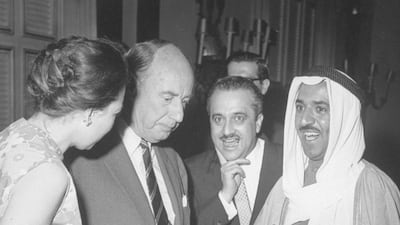
US Ambassador to UN Adlai Stevenson with Talat Ghoussein, Charge d'Affaires of Kuwait Embassy and then Kuwaiti foreign minister Sheikh Sabah, at Kuwaiti reception at UN. Getty Images -

Sheikh Sabah, Kuwait's foreign minister between 1963 and 2003, and Khalid Jaffar, Kuwait's ambassador to London, with Sir Neville Bland Of the UK Foreign Office in 1964. Rex Features -

US president Richard Nixon and Henry Kissinger, secretary of state, meet Arab foreign ministers Abdelaziz Bouteflika of Algeria, Sheikh Sabah of Kuwait and Omar Saqqaf of Saudi Arabia on October 17, 1973 at the Oval Office in Washington, United States. AFP -

French president Jacques Chirac shakes hands with Sheikh Sabah at the Elysee Palace in Paris on September 7, 1998. AFP -
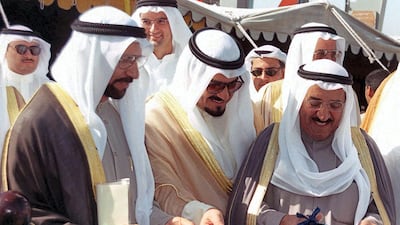
Kuwait's foreign minister Sheikh Sabah, commerce minister Abdel Wahab Al Wazzan and finance and communications minister Sheikh Ahmad open the Gulf state's free trade zone in November 1999. AFP -

Sheikh Sabah kisses a Palestinian boy at a hospital in October 2000. Sheikh Sabah visited five Palestinians who had arrived in Kuwait for medical care. AFP -
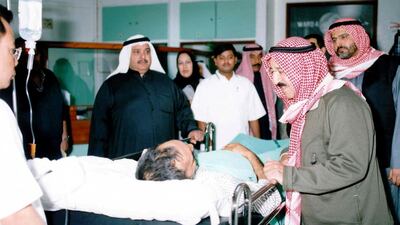
Kuwaiti's first deputy premier, foreign minister and chairman of the Supreme Petroleum Council Sheikh Sabah visits injured oil workers following a blast at the Al Rawdhatain oilfield north of Kuwait, near the border with Iraq. Four people were killed and 19 others injured. AFP -

Lebanese prime minister Rafiq Hariri talks to Kuwait's deputy premier and foreign minister Sheikh Sabah during the opening session of the Arab leader's summit in Sharm El Sheikh in March 2003. AFP -
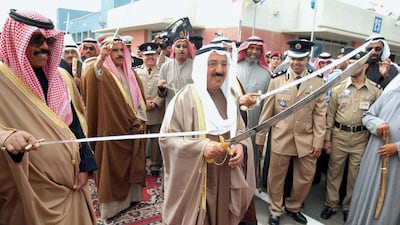
Kuwaiti prime minister Sheikh Sabah performs a Kuwaiti traditional dance during the inauguration of a naval base in Kuwait in 2004. AFP -
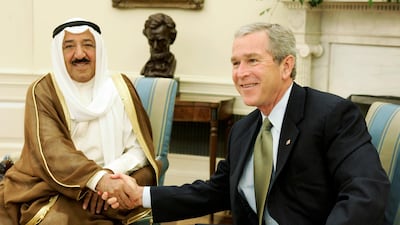
US president George W Bush shakes hands with Kuwait's prime minister Sheikh Sabah in the Oval Office of the White House in July 2005. Reuters -

Sheikh Sabah welcomes Sultan Qaboos of Oman to Kuwait City in June 2005 at the start of a three-day official visit. AFP -
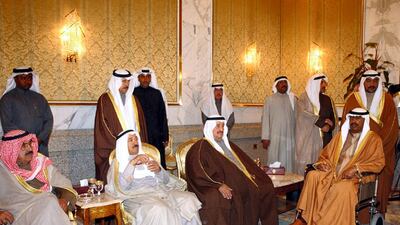
Sheikh Saad, Sheikh Salem, chief of Kuwait's national guard, and prime minister Sheikh Sabah receive condolences on the death of Kuwait's Emir Sheikh Jaber at the Al Bayan Palace on January 17, 2006 in Kuwait City. AFP -
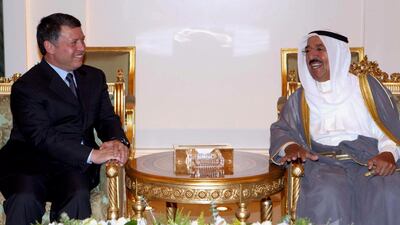
Sheikh Sabah meets Jordan's King Abdullah in September 2008. Reuters -
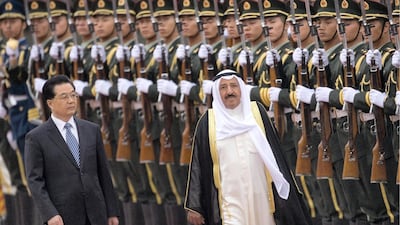
Chinese President Hu Jintao walks with Kuwait's Emir Sheikh Sabah during a welcoming ceremony held at the Great Wall of the People in Beijing, China in May 2009. EPA -
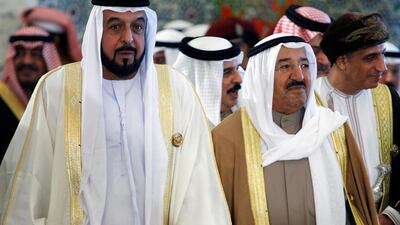
Sheikh Sabah arrives with UAE President, Sheikh Khalifa at the final session of the Gulf Cooperation Council (GCC) summit in Kuwait City on December 15, 2009. AFP -

President Sheikh Khalifa with Sheikh Sabah at the GCC Summit in the UAE in December 2010. EPA -
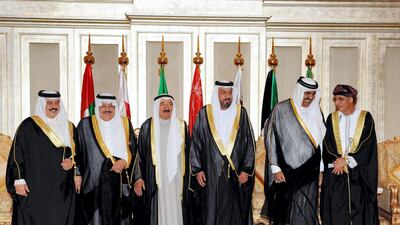
Sheikh Sabah at the December 2010 GCC Summit. EPA -
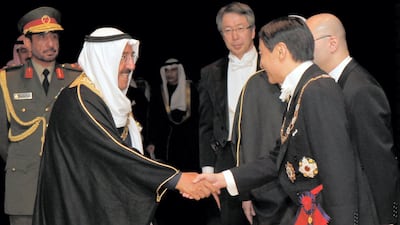
Sheikh Sabah is welcomed by Crown Prince Naruhito prior to their official dinner at the Imperial Palace in Tokyo in 2012. Reuters -

Sheikh Sabah chats with Queen Elizabeth II as he arrives at Windsor Castle during a three-day state visit on November 27, 2012. Getty Images -
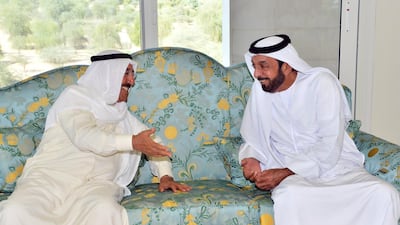
Sheikh Khalifa meets Sheikh Sabah in Al Ain on October 3, 2012. AFP -
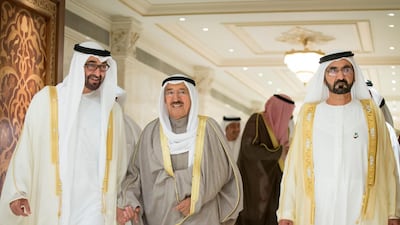
Sheikh Sabah with Sheikh Mohammed bin Rashid and Sheikh Mohamed bin Zayed in 2014. Ryan Carter / Crown Prince Court - Abu Dhabi -

Sheikh Mohammed bin Rashid receives Sheikh Sabah at the Presidential Airport. Seen with Sheikh Mohamed bin Zayed and Sheikh Sabah Al Khalid of Kuwait, November 07, 2014. Mohamed Al Hammadi / Crown Prince Court -
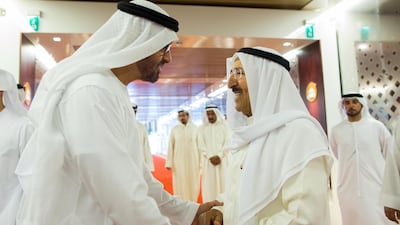
Sheikh Mohamed bin Zayed with Sheikh Sabah at Abu Dhabi's Presidential Airport in October 2014. Mohamed Al Hammadi / Crown Prince Court - Abu Dhabi -
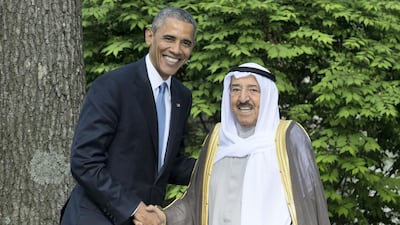
US president Barack Obama shakes hands with Sheikh Sabah at Camp David in May 2015. EPA -

Sheikh Mohamed bin Zayed and Sheikh Mohammed bin Rashid meet with Sheikh Sabah at Zabeel Palace, June 7, 2017. Rashed Al Mansoori / Crown Prince Court -
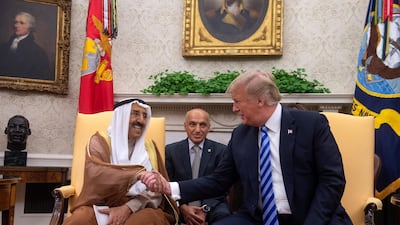
US President Donald Trump shakes hands with the Emir of Kuwait Sheikh Sabah al-Ahmad al-Jaber al-Sabah in the Oval Office at the White House in Washington, DC, on September 5, 2018. AFP -
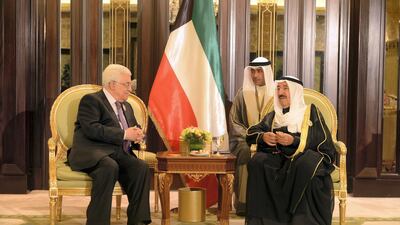
Sheikh Sabah meets Palestinian president Mahmoud Abbas during the 2013 Arab-African Summit in Kuwait. Getty Images -
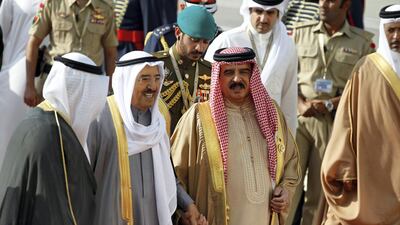
Sheikh Sabah is received by Bahrain's King Hamad upon his arrival in Bahrain for the GCC summit in December 2016. Reuters -
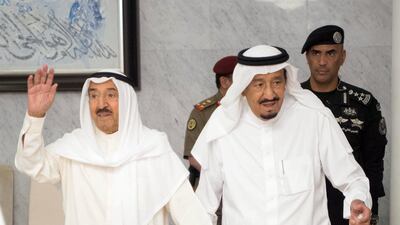
Sheikh Sabah and Saudi Arabia's King Salman in Jeddah on June 6, 2017. Reuters -
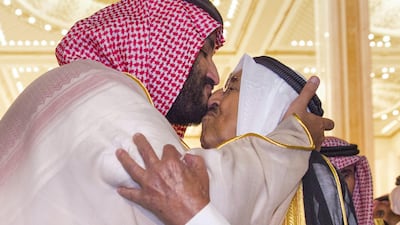
Kuwaiti Emir Sheikh Sabah greets the Saudi Crown Prince Mohammed bin Salman in Kuwait in September 2018. Reuters -
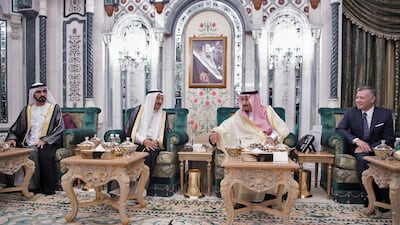
King Abdullah II of Jordan attending a meeting in Mecca with King Salman of Saudi Arabia, Emir Sheikh Sabah of Kuwait and Sheikh Mohammed bin Rashid, Vice President of the UAE. AFP -
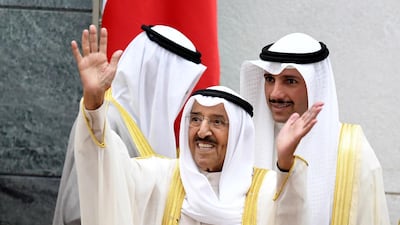
Sheikh Sabah at the Kuwait National Assembly in October 2019. EPA


"We have also been blessed with the spirit of democracy, which has allowed us to protect the rights and dignity of all Kuwaitis – something our society has struggled for since its inception," he wrote in an Oxford Business Group report published in 2012.
"Kuwait has a great potential for growth, advancement and prosperity.
"After half a century of independence and two decades of liberation, Kuwait is entering a phase full of new trials and obligations.
"Henceforth, Kuwait must adhere to sound planning and devote its time and abilities towards fulfilling obligations and prioritising national interests."
In 2014, Sheikh Sabah visited Tehran for his only visit to the Iran as emir.
The country maintained official ties even after many states cut their formal relations.
But the relationship, centred on trade and mutually beneficial economic development, was not always easy.
Kuwait expelled the Iranian ambassador in 2017 after 23 Kuwaiti men were convicted of spying for Hezbollah.
Sheikh Sabah was a patient political leader who relentlessly pursued stability.
As tensions flared anew in recent years, he strived to stop the region repeating the errors of the past.
While Kuwait has lost a leader, the Middle East has lost one of its most respected diplomats.

