Sheikh Sabah Al Ahmad Al Sabah, Emir of Kuwait, has died aged 91.
“With great sadness and sorrow, we mourn the death of the late Sheikh Sabah, Emir of the State of Kuwait,” the state news agency Kuna reported.
After a meeting, Kuwait’s Cabinet said that crown prince Sheikh Nawaf Al Ahmad Al Sabah has become Emir.
The Cabinet announcement was read on state television. Under the Kuwaiti constitution, the crown prince automatically assumes power after taking an oath in Parliament.

Ministers also announced 40 days of mourning and ordered all official departments to close for three days from Tuesday.
Sheikh Sabah was admitted to hospital in the US in July after surgery for an unspecified condition in Kuwait.
He ruled Kuwait, an Opec oil producer and ally of the US, since 2006 and had steered its foreign policy for more than 50 years.
-
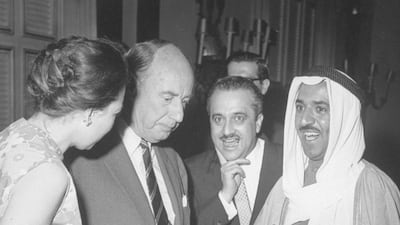
US Ambassador to UN Adlai Stevenson with Talat Ghoussein, Charge d'Affaires of Kuwait Embassy and then Kuwaiti foreign minister Sheikh Sabah, at Kuwaiti reception at UN. Getty Images -

Sheikh Sabah, Kuwait's foreign minister between 1963 and 2003, and Khalid Jaffar, Kuwait's ambassador to London, with Sir Neville Bland Of the UK Foreign Office in 1964. Rex Features -

US president Richard Nixon and Henry Kissinger, secretary of state, meet Arab foreign ministers Abdelaziz Bouteflika of Algeria, Sheikh Sabah of Kuwait and Omar Saqqaf of Saudi Arabia on October 17, 1973 at the Oval Office in Washington, United States. AFP -

French president Jacques Chirac shakes hands with Sheikh Sabah at the Elysee Palace in Paris on September 7, 1998. AFP -
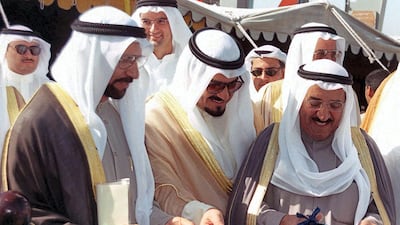
Kuwait's foreign minister Sheikh Sabah, commerce minister Abdel Wahab Al Wazzan and finance and communications minister Sheikh Ahmad open the Gulf state's free trade zone in November 1999. AFP -

Sheikh Sabah kisses a Palestinian boy at a hospital in October 2000. Sheikh Sabah visited five Palestinians who had arrived in Kuwait for medical care. AFP -
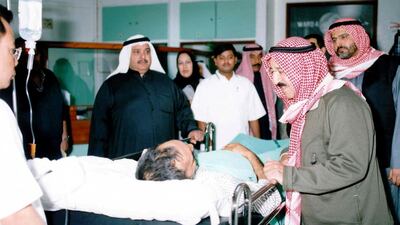
Kuwaiti's first deputy premier, foreign minister and chairman of the Supreme Petroleum Council Sheikh Sabah visits injured oil workers following a blast at the Al Rawdhatain oilfield north of Kuwait, near the border with Iraq. Four people were killed and 19 others injured. AFP -

Lebanese prime minister Rafiq Hariri talks to Kuwait's deputy premier and foreign minister Sheikh Sabah during the opening session of the Arab leader's summit in Sharm El Sheikh in March 2003. AFP -
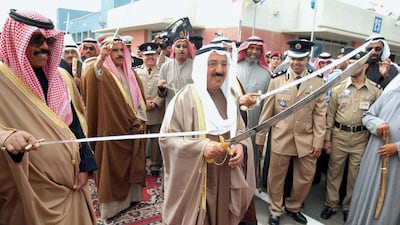
Kuwaiti prime minister Sheikh Sabah performs a Kuwaiti traditional dance during the inauguration of a naval base in Kuwait in 2004. AFP -
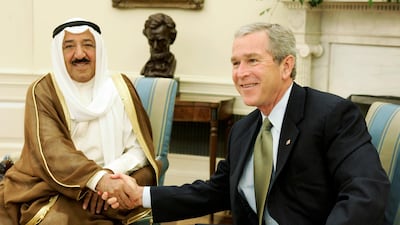
US president George W Bush shakes hands with Kuwait's prime minister Sheikh Sabah in the Oval Office of the White House in July 2005. Reuters -

Sheikh Sabah welcomes Sultan Qaboos of Oman to Kuwait City in June 2005 at the start of a three-day official visit. AFP -
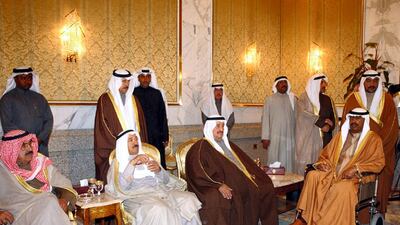
Sheikh Saad, Sheikh Salem, chief of Kuwait's national guard, and prime minister Sheikh Sabah receive condolences on the death of Kuwait's Emir Sheikh Jaber at the Al Bayan Palace on January 17, 2006 in Kuwait City. AFP -
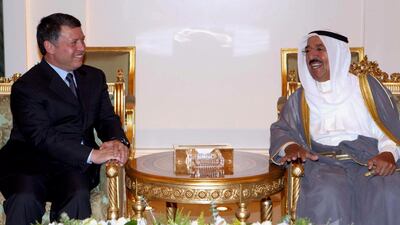
Sheikh Sabah meets Jordan's King Abdullah in September 2008. Reuters -
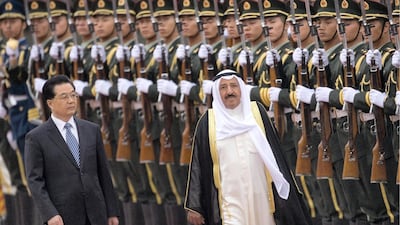
Chinese President Hu Jintao walks with Kuwait's Emir Sheikh Sabah during a welcoming ceremony held at the Great Wall of the People in Beijing, China in May 2009. EPA -
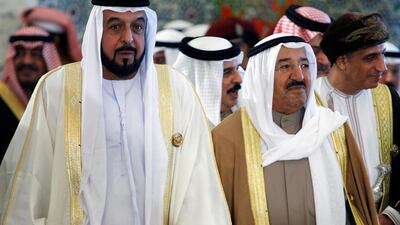
Sheikh Sabah arrives with UAE President, Sheikh Khalifa at the final session of the Gulf Cooperation Council (GCC) summit in Kuwait City on December 15, 2009. AFP -

President Sheikh Khalifa with Sheikh Sabah at the GCC Summit in the UAE in December 2010. EPA -
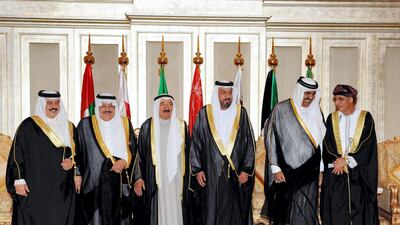
Sheikh Sabah at the December 2010 GCC Summit. EPA -
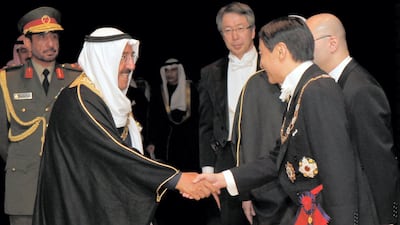
Sheikh Sabah is welcomed by Crown Prince Naruhito prior to their official dinner at the Imperial Palace in Tokyo in 2012. Reuters -

Sheikh Sabah chats with Queen Elizabeth II as he arrives at Windsor Castle during a three-day state visit on November 27, 2012. Getty Images -
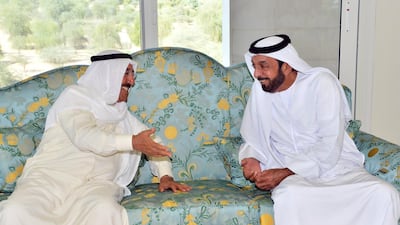
Sheikh Khalifa meets Sheikh Sabah in Al Ain on October 3, 2012. AFP -
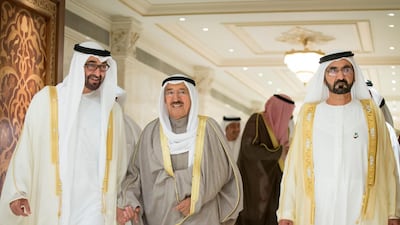
Sheikh Sabah with Sheikh Mohammed bin Rashid and Sheikh Mohamed bin Zayed in 2014. Ryan Carter / Crown Prince Court - Abu Dhabi -

Sheikh Mohammed bin Rashid receives Sheikh Sabah at the Presidential Airport. Seen with Sheikh Mohamed bin Zayed and Sheikh Sabah Al Khalid of Kuwait, November 07, 2014. Mohamed Al Hammadi / Crown Prince Court -
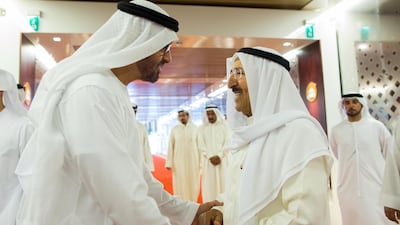
Sheikh Mohamed bin Zayed with Sheikh Sabah at Abu Dhabi's Presidential Airport in October 2014. Mohamed Al Hammadi / Crown Prince Court - Abu Dhabi -
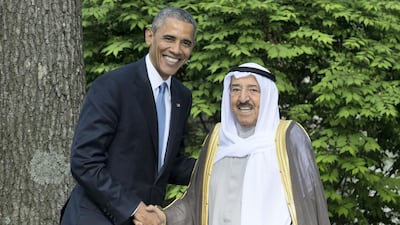
US president Barack Obama shakes hands with Sheikh Sabah at Camp David in May 2015. EPA -

Sheikh Mohamed bin Zayed and Sheikh Mohammed bin Rashid meet with Sheikh Sabah at Zabeel Palace, June 7, 2017. Rashed Al Mansoori / Crown Prince Court -
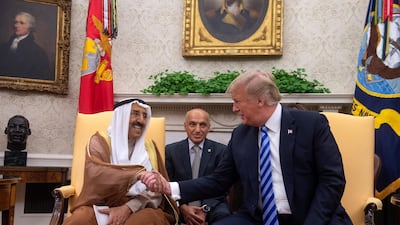
US President Donald Trump shakes hands with the Emir of Kuwait Sheikh Sabah al-Ahmad al-Jaber al-Sabah in the Oval Office at the White House in Washington, DC, on September 5, 2018. AFP -
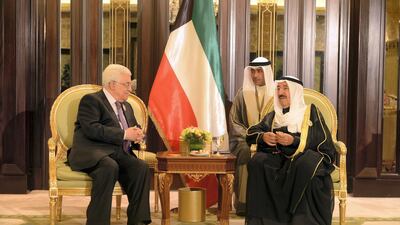
Sheikh Sabah meets Palestinian president Mahmoud Abbas during the 2013 Arab-African Summit in Kuwait. Getty Images -
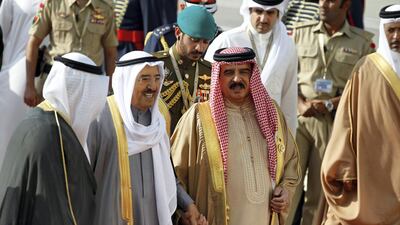
Sheikh Sabah is received by Bahrain's King Hamad upon his arrival in Bahrain for the GCC summit in December 2016. Reuters -
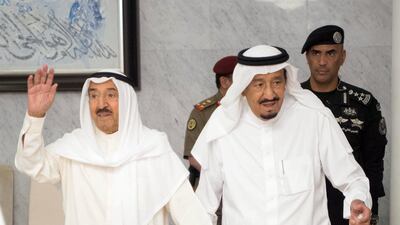
Sheikh Sabah and Saudi Arabia's King Salman in Jeddah on June 6, 2017. Reuters -
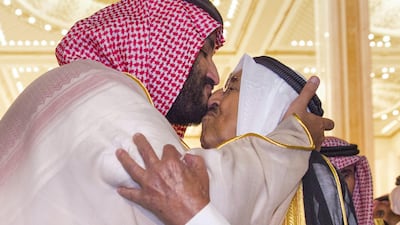
Kuwaiti Emir Sheikh Sabah greets the Saudi Crown Prince Mohammed bin Salman in Kuwait in September 2018. Reuters -
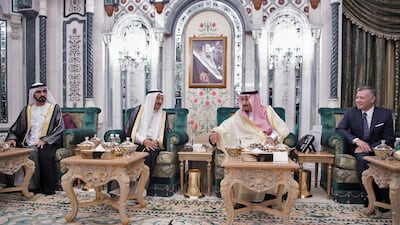
King Abdullah II of Jordan attending a meeting in Mecca with King Salman of Saudi Arabia, Emir Sheikh Sabah of Kuwait and Sheikh Mohammed bin Rashid, Vice President of the UAE. AFP -
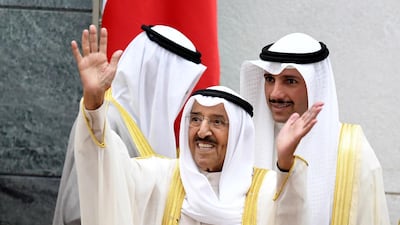
Sheikh Sabah at the Kuwait National Assembly in October 2019. EPA


The Kuwaiti Parliament on Tuesday morning adjourned its debate and senior officials, including Prime Minister Sheikh Sabah Al Khalid Al Sabah and Speaker Marzouq Al Ghanim, met Sheikh Nawaf at the palace.
In the UAE, President Sheikh Khalifa said he mourned Sheikh Sabah with great sadness.
Sheikh Mohammed bin Rashid, Vice President and Ruler of Dubai, said Sheikh Sabah was a compassionate ruler and the heart of the Arabian Gulf.
“May God have mercy on the compassionate father of Kuwait. We belong to Allah and to Him we shall return,” Sheikh Mohammed said.
Sheikh Mohamed bin Zayed, Crown Prince of Abu Dhabi and Deputy Supreme Commander of the Armed Forces, also paid tribute.
"Sheikh Sabah epitomised wisdom, tolerance and peace, and he was a great pioneer of Gulf co-operation," Sheikh Mohamed said.
"He served Kuwait with honour and grace, and his work will never be forgotten. May God have mercy on him."
Saudi Arabia’s King Salman and Crown Prince Mohammed bin Salman expressed their sorrow.
The king said Sheikh Sabah's life was "a journey full of achievement and giving and a great service to his country.
US Secretary of State Mike Pompeo expressed his condolences.
Mr Pompeo said Sheikh Sabah's "vision shaped Kuwait into the prosperous and modern state it is today, and his global leadership resulted in lasting and positive change in Kuwait and the entire Middle East region".
He said the late emir was "a revered leader and a friend to all nations".
"We especially appreciated his efforts to facilitate Gulf unity and his humanitarianism," Mr Pompeo said.
"We honour his legacy and remain committed to our strong partnership and friendship with Kuwait."
Egypt on Tuesday announced three days of mourning to mark the Kuwaiti leader’s death.
“He was a wise leader who devoted his life to the service of his people, country and the entire humanity,” the office of Egyptian President Abdel Fattah El Sisi said.
Kuwait has traditionally been among Egypt’s main Arab backers, handing successive Cairo governments billions of dollars in economic assistance.
Egypt was a member of the US-led coalition that liberated Kuwait from Iraqi occupation in 1991.
About a million Egyptians work in Kuwait and make a significant contribution to remittances home every year.
Jordan’s King Abdullah II said: “Today, we lost a great brother and a wise leader who loves Jordan.”
King Abdullah called Sheikh Sabah an “exceptional leader and an emir of humanity and morals who dedicated his life to the service of his country and his nation, and did not hesitate in his benevolent endeavours to unite the Arab peoples".
Lebanon’s President Michel Aoun described the late emir as an “example of chivalry, moderation and wisdom".
“He stood with the Lebanese in the difficult circumstances they went through and rebuilt many Lebanese cities and villages, and launched many development and construction projects," Mr Aoun said. "His absence will be a great loss.”
The US embassy in Kuwait wrote of Sheikh Sabah's achievements in diplomacy.
"We extend our deepest condolences to the esteemed Al Sabah family and to the government and people of the state of Kuwait on the death of His Highness," the embassy Twitter account said.
"We can not fail to mention the achievements of His Highness, the late emir, who devoted his life to bringing peace and stability to the region."
European leaders and officials have also offered their condolences.
British Prime Minister Boris Johnson said he was saddened to hear of Sheikh Sabah's death and praised his work to maintain regional stability.
“I sincerely hope the long and deep ties that unite our countries will continue, and through our co-operation and friendship we can contribute to peace, prosperity and justice in the world," Mr Johnson said.
"We mourn with you a great leader of wisdom and humanity, and a true friend of the UK," tweeted Ambassador Michael Davenport.
Niels Annen, the German Minister for the Middle East, said Sheikh Sabah had built a legacy as a great statesman.
"Under his leadership Kuwait became an important donor," Mr Annen said. "May his legacy of humanitarianism inspire future generations."
Former British prime minister Tony Blair said Sheikh Sabah was "a man of profound compassion, humanity and dignity who all his life worked tirelessly for the best interests of his country and the region. He was deeply respected across the Middle East".
"He showed courage at the time of the invasion of Kuwait and wisdom in rebuilding his nation afterwards. His passing will be greatly mourned,” Mr Blair said.
Kenyan President Uhuru Kenyatta described the late emir as a true friend of Kenya and an astute global leader, who stood and worked tirelessly for peace in the Middle East.
"His Highness Sheikh Sabah was a global icon for peace, especially in the Middle East where he was involved in several peace processes covering a number of countries in the region," Mr Kenyatta wrote.
The Director General of the World Health Organisation, Dr Tedros Adhanom Ghebreyesus, expressed his sympathies with the people of Kuwait.
"It is a sad day! I am heartbroken to hear about the passing of Kuwait Emir Sheikh Sabah," Dr Tedros said.
He called Sheikh Sabah "a global humanitarian leader at a time when such leadership is most needed".
The UN special co-ordinator for Middle East peace, Nickolay Mladenov, said Sheikh Sabah's death marked the end of an era.
"He gave his life in the service of his nation," Mr Mladenov said. "A humanitarian giant committed to peace. His wisdom will be dearly missed in the Middle East."

