• Men wearing protective face masks stand as they work on raising the Kiswa, a silk cloth covering the Holy Kaaba, before the annual pilgrimage season, at the Grand Mosque in Mecca, Saudi Arabia. REUTERS
    Men wearing protective face masks stand as they work on raising the Kiswa, a silk cloth covering the Holy Kaaba, before the annual pilgrimage season, at the Grand Mosque in Mecca, Saudi Arabia. REUTERS
  • A security man checks the temperature of a worker as they work on raising the Kiswa, a silk cloth covering the Holy Kaaba, before the annual pilgrimage season, at the Grand Mosque in Mecca, Saudi Arabia. REUTERS
    A security man checks the temperature of a worker as they work on raising the Kiswa, a silk cloth covering the Holy Kaaba, before the annual pilgrimage season, at the Grand Mosque in Mecca, Saudi Arabia. REUTERS
  • Workers wearing protective face masks work on raising the Kiswa, a silk cloth covering the Holy Kaaba, before the annual pilgrimage season, at the Grand Mosque in Mecca, Saudi Arabia. REUTERS
    Workers wearing protective face masks work on raising the Kiswa, a silk cloth covering the Holy Kaaba, before the annual pilgrimage season, at the Grand Mosque in Mecca, Saudi Arabia. REUTERS
  • The President of the Haramain Sheikh Abdul Rehman Al Sudais inspects the King Abdulaziz Gate at the Grand Mosque. SPA
    The President of the Haramain Sheikh Abdul Rehman Al Sudais inspects the King Abdulaziz Gate at the Grand Mosque. SPA
  • Saudi officials and workers pose for a photo after inspections ahead of Hajj. SPA
    Saudi officials and workers pose for a photo after inspections ahead of Hajj. SPA
  • The King Abdulaziz Gate at the Grand Mosque in Makkah. SPA
    The King Abdulaziz Gate at the Grand Mosque in Makkah. SPA
  • The Minister of Hajj and Umrah inspects the equipment prepared for the service of pilgrims this year
    The Minister of Hajj and Umrah inspects the equipment prepared for the service of pilgrims this year
  • the Minister of Hajj and Umrah inspects the equipment prepared for the service of pilgrims this year
    the Minister of Hajj and Umrah inspects the equipment prepared for the service of pilgrims this year
  • The Minister of Hajj and Umrah inspects the equipment prepared for the service of pilgrims this year
    The Minister of Hajj and Umrah inspects the equipment prepared for the service of pilgrims this year
  • A few worshippers performing the fajr prayer at the Grand Mosque in Makkah. Saudi Arabia has announced it will hold a "very limited" Hajj this year. AFP
    A few worshippers performing the fajr prayer at the Grand Mosque in Makkah. Saudi Arabia has announced it will hold a "very limited" Hajj this year. AFP
  • Saudi Arabia's authorities said only a limited number of people, who are already in Saudi Arabia, will be able to perform the Hajj amid a spike of cases and deaths in the kingdom. AFP
    Saudi Arabia's authorities said only a limited number of people, who are already in Saudi Arabia, will be able to perform the Hajj amid a spike of cases and deaths in the kingdom. AFP
  • Arab countries have expressed their support for Saudi Arabia's decision to ban pilgrims from abroad attending the Hajj pilgrimage this year to stem the spread of the coronavirus pandemic. AFP
    Arab countries have expressed their support for Saudi Arabia's decision to ban pilgrims from abroad attending the Hajj pilgrimage this year to stem the spread of the coronavirus pandemic. AFP
  • Arafat mountain in Saudi Arabia's holy city of Makkah. Egypt, home of Al Azhar, one of the Muslim world’s main centres of learning, quickly came out in support of the decision. AFP
    Arafat mountain in Saudi Arabia's holy city of Makkah. Egypt, home of Al Azhar, one of the Muslim world’s main centres of learning, quickly came out in support of the decision. AFP
  • Egyptan Religious Affairs Minister Mukhtar Jumah described the downsizing as “practical” and “conforming with jurisprudence regarding the pandemic”. AFP
    Egyptan Religious Affairs Minister Mukhtar Jumah described the downsizing as “practical” and “conforming with jurisprudence regarding the pandemic”. AFP
  • Hundreds of thousands usually perform Hajj every year. AFP
    Hundreds of thousands usually perform Hajj every year. AFP
  • Bahraini Justice and Islamic Affairs Minister Khaled Bin Khalifa said the ban “conforms with the core values of Islam” and that Bahrain appreciates what he described as Saudi Arabia’s quest to save lives. AFP
    Bahraini Justice and Islamic Affairs Minister Khaled Bin Khalifa said the ban “conforms with the core values of Islam” and that Bahrain appreciates what he described as Saudi Arabia’s quest to save lives. AFP
  • The Emirates Hajj Affairs Office said Saudi Arabia's move “preserves the health of the people and their lives, which is one of the main purposes of our honoured religion”. AFP
    The Emirates Hajj Affairs Office said Saudi Arabia's move “preserves the health of the people and their lives, which is one of the main purposes of our honoured religion”. AFP
  • Part of the Grand Mosque complex in Saudi Arabia's holy city of Makkah. AFP
    Part of the Grand Mosque complex in Saudi Arabia's holy city of Makkah. AFP

Coronavirus: Arab countries back Saudi Arabia's Hajj downsizing


  • English
  • Arabic

Arab countries and health experts have expressed support for Saudi Arabia’s decision to bar people from travelling to the kingdom for the Hajj pilgrimage this year.

On Monday, Saudi authorities said the pilgrimage, which usually draws about 2.5 million people to Makkah, would only be open to pilgrims who are already in the kingdom.

Yesterday, Saudi Minister of Hajj and Umrah Muhammad Saleh Benten said the decision could mean there are only about 1,000 pilgrims taking part this year.

It is the latest measure to stop the spread of coronavirus in Saudi Arabia.

Nezar Bahabri, a Saudi infectious diseases consultant, said if Hajj were to be performed as usual this year, it would be difficult to control the spread of coronavirus.

"In such crowded gatherings, social distancing between pilgrims is very difficult to control while performing rituals," he told The National.

"We respect Saudi Arabia's decision to hold this year’s Hajj for only a limited number within the country. The kingdom made the prompt decision as precautionary measures to prevent the coronavirus or Covid-19 from spreading among pilgrims.”

Dr Bahabri said it was not unusual for pilgrims to contract illnesses such as respiratory infections from bacteria or viruses, which increased the risk that Covid-19 could spread easily if the number of people attending the Hajj pilgrimage was not limited.

Sami Angawi, an expert on Islamic architecture in Makkah and Madinah, praised the decision.

“The world is going through difficult times because of coronavirus. We want to protect the people. And in Islam, God is forgiving and merciful, so, if we're not able to go for Hajj, then it's not going to be a burden on anybody. We firmly believe that God does not place a burden on us more than what we can bear,” he said.

We want to protect the people. And in Islam, God is forgiving and merciful, so, if we're not able to go for Hajj, then it's not going to be a burden on anybody

Ammani Saad, head of government relations at International Hajj and Umrah establishment in Jeddah, said keeping pilgrims to those living in Saudi Arabia was a good decision under the circumstances.

“It is a wise decision, keeping in mind the safety of pilgrims and public health as a priority.”

This month, Malaysia, Singapore, Brunei and Indonesia barred their citizens from travelling to Saudi Arabia for the pilgrimage, citing fears of the coronavirus. In France, faith leaders have urged Muslims to reschedule their pilgrimage plans for next year.

“We worked with the Ministry of Health in Saudi Arabia to develop preventive and precautionary measures and protocols that are needed to ensure a safe Hajj season,” Dr Benten said.

As part of those precautions, pilgrims will be tested for infection before reaching the holy sites and people older than 65 will also be barred from taking part.

The UAE Egypt were among the countries that came out in support of the decision.

Egyptian Religious Affairs Minister Mukhtar Juma described the downsizing as practical and “conforming with jurisprudence regarding the pandemic”.

The Emirates' Hajj Affairs Office said Saudi Arabia's move “preserves the health of the people and their lives, which is one of the main purposes of our honoured religion”.

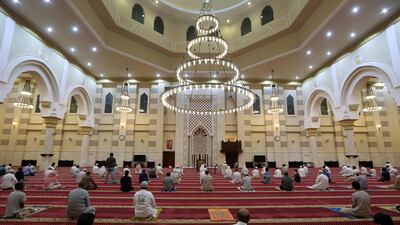
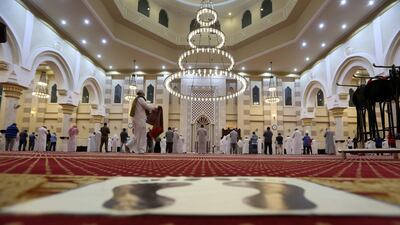
  • Worshippers perform the dawn prayer at a mosque in Makkah, Saudi Arabia, after authorities eased lockdown measures that had been imposed in a bid to stem the spread of coronavirus. AFP
    Worshippers perform the dawn prayer at a mosque in Makkah, Saudi Arabia, after authorities eased lockdown measures that had been imposed in a bid to stem the spread of coronavirus. AFP
  • Worshippers gather for the dawn prayer at a mosque in the Saudi city of Makkah. AFP
    Worshippers gather for the dawn prayer at a mosque in the Saudi city of Makkah. AFP
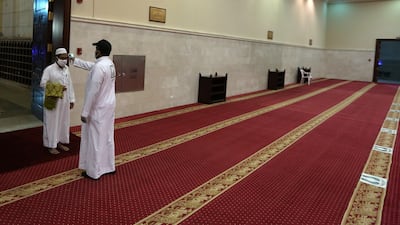
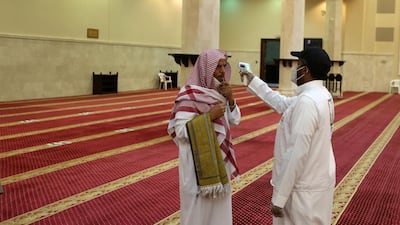
  • A volunteer checks the temperature of a man as he arrives to perform the dawn prayer at a mosque in the Saudi city of Makkah. AFP
    A volunteer checks the temperature of a man as he arrives to perform the dawn prayer at a mosque in the Saudi city of Makkah. AFP
  • A volunteer checks the temperature of a man as he arrives to perform the dawn prayer at a mosque in Makkah. AFP
    A volunteer checks the temperature of a man as he arrives to perform the dawn prayer at a mosque in Makkah. AFP

Bahraini Justice and Islamic Affairs and Endowments Minister Sheikh Khalid bin Khalifa said the decision “conforms with the core values of Islam” and that Bahrain appreciates what he described as Saudi Arabia’s quest to save lives.

The Saudi health ministry on Tuesday confirmed an additional 39 coronavirus deaths and 3,139 infections.

The death toll now stands at 1,346, with 164,144 infections.