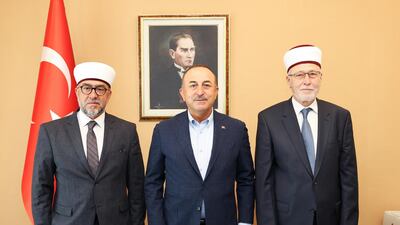

Turkey’s Foreign Minister Mevlut Cavusoglu angered Greece after he described the Muslim minority in the Greek region of Thrace as “Turkish”.
Mr Cavusoglu made the comment on arrival in Alexandroupolis, near the Turkish border, as he began a two-day visit.
"In Greece to meet members of Turkish minority in western Thrace and discuss our bilateral relations," he wrote on Twitter.
Mr Cavusoglu then used the phrase “Turkish minority” five times in a series of tweets detailing his talks with representatives of the Muslim community and a visit to a school.
“Emphasised that we will always stand resolutely with the Turkish minority in their struggle for their rights and underlined once again our strong support,” he said after meeting Western Thrace Turkish Minority Advisory Board members.
Ankara has often accused Greece of failing to sufficiently look after the Muslim minority in Thrace, many of whom are of Turkish descent.
Mr Cavusoglu's comments resulted in a swift rebuke from Athens, which said the minority is made of multi-ethnic Muslims.
"The Muslim minority in Thrace has about 120,000 Greek inhabitants," Greek Foreign Ministry spokesman Alexandros Papaioannou said.
"Turkey's constant attempts to distort this reality, as well as the allegations of non-protection of the rights of these citizens, or of discrimination, are unfounded and are rejected in their entirety.
"Greece would like to improve relations with Turkey, but with the respect for international law as a prerequisite."
Under the 1923 Treaty of Lausanne, Muslims in Thrace were given minority status and protection.
Mr Cavusoglu is scheduled to meet Greece’s Prime Minister Kyriakos Mitsotakis and Foreign Minister Nikos Dendias on Monday.
The Greek government said Mr Cavusoglu’s visit to Thrace was a private affair.
"The visit in Thrace is a private visit. Greece is an open, democratic country that does not forbid private visits. As far as the [Thrace] minority is concerned, it is enjoying a status of equality," spokeswoman Aristotelia Peloni said on Thursday.
At a press conference in April, Mr Cavusolgu raised the minority issue with Mr Dendias.
"You don't allow the Turkish minority to call themselves Turkish. You call them Muslims," he said.
"If they call themselves Turkish, they are Turkish – you have to recognise this."
The status of Muslims in Thrace is one of a series of diplomatic clashes between Greece and Turkey, although there are hints that relations may be improving.
They are engaged in a separate dispute over maritime rights in the eastern Mediterranean.

