Staff carry out a lateral flow Covid-19 tests on colleagues in a temporary testing facility in Brighton, England. Getty Images

Threat of Covid-19 mutations enters danger zone


Thomas Harding
  • English
  • Arabic

The pandemic is at its "most dangerous moment" with the threat of Covid-19 mutating into a variant resistant to current vaccines, a leading scientist said.

The Covid-19 strain could evolve if it learns how to survive the mass vaccination programmes being introduced around the world, Prof Graeme Ackland of Edinburgh University told The National.

In particular, with a high number of people vaccinated and a large number of people infected, Britain is currently the "most risky" country for a new mutation, he said, and that it could get "very nasty, very quickly".

India reported a new double mutation of the virus on Wednesday and the British government announced on Monday that it was urgently developing a new mutant testing technique.

The respected British Medical Journal on Tuesday published a report that debunks some scientific thinking suggesting Covid-19 mutates more slowly than other viruses.

Latest Public Health England data show there are 10 strains now circulating in the UK.

While it now appears to be a race to get the world vaccinated before a deadly and infectious Covid mutation, many western countries are struggling with their programmes, with significant issues in the European Union.

"The big uncertainty at the moment is whether we get a vaccine-resistant mutant," Prof Ackland said. "The coronavirus variants that came out last year had no reason to mutate to become resistant to the vaccine because there was no vaccine.

"Now, because a large fraction of the population is vaccinated, there’s a huge evolutionary advantage for a mutation that’s immune to the vaccine. It could get very nasty, very quickly if that happens.”

The best strategy now is to infect vaccinated people. That's where the evolutionary pressure is on the virus

The physician and computer modelling specialist – who helped lead Rapid Assistance in Modelling the Pandemic, a group of experts in Britain – said the infectious UK variant B1117 was successful in a wave of infections because no one was vaccinated.

“Now there's a big pressure on the virus,” he said. “If you think from the viewpoint of coronavirus, what do you want to do to infect people? The best strategy now is to infect vaccinated people. That's where the evolutionary pressure is on the virus.”

Scientists at Imperial College London, who helped to identify the virulent UK variant, are now developing the ability to respond rapidly if vaccine-resistant strains emerge.

Britain has 468,000 active Covid-19 cases and more than 28 million inoculated with a first vaccine dose, making it vulnerable to a mutant strain.

“We’re entering the most dangerous time at the moment, where there are still lots of cases in the UK and lots of vaccinations. The UK is probably the most risky place for that happening.”

Scientists know that it is challenging to vaccinate at the height of a pandemic because of the mutation risk, he said, “but what else can you do?”

There is also a fear that if a new strain does not evolve in Britain then it could do so in Europe, which is several weeks behind the UK in its vaccination programme. “If coronavirus randomly evolves to find a way around the vaccine then it will spread very fast,” he said.

The BMJ report supports Prof Ackland's thinking, stating that genome sequencing shows that coronavirus mutates at the same rate as Ebola.

“Coronaviruses throw up variants all the time,” the report said: “Some countries will be slower than others to vaccinate their populations. Sars-CoV-2 [Covid-19] and its variants will be around for some time, and concerns around the protection afforded by current vaccines will continue.”

The report, Covid-19: variants and vaccination, suggests that vaccines will be needed "for many years" and will have to change as variants emerge, similar to influenza vaccines.

The British government is urgently developing new technology to rapidly detect new Covid mutations. The method, known as “genotype assay testing”, will halve the time it currently takes to identify a variant of concern.

After the report of a double mutation in India, virologist Shahid Jameel told the BBC that the variant may increase risks and "allow the virus to escape the immune system and make it more infectious".

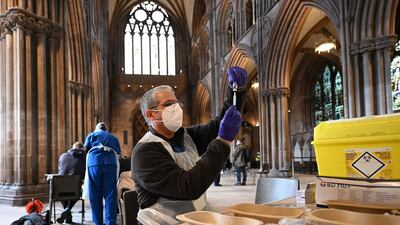
  • Dr Andy Wakeman prepares a dose of the Oxford/AstraZeneca vaccine as members of the public wait to receive a dose at Lichfield cathedral. AFP
    Dr Andy Wakeman prepares a dose of the Oxford/AstraZeneca vaccine as members of the public wait to receive a dose at Lichfield cathedral. AFP
  • Patients are greeted by Abbey staff outside a vaccination centre at Westminster Abbey in London. Reuters
    Patients are greeted by Abbey staff outside a vaccination centre at Westminster Abbey in London. Reuters
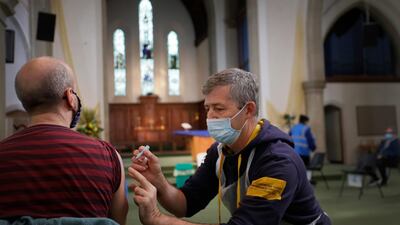
  • Nick Gray, a St Johns Ambulance vaccinator gives the AstraZeneca vaccine at St John's Church, in Ealing, London. AP Photo
    Nick Gray, a St Johns Ambulance vaccinator gives the AstraZeneca vaccine at St John's Church, in Ealing, London. AP Photo
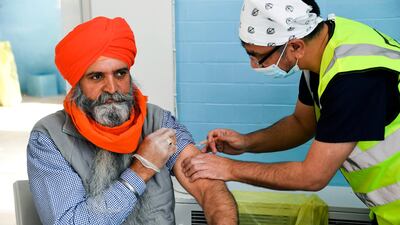
  • Dr Manraj Barhey administers a dose of AstraZeneca vaccine to Baltjit Singh, at the Guru Nanak Gurdwara Sikh temple in Luton. AP Photo
    Dr Manraj Barhey administers a dose of AstraZeneca vaccine to Baltjit Singh, at the Guru Nanak Gurdwara Sikh temple in Luton. AP Photo
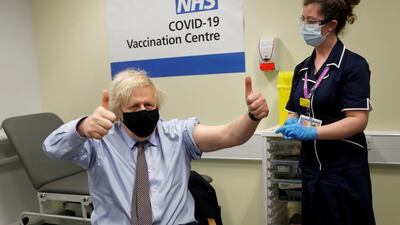
  • British Prime Minister Boris Johnson reacts after receiving a dose of the AstraZeneca vaccine in London. Reuters
    British Prime Minister Boris Johnson reacts after receiving a dose of the AstraZeneca vaccine in London. Reuters
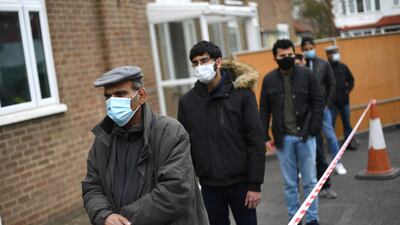
  • Members of the public form a queue at a coronavirus vaccination centre at the Fazl Mosque in southwest London. AFP
    Members of the public form a queue at a coronavirus vaccination centre at the Fazl Mosque in southwest London. AFP
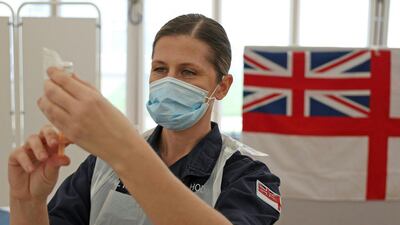
  • Royal Navy medics prepare syringes at a vaccination centre set up at Bath racecourse. AFP
    Royal Navy medics prepare syringes at a vaccination centre set up at Bath racecourse. AFP
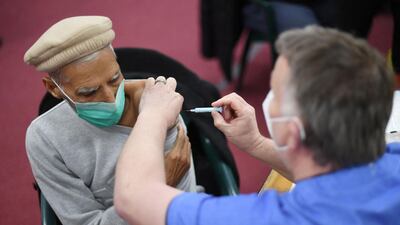
  • A health worker administers a dose of the AstraZeneca vaccine at a coronavirus vaccination centre at the Fazl Mosque in southwest London. AFP
    A health worker administers a dose of the AstraZeneca vaccine at a coronavirus vaccination centre at the Fazl Mosque in southwest London. AFP
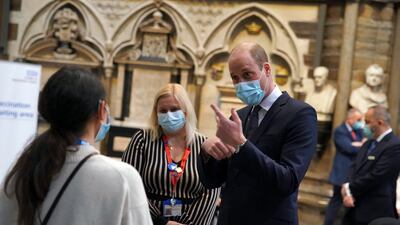
  • Prince William speaks to staff during a visit to the vaccination center at Westminster Abbey. AP Photo
    Prince William speaks to staff during a visit to the vaccination center at Westminster Abbey. AP Photo
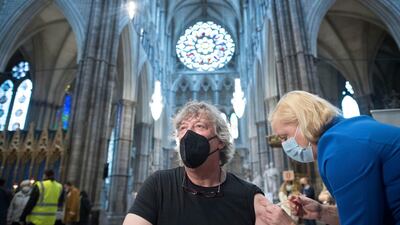
  • Actor Stephen Fry receives the vaccine at Poets' Corner in Westminster Abbey. AP Photo
    Actor Stephen Fry receives the vaccine at Poets' Corner in Westminster Abbey. AP Photo
About Proto21

Date started: May 2018
Founder: Pir Arkam
Based: Dubai
Sector: Additive manufacturing (aka, 3D printing)
Staff: 18
Funding: Invested, supported and partnered by Joseph Group

F1 The Movie

Starring: Brad Pitt, Damson Idris, Kerry Condon, Javier Bardem

Director: Joseph Kosinski

Rating: 4/5

SPEC%20SHEET%3A%20APPLE%20IPAD%20PRO%20(12.9%22%2C%202022)
%3Cp%3E%3Cstrong%3EDisplay%3A%3C%2Fstrong%3E%2012.9-inch%20Liquid%20Retina%20XDR%2C%202%2C732%20x%202%2C048%2C%20264ppi%2C%20wide%20colour%2C%20True%20Tone%2C%20ProMotion%2C%201%2C600%20nits%20max%2C%20Apple%20Pencil%20hover%3C%2Fp%3E%0A%3Cp%3E%3Cstrong%3EChip%3A%3C%2Fstrong%3E%20Apple%20M2%2C%208-core%20CPU%2C%2010-core%20GPU%2C%2016-core%20Neural%20Engine%3C%2Fp%3E%0A%3Cp%3E%3Cstrong%3EMemory%3A%3C%2Fstrong%3E%20Storage%20%E2%80%93%20128GB%2F256GB%2F512GB%20%2F%201TB%2F2TB%3B%20RAM%20%E2%80%93%208GB%2F16GB%3C%2Fp%3E%0A%3Cp%3E%3Cstrong%3EPlatform%3A%3C%2Fstrong%3E%20iPadOS%2016%3C%2Fp%3E%0A%3Cp%3E%3Cstrong%3EMain%20camera%3A%3C%2Fstrong%3E%20Dual%2012MP%20wide%20(f%2F1.8)%20%2B%2010MP%20ultra-wide%20(f%2F2.4)%2C%202x%20optical%2F5x%20digital%2C%20Smart%20HDR%204%3C%2Fp%3E%0A%3Cp%3E%3Cstrong%3EVideo%3A%3C%2Fstrong%3E%20ProRes%204K%20%40%2030fps%2C%204K%20%40%2024%2F25%2F30%2F60fps%2C%20full%20HD%20%40%2025%2F30%2F60fps%2C%20slo-mo%20%40%20120%2F240fps%3C%2Fp%3E%0A%3Cp%3E%3Cstrong%3EFront%20camera%3A%3C%2Fstrong%3E%20TrueDepth%2012MP%20ultra-wide%20(f%2F2.4)%2C%202x%2C%20Smart%20HDR%204%2C%20Centre%20Stage%2C%20Portrait%2C%20Animoji%2C%20Memoji%3B%20full%20HD%20%40%2025%2F30%2F60fps%3C%2Fp%3E%0A%3Cp%3E%3Cstrong%3EAudio%3A%3C%2Fstrong%3E%20Four-speaker%20stereo%3C%2Fp%3E%0A%3Cp%3E%3Cstrong%3EBiometrics%3A%3C%2Fstrong%3E%20Face%20ID%2C%20Touch%20ID%3C%2Fp%3E%0A%3Cp%3E%3Cstrong%3EI%2FO%3A%3C%2Fstrong%3E%20USB-C%2C%20smart%20connector%20(for%20folio%2Fkeyboard)%3C%2Fp%3E%0A%3Cp%3E%3Cstrong%3EBattery%3A%3C%2Fstrong%3E%20Up%20to%2010%20hours%20on%20Wi-Fi%3B%20up%20to%20nine%20hours%20on%20cellular%3C%2Fp%3E%0A%3Cp%3E%3Cstrong%3EFinish%3A%3C%2Fstrong%3E%20Silver%2C%20space%20grey%3C%2Fp%3E%0A%3Cp%3E%3Cstrong%3EIn%20the%20box%3A%3C%2Fstrong%3E%20iPad%2C%20USB-C-to-USB-C%20cable%2C%2020-watt%20power%20adapter%3C%2Fp%3E%0A%3Cp%3E%3Cstrong%3EPrice%3A%3C%2Fstrong%3E%20WiFi%20%E2%80%93%20Dh4%2C599%20(128GB)%20%2F%20Dh4%2C999%20(256GB)%20%2F%20Dh5%2C799%20(512GB)%20%2F%20Dh7%2C399%20(1TB)%20%2F%20Dh8%2C999%20(2TB)%3B%20cellular%20%E2%80%93%20Dh5%2C199%20%2F%20Dh5%2C599%20%2F%20Dh6%2C399%20%2F%20Dh7%2C999%20%2F%20Dh9%2C599%3C%2Fp%3E%0A

Torbal Rayeh Wa Jayeh
Starring: Ali El Ghoureir, Khalil El Roumeithy, Mostafa Abo Seria
Stars: 3

ADCC AFC Women’s Champions League Group A fixtures

October 3: v Wuhan Jiangda Women’s FC
October 6: v Hyundai Steel Red Angels Women’s FC
October 9: v Sabah FA

TOURNAMENT INFO

Women’s World Twenty20 Qualifier

Jul 3- 14, in the Netherlands
The top two teams will qualify to play at the World T20 in the West Indies in November

UAE squad
Humaira Tasneem (captain), Chamani Seneviratne, Subha Srinivasan, Neha Sharma, Kavisha Kumari, Judit Cleetus, Chaya Mughal, Roopa Nagraj, Heena Hotchandani, Namita D’Souza, Ishani Senevirathne, Esha Oza, Nisha Ali, Udeni Kuruppuarachchi

Day 1 results:

Open Men (bonus points in brackets)
New Zealand 125 (1) beat UAE 111 (3)
India 111 (4) beat Singapore 75 (0)
South Africa 66 (2) beat Sri Lanka 57 (2)
Australia 126 (4) beat Malaysia -16 (0)

Open Women
New Zealand 64 (2) beat South Africa 57 (2)
England 69 (3) beat UAE 63 (1)
Australia 124 (4) beat UAE 23 (0)
New Zealand 74 (2) beat England 55 (2)