
Spain is set to pardon nine jailed Catalan independence leaders, as the government in Madrid seeks to rebuild ties with the region.
But the peace offering by Prime Minister Pedro Sanchez has angered conservative politicians and risks upsetting Spaniards opposed to freeing the group.
Mr Sanchez said his Cabinet would approve the pardons on Tuesday.
A statement from his office before the Cabinet meeting said the government "has decided to confront the problem and to look for concord, opening a way for reconciliation and reunion".
The nine politicians and activists who led Catalonia's failed 2017 independence bid were jailed in 2019 by Spain's Supreme Court for their role in an unauthorised independence referendum.
The vote, on a turnout of 43 per cent, saw 92 per cent back independence for the region of 7.5 million people.
In response, the government in Madrid imposed direct control for seven months during 2017 and 2018.
“With this action, we materially get nine people out of prison, but we symbolically add millions and millions of people to coexistence,” Mr Sanchez said, during a speech in Barcelona.
“We are going to do it for the sake of agreement, we are going to do it wholeheartedly", he told an audience of a few hundred civil society activists at Barcelona’s opera house.
No prominent independence supporters were in attendance.
-
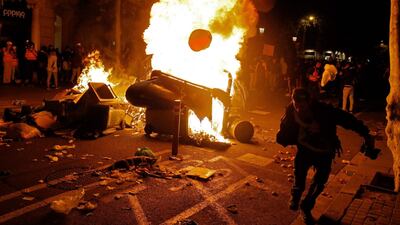
Pro-independence Catalan protesters burn barricades after a previous protest called by the local Republic Defence Committees (CDR) in Barcelona on October 17, 2019. After years of peaceful separatist demonstrations, violence finally exploded on the Catalan streets this week, led by activists frustrated by the political paralysis and infuriated by the Supreme Court's conviction of nine of its leaders over a failed independence bid. / AFP / Pau Barrena -
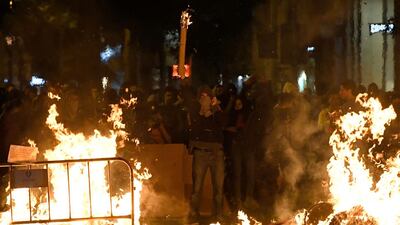
Catalan protesters gesture behind barricades in flames after a demonstration called by the local Republic Defence Committees (CDR) in Barcelona on October 17, 2019. AFP / LUIS GENE -

An Estelada (Catalan separatist flags) hangs from an overpass as demonstrators march during Catalonia's general strike in El Masnou, Spain, October 18, 2019. REUTERS/Albert Gea -
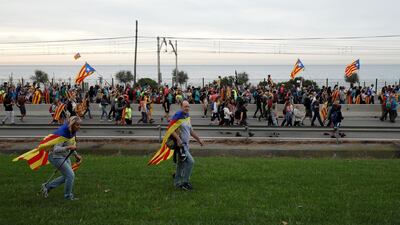
Catalan demonstrators wearing and waving Esteladas (Catalan separatist flags) chant slogans as they march during Catalonia's general strike in El Masnou, Spain, October 18, 2019. REUTERS/Albert Gea -
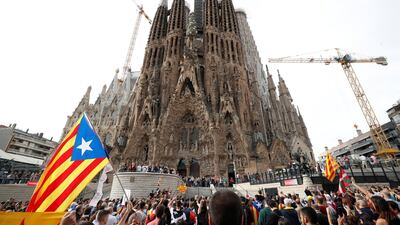
Catalan demonstrators chant slogans in front of La Sagrada Familia basilica during Catalonia's general strike in Barcelona, Spain, October 18, 2019. REUTERS/Albert Gea -
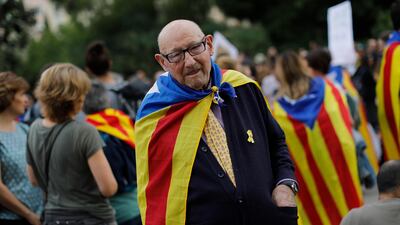
An elderly man joins a pro-independence gathering outside the Sagrada Família basilica i on the fifth day of protests over the conviction of a dozen Catalan independence leaders in Barcelona, Spain, Friday, Oct. 18, 2019. AP Photo/Bernat Armangue -
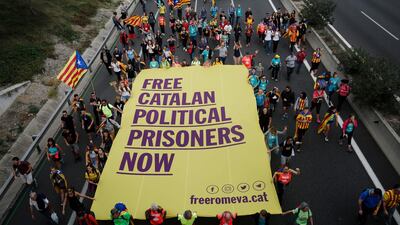
Pro-independence protesters march along a highway in San Vicenc dels Horts, on October 18, 2019, on the day that separatists have called a general strike and a mass rally. AFP / Pau Barrena -

Protesters ride on tractors as they enter the city on the fifth day of protests over the conviction of a dozen Catalan independence leaders in Barcelona, Spain, Friday, October 18, 2019. AP Photo/Manu Fernandez -
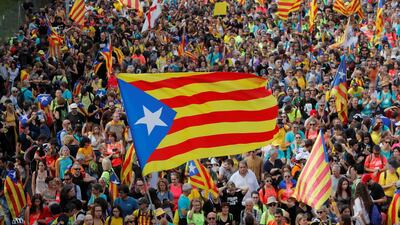
Catalan demonstrators wave Esteladas (Catalan separatist flags) as they block roads during Catalonia's general strike in Sant Just Desvern, Spain, October 18, 2019. REUTERS/Juan Medina


Outside the venue, separatist protesters demanded a full amnesty for the nine leaders.
Pere Aragones, head of the Catalan government since May 2021, said: "The Spanish government corrects an unfair ruling by the Supreme Court.”
However, he also vowed to push for a new, authorised referendum.
In a recent poll, more than 60 per cent of Spaniards opposed pardons for the Catalan independence activists, with about half of those voting for Mr Sanchez’s left-leaning government at the last election.
The move to pardon also angered right-wing politicians.
"Sánchez is not trying to solve a national problem," said Pablo Casado, leader of the conservative People's Party.
“He's destroying the foundations of our democracy, systematically disarming the state."

