

French President Emmanuel Macron faces growing unease that his campaign against “radical Islam” will backfire and could hand his far-right rival Marine Le Pen an advantage in next year’s elections.
The French Parliament votes on Tuesday on a contentious bill attacking what Mr Macron regards as “Islamist separatism”.
Although the government said it sought to protect core French values and stop extremism taking root, the new law is widely seen by Muslims as being against them.
But while the policy has alienated minorities and frustrated liberals, rekindling claims of state-sponsored “Islamophobia”, the president is struggling to persuade conservative voters he needs for re-election that his approach will work.
Polls suggested that voters overwhelmingly agree on the importance of the issue but show Mr Macron lagging behind Ms Le Pen when electors are asked who they trust to handle it.

“The problem is that the farther you extend your reach towards the far right, the more the far right progresses,” said Ugo Palheta, a sociologist, author and lecturer at Lille University.
At one point in a televised debate with Ms Le Pen last week, Mr Macron’s hardline Interior Minister, Gerald Darmanin, caused surprise by suggesting she was softer on separatism than the government.
“This debate signals once again that Mr Macron’s majority, which is currently losing dominance, is trying to recuperate momentum by gaining the support of the far right,” Mr Palheta told France 24 television.
But there was now a “real possibility” of a win for Ms Le Pen in 2022, he said.
The left-wing newspaper Liberation quoted a prominent but unidentified supporter of Mr Macron as saying the president "clearly has a second-round problem".
It was a reference to a repeat of the 2017 Macron-Le Pen run-off increasingly predicted for next year’s race for the Elysee Palace.
“How can we continue to stick the extreme right label on Le Pen when a minister is proud to be harder than her on questions of Islam and immigration?” the paper asked.
Ms Le Pen’s father, Jean-Marie, founder of their National Rally party (formerly the Front National) was humiliated by the centre-right Jacques Chirac in the 2002 presidential election, winning only 18 per cent of the vote.
Mr Macron won comfortably in 2017, although Ms Le Pen attracted 34 per cent, or 10.6 million votes.
Now, she is running neck and neck with Mr Macron after working relentlessly to “de-demonise” her party’s image without weakening its central anti-Islamism, anti-immigration message.
Raberh Achi, a political scientist, told The National that Mr Macron's government had adopted a "purely repressive" posture in its approach to separatism.
Mr Achi said that this was the first time a government had tampered with France’s keystone law of 1905, separating church and state “in an anti-liberal sense”.
“This bill allows the executive to occupy the political space that goes from the traditional right to the extreme right,” he said.
The comments reinforced his attack on Mr Macron's policies in the daily newspaper Le Monde, accusing the president of fighting "a deadly ideology which claims to be Islamic" with unjustified curbs on the freedom of association.
In the toughest measure of the new law, MPs have voted to make it a criminal offence, punishable by up to five years in jail, fines or expulsion, to threaten or intimidate a public official in support of demands for separate treatment.
-

People gather on Place de la Republique in Paris in homage to history teacher Samuel Paty two days after he was beheaded by an attacker who was shot dead by policemen. AFP -
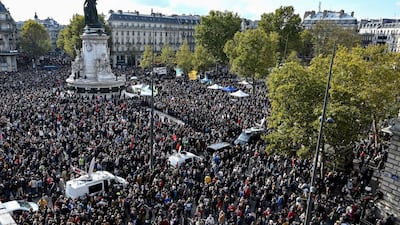
The murder has shocked France and politicians of all stripes attended the Paris rally. AFP -
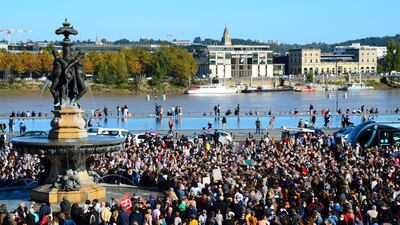
In Bordeaux, people gather on Place de la Bourse. AFP -
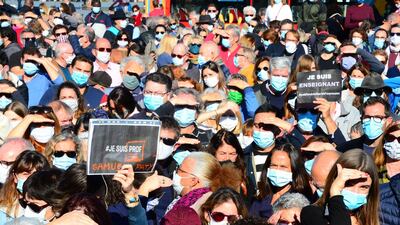
A person holds a placard reading 'I am a teacher' as people gather on Place de la Bourse. AFP -
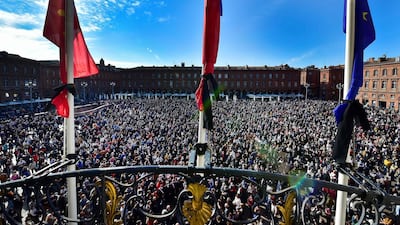
Flags at city hall are at half-mast as people gather in Place du Capitole in Toulouse. AFP -
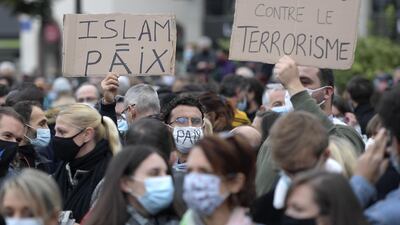
People hold placards reading 'Islam = peace' and 'Muslims against terrorism' as they gather in Strasbourg. AFP -
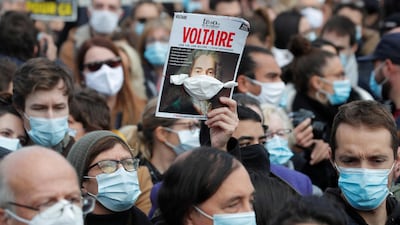
Samuel Paty, was killed in the Paris suburb of Conflans-Sainte-Honorine. Reuters -
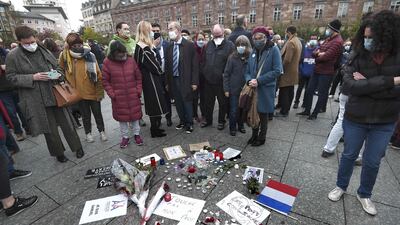
People stand near flowers and placards reading 'I am Samuel' and 'Don't touch my teacher' at a rally in Strasbourg. AFP -
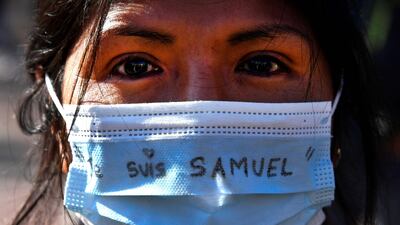
A person wears a prtotective face mask with an inscription reading 'I am Samuel'. AFP -
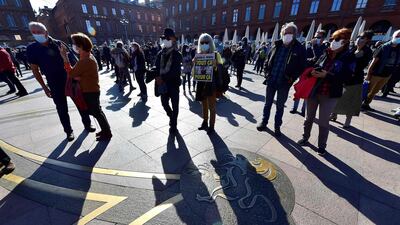
History teacher Samuel Paty was killed on Friday. AFP -

People gather at the Place de la Republique in Paris. Reuters -
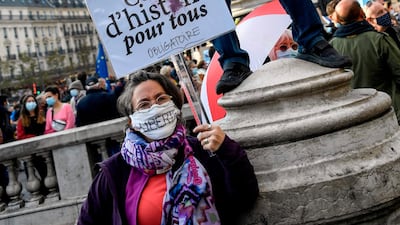
A woman holds a placard reading 'History course for eveyone' and a man holds a French flag on Place de la Republique in Paris. AFP


The beheading by a Chechen refugee of Samuel Paty, a history teacher, outside his school last October also led to the forced closure of some Muslim groups accused of supporting extremism.
France's Muslim federations agreed to a new charter of principles requested by Mr Macron as part of his reforms.
But the draft law, which is likely to win the approval of both houses and has been debated by Parliament in recent weeks, has been damned by some as trampling on religious freedom.
About 150 people protested near the Eiffel Tower in Paris on Sunday, calling for the bill to be scrapped.
The legislation before Parliament, which seeks to ensure that extremists do not infiltrate public institutions, is called the anti-separatism bill because ministers fear some communities are separate from France's staunchly secular identity.
The government said it would strengthen France's secular system.
Tuesday’s vote will focus on plans to ban doctors from issuing virginity certificates. Laws against polygamy and forced marriage will be strengthened.
The bill includes restrictions on home schooling and extends a ban on wearing religious symbols by civil servants to all public sector workers.
In an effort to protect children from indoctrination and do away with underground schools, the text requires all children from age 3 to attend a regular school.
Among other key points, the bill aims to keep a close watch on associations including those that often run mosques.
Measures include one aimed at ensuring that outsiders cannot take control of an association.
But critics said that the authorities already had powers to fight abuse.
Ms Le Pen has problems of her own. She appeared in court last week charged with illegally distributing images of ISIS atrocities. A verdict is expected in May.
She also faces prosecution over EU funds allegedly diverted to pay party staff.
By portraying herself as the victim of politically motivated proceedings, Ms Le Pen calculates her traditional support will remain resilient.
Her chances of becoming France’s first female president would then depend on attracting conservative voters unconvinced by Mr Macron.
He served in France’s last socialist administration before launching his own centrist party, La Republique en Marche.
Mr Macron’s bill was renamed to remove the word “separatism” in favour of “reinforcing republican principles”.
But he is determined to reform the way Islam is organised in France, freeing the faith from foreign influence, ending reliance on imams trained overseas and limiting funding of religious associations to those committed to republican values.
Mr Macron’s opponents said he was gambling on winning right-wing support for his measures on extremism, diverting attention from his handling of the coronavirus.
Mr Achi expected the president’s campaign to highlight his economic response to the pandemic, minimise the “fiasco” on supply of masks and slowness of France’s vaccination programme and focus on sovereign issues, Islam and secularism.

