

The European Union will soon begin a mass Covid-19 vaccination programme with at least 750 million doses to be shared out among its 27 member states. It could well prove chaotic.
The roll out will follow closely in the footsteps of Britain's immunisation programme with the approval by regulators today of the Pfizer/BioNTech coronavirus vaccine for widespread use. The 40 million doses for 20 million people will be the start of the battle against Covid-19 as the continent of more than 740 million people battles to fight off a virulent second wave of infections.
The European Medicines Agency said it would decide on December 29 if there was enough safety and efficacy data to approve the vaccine developed by German company BioNTech and US pharmaceutical giant Pfizer.
The agency also said it could decide as early as January 12 whether to approve Moderna Inc's rival shot.
French President Emmanuel Macron said vaccinations would not begin for the general public until April next year as he outlined a five phase plan for the country's immunisation. However, the estimated 650,000 elderly living in care homes could receive shots at the end of this month.
With Britain today becoming the first to approve a vaccine, the US could follow very soon with emergency approval potentially being granted between December 8 and December 10.
Worldwide it is estimated that 6.4 billion doses of vaccines have been bought, with another 3.2 billion under negotiation in a global inoculation drive to stop the spread of the pandemic among a population of 7.4 billion.
Doubtless over the coming year there will be arguments over countries having too much or too little and politics will come into play, with some nations acting with largesse and others as misers. Throw into the mix the anti-vaccination conspiracy theorists and it is unlikely to be straightforward.
Despite the potential opposition, governments across Europe and beyond will be looking to immunise enough of their population, between 60 to 80 per cent, to achieve ‘herd immunity’ and bring an end to the economic misery caused by Covid-19.
Currently, four major vaccines have been deemed viable with the ability to immunise more than 90 per cent of recipients.
.
The EU has announced a deal with Pfizer/BioNTech for an initial 300 million doses of their joint vaccine. In addition, the bloc will purchase 405 million doses of a potential coronavirus vaccine from German bio-tech company CureVac.
Germany has transformed exhibition halls into vaccination centres and has bought ultra-cold freezers for storing the shots. Similar plans are under way in Britain, which has ordered seven different vaccines including the Pfizer shot, with medical staff preparing for round-the-clock inoculation. Elsewhere, countries such as Italy and Portugal have yet to outline detailed plans.
Each immunisation requires two shots per person over a 28-day period with each dose costing between $10 and $20.
What are Europe's key nations doing?
Germany
Population: 84m
The government has 300 million doses in total through the EU scheme and through its own deals. This includes 100 million of the 300 million Pfizer/BioNTech shots being prepared. Germany aims to start immunisation in December, opening six mass vaccination centres. Priority will be given to the elderly and those with underlying health conditions.
The first phase will last until the summer when local doctors and pharmacists will take over the process. An 820,000 litre, ultra-cold storage freezer will open in Berlin later in December.
France
Population: 65m
It has 295 million doses and is likely to start the vaccination programme in late December with the vulnerable population a priority. France has ordered another 90 million shots, enough for 45 million people, from several different firms.
Italy
Population: 60m
It has 108 million doses through the EU scheme. The majority of its people will be vaccinated by next September with a detailed plan to be announced in coming weeks. The priority will be police, medical staff and the elderly probably starting in January.
Mobile units and drive-through centres are among the proposals for distribution. It will receive 3.4 million doses of the Pfizer/BioNTech drug in mid-January.
Britain
Population: 58m
Britain has access to 357 million doses from seven different vaccine developers. The inoculation scheme is being led by Iraqi-born minister Nadhim Zahawi, the newly appointed ‘vaccine minister’. With approval of the Pfizer drug, the first batch of 800,000 jabs will begin within a week. Vaccination centres will administer the shots and the government plans for normality around the end of March. Care homes will be the immediate priority, as well as medical and emergency workers.
Spain
Population: 46m
It has 140 million doses. Its priority will be the 2.5 million people living and working in care homes, then healthcare workers, and the scheme will start in January. Spain will distribute the rest of the vaccines from 13,000 health centres, however, no full details of its strategy have been made public.
Denmark
Population: 5.8m
It has bought a total of 19.3 million shots. In a strategy plan announced last week, the Danish government said it has bought 38 special freezers and will first immunise those people living or working in care homes and in the medical profession. Health authorities plan to vaccinate the entire population within a year.
Belgium
Population: 11m
The country with the highest death rate in the world aims to procure 20 million doses via the EU scheme. Belgium plans to vaccinate 70 per cent of its population by the summer of next year with mass vaccinations beginning early in 2021.
How do the front-running vaccines work?
Pfizer's 95 per cent effective shot is a mRNA vaccine.
Traditional vaccines inject people with a dead or weakened part of a virus so the body produces antibodies to fight it, as it would in a natural infection.
However, mRNA vaccines differ in that they encourage the body to become its own miniature vaccine factory.
The vaccine, an abbreviation of 'messenger RNA', delivers genetic instructions that prompt the body to produce virus proteins – without exposing the body to any threat.
Once this happens, the immune system begins to build up protective antibodies to guard against infection.
The Moderna vaccine is also an mRNA type, with about 94 per cent efficacy.
The company used the same highly innovative and experimental approach to AstraZeneca in designing its shot.
AstraZeneca and Oxford's vaccine is a traditional inoculation in that it uses a weakened version of a virus.
In this case, scientists used a virus that causes a common cold in chimpanzees but is harmless to humans.
The genetic instructions for the spike protein of coronavirus – which it needs to invade cells – are transferred to the vaccine.
It triggers an immune response, effectively training the body to recognise coronavirus and destroy it.
Having been through a practice run, the body is then to fight the real thing.
What are the key differences between the vaccines?
The Pfizer vaccine needs to be kept at minus 70°C while in storage, which may present headaches for health officials who have to source ultra-cold freezers.
The Moderna vaccine can to be stored for up to six months at minus 20°C.
While the AstraZeneca/Oxford vaccine has lower efficacy than the Pfizer and Morderna shots, it is cheaper, easier to store and and therefore more practical to distribute to every corner of the world than the two rivals.
The Oxford dose has an average 70 per cent effectiveness rate.
The trials showed a regimen of two full doses one month apart was 62 per cent effective, but a half dose followed by another full shot showed 90 per cent.
-
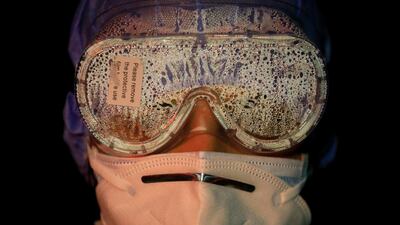
A female soldier's goggles are covered with vapor after handling bodies of coronavirus victims in Kathmandu, Nepal. Reuters -
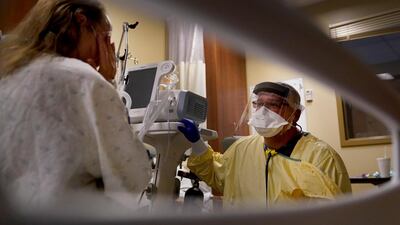
Dr Shane Wilson kneels at the bedside of a patient suffering from Covid-19 inside Scotland County Hospital in Memphis, Missouri. AP Photo -
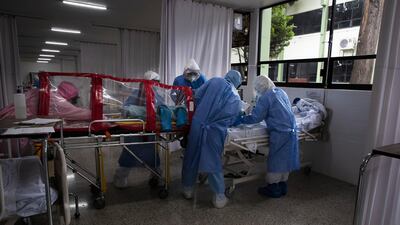
Military surgeon, Coronel Oscar Benavides Aguilar and his team place a Covid-19 patient in an isolation chamber before moving him to an X-Ray room at a military hospital in Mexico City. AP Photo -
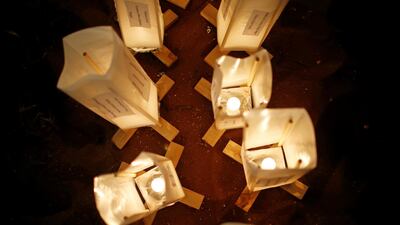
Floating lanterns are seen before they are let go on the water with names of people who died from Covid-19 in Brasilia, Brazil. Reuters -
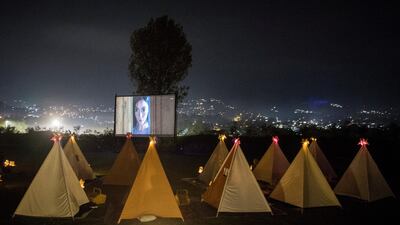
People watch movies from tents placed for social distancing at the campsites in Bandung, West Java Province, Indonesia. Reuters -

A chef cooks Chinese food while the restaurant is open for curb-side pickup in Toronto. The Canadian Press via AP -
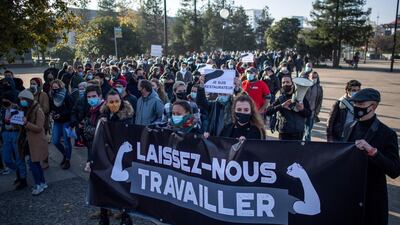
Protesters hold a banner reading "let us work" as hundreds of workers protest against the sanitary measures in Nantes, western France. AFP -
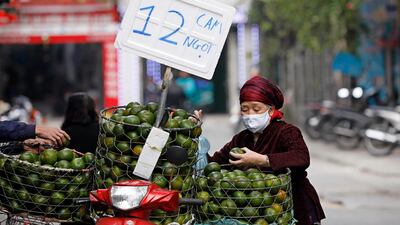
An elderly woman buys oranges on a street in Hanoi, Vietnam. EPA -
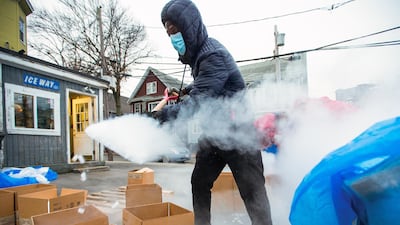
A crew member at the Acme Dry Ice Company shovels pellets of -109F (-78.5C) dry ice or CO2, into packaging for clients in North America at the company facilities in Cambridge, Massachusetts, US. EPA -

A Virgin plane arrives with passengers from the first flight from Melbourne since the Queensland border re-opened in Brisbane, Australia. Getty Images



