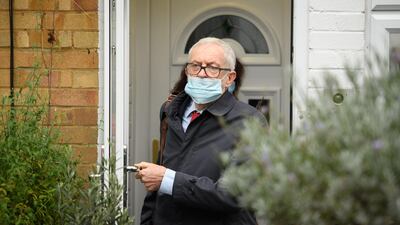
Former UK Labour leader Jeremy Corbyn has been suspended from the party in the wake of a report that found serious failings in dealing with anti-Semitism during his tenure.
Mr Corbyn said the number of complaints during his four-and-a-half years as leader was “dramatically overstated” and insisted: “I’m not part of the problem.”
A statement by the Labour Party said: “In light of his comments made today and his failure to retract them subsequently, the Labour Party has suspended Jeremy Corbyn pending investigation. He has also had the whip removed from the Parliamentary Labour Party."
Mr Corbyn criticised the move.
"I will strongly contest the political intervention to suspend me," he said.
"I’ve made absolutely clear those who deny there has been an anti-Semitism problem in the Labour Party are wrong. I will continue to support a zero tolerance policy towards all forms of racism."
Mr Corbyn earlier said anti-Semitism was “absolutely abhorrent, wrong and responsible for some of humanity’s greatest crimes”.
“As Leader of the Labour Party I was always determined to eliminate all forms of racism and root out the cancer of anti-Semitism,” he said.
He said he did not accept all the report’s findings and that the scale of the problem had been overstated for political reasons.
The inquiry by the Equality and Human Rights Commission (EHRC) said the party was “responsible for unlawful acts of harassment and discrimination” under his leadership and that his office had interfered in the complaints procedure.
Mr Corbyn's tenure was marred by persistent complaints of anti-Semitism within the party and criticism of the leader's response.
Current Labour leader Keir Starmer said he accepted the report in full and would implement all of its recommendations.
"It is a day of shame for the Labour Party. We have failed Jewish people... I am truly sorry for all the pain and grief that has been caused," he said.
"Never again will we fail to tackle anti-Semitism and never again will we lose your trust."
The EHRC said that under Mr Corbyn, Labour was guilty of three breaches of Britain's 2010 Equality Act for political interference in complaints, failure to provide adequate training to those handling anti-Semitism cases and harassment of complainants.
It did not launched legal proceedings and instead ordered Labour to draft an action plan by December 10 to remedy its failures.
"Our investigation has highlighted multiple areas where (Labour's) approach and leadership to tackling anti-Semitism was insufficient," EHRC's interim chairwoman, Caroline Waters, said in presenting the 129-page report.
"This is inexcusable and appeared to be a result of a lack of willingness to tackle anti-Semitism rather than an inability to do so."
The Board of Deputies of British Jews welcomed Mr Corbyn's suspension.
"Having presided over the descent of a proudly anti-racist party into a party that broke equalities law in its treatment of Jews, his shameless comments today showed that he remains part of the problem and is an obstruction to the resolution of the issue," President Marie van der Zyl said.

THE BIO: Mohammed Ashiq Ali
Proudest achievement: “I came to a new country and started this shop”
Favourite TV programme: the news
Favourite place in Dubai: Al Fahidi. “They started the metro in 2009 and I didn’t take it yet.”
Family: six sons in Dubai and a daughter in Faisalabad
Mercer, the investment consulting arm of US services company Marsh & McLennan, expects its wealth division to at least double its assets under management (AUM) in the Middle East as wealth in the region continues to grow despite economic headwinds, a company official said.
Mercer Wealth, which globally has $160 billion in AUM, plans to boost its AUM in the region to $2-$3bn in the next 2-3 years from the present $1bn, said Yasir AbuShaban, a Dubai-based principal with Mercer Wealth.
“Within the next two to three years, we are looking at reaching $2 to $3 billion as a conservative estimate and we do see an opportunity to do so,” said Mr AbuShaban.
Mercer does not directly make investments, but allocates clients’ money they have discretion to, to professional asset managers. They also provide advice to clients.
“We have buying power. We can negotiate on their (client’s) behalf with asset managers to provide them lower fees than they otherwise would have to get on their own,” he added.
Mercer Wealth’s clients include sovereign wealth funds, family offices, and insurance companies among others.
From its office in Dubai, Mercer also looks after Africa, India and Turkey, where they also see opportunity for growth.
Wealth creation in Middle East and Africa (MEA) grew 8.5 per cent to $8.1 trillion last year from $7.5tn in 2015, higher than last year’s global average of 6 per cent and the second-highest growth in a region after Asia-Pacific which grew 9.9 per cent, according to consultancy Boston Consulting Group (BCG). In the region, where wealth grew just 1.9 per cent in 2015 compared with 2014, a pickup in oil prices has helped in wealth generation.
BCG is forecasting MEA wealth will rise to $12tn by 2021, growing at an annual average of 8 per cent.
Drivers of wealth generation in the region will be split evenly between new wealth creation and growth of performance of existing assets, according to BCG.
Another general trend in the region is clients’ looking for a comprehensive approach to investing, according to Mr AbuShaban.
“Institutional investors or some of the families are seeing a slowdown in the available capital they have to invest and in that sense they are looking at optimizing the way they manage their portfolios and making sure they are not investing haphazardly and different parts of their investment are working together,” said Mr AbuShaban.
Some clients also have a higher appetite for risk, given the low interest-rate environment that does not provide enough yield for some institutional investors. These clients are keen to invest in illiquid assets, such as private equity and infrastructure.
“What we have seen is a desire for higher returns in what has been a low-return environment specifically in various fixed income or bonds,” he said.
“In this environment, we have seen a de facto increase in the risk that clients are taking in things like illiquid investments, private equity investments, infrastructure and private debt, those kind of investments were higher illiquidity results in incrementally higher returns.”
The Abu Dhabi Investment Authority, one of the largest sovereign wealth funds, said in its 2016 report that has gradually increased its exposure in direct private equity and private credit transactions, mainly in Asian markets and especially in China and India. The authority’s private equity department focused on structured equities owing to “their defensive characteristics.”
THE DETAILS
Kaala
Dir: Pa. Ranjith
Starring: Rajinikanth, Huma Qureshi, Easwari Rao, Nana Patekar
Rating: 1.5/5
SHALASH%20THE%20IRAQI
%3Cp%3EAuthor%3A%20Shalash%3Cbr%3ETranslator%3A%20Luke%20Leafgren%3Cbr%3EPages%3A%20352%3Cbr%3EPublisher%3A%20And%20Other%20Stories%3C%2Fp%3E%0A
The specs
Engine: 5.0-litre V8
Power: 480hp at 7,250rpm
Torque: 566Nm at 4,600rpm
Transmission: 10-speed auto
Fuel consumption: L/100km
Price: Dh306,495
On sale: now
