A student from the University of St Andrews takes a swab for a lateral-flow test in a mass testing centre. AFP

I’m going home for Christmas – how do I get a Covid test in the UK?


  • English
  • Arabic

Britons have been granted a temporary reprieve from coronavirus restrictions over Christmas.

Many are eager to see family and friends after enduring nearly a month of lockdown and other harsh restrictions across the country.

However, as travel is permitted, many of those returning home have asked how they can take a coronavirus test to help stop the disease from spreading. Those questions are answered here.

Can I get a free test?

You should only order a free NHS test if you are displaying symptoms of coronavirus or have been asked to by your council.

The main symptoms include a high temperature, a new and continuous cough, and a loss of, or change in, your sense of smell or taste.

If you are displaying symptoms, the government advises you to get tested as soon as possible. You can visit your nearest testing centre or order a home kit.

What if I don’t have symptoms?

People who are not showing symptoms can order a private test. A range of health providers offer the coronavirus tests for a fee. Boots, the UK’s largest pharmacy, offers the test for £120 ($160) with results made available within 48 hours.

What kind of coronavirus test will I get?

People who order a private coronavirus test are most likely to receive a PCR (lab-based) test, with results available between 24 and 48 hours after a swab.

Some healthcare providers offer lateral flow rapid Covid swabs, which can deliver a result in less than an hour, but these are not widely available.

A member of the community swabbing team carries out a doorstep COVID-19 test following the outbreak of the coronavirus disease in Chadderton. Reuters

However, the government has made rapid coronavirus testing available to all cities placed in Tier 3, including Manchester, Leeds, Newcastle, Birmingham and Bristol.

Anyone in a Tier 3 area – whether displaying symptoms or not – is eligible for a Covid-19 test. England returns to its tier system on December 2.

When should you get tested?

People returning home should calculate the correct time to take a test.

If planned too early, there is more time to catch the virus before meeting friends and family. Plan it too late, and there is the risk of results coming back after you head off, a potential risk if you happen to test positive.

Lab-based tests, the most common, take between 24 and 48 hours to return a result.

  • A man walks in London's China Town. British Prime Minister Boris Johnson on November 23 said the "escape route" from the coronavirus was in sight as he announced that tough restrictions in England would not be extended beyond December 2. AFP
    A man walks in London's China Town. British Prime Minister Boris Johnson on November 23 said the "escape route" from the coronavirus was in sight as he announced that tough restrictions in England would not be extended beyond December 2. AFP
  • London taxi driver Michael Harris, dressed as Santa Claus, who said he was in hospital with coronavirus for three weeks earlier in the year, poses for photographs in his cab parked outside Burlington Arcade in London. AP Photo
    London taxi driver Michael Harris, dressed as Santa Claus, who said he was in hospital with coronavirus for three weeks earlier in the year, poses for photographs in his cab parked outside Burlington Arcade in London. AP Photo
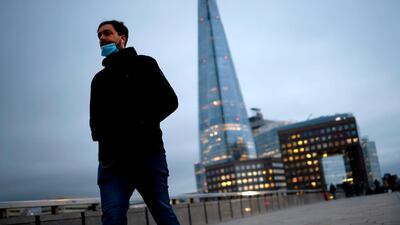
  • A pedestrian wearing a mask crosses London Bridge with the Shard tower in the background. AFP
    A pedestrian wearing a mask crosses London Bridge with the Shard tower in the background. AFP
  • Students of Newcastle Sixth Form College perform a lateral flow antigen test in Newcastle upon Tyne. Reuters
    Students of Newcastle Sixth Form College perform a lateral flow antigen test in Newcastle upon Tyne. Reuters
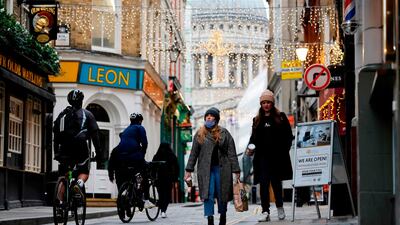
  • Pedestrians and cyclists make their way through the streets of the City of London. AFP
    Pedestrians and cyclists make their way through the streets of the City of London. AFP
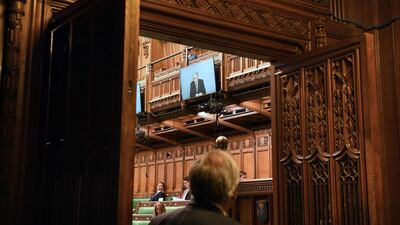
  • A screen displaying Britain's Prime Minister Boris Johnson as he takes part remotely via a video call in the weekly Prime Minister's Questions at the House of Commons in London. AFP
    A screen displaying Britain's Prime Minister Boris Johnson as he takes part remotely via a video call in the weekly Prime Minister's Questions at the House of Commons in London. AFP
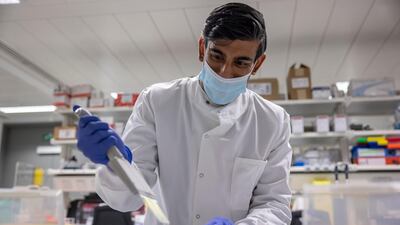
  • Chancellor of the Exchequer Rishi Sunak during a visit to Imperial Clinic Research Facility at Hammersmith Hospital in London. AP Photo
    Chancellor of the Exchequer Rishi Sunak during a visit to Imperial Clinic Research Facility at Hammersmith Hospital in London. AP Photo
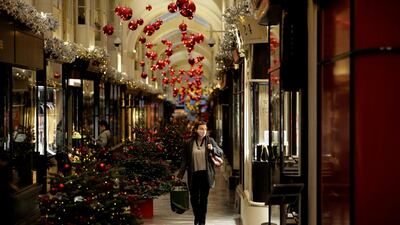
  • A woman walks past Christmas trees and decorations in Burlington Arcade, where all non-essential shops are temporarily closed, in London. AP Photo
    A woman walks past Christmas trees and decorations in Burlington Arcade, where all non-essential shops are temporarily closed, in London. AP Photo
THE BIO

Favourite car: Koenigsegg Agera RS or Renault Trezor concept car.

Favourite book: I Am Pilgrim by Terry Hayes or Red Notice by Bill Browder.

Biggest inspiration: My husband Nik. He really got me through a lot with his positivity.

Favourite holiday destination: Being at home in Australia, as I travel all over the world for work. It’s great to just hang out with my husband and family.


What are NFTs?

Are non-fungible tokens a currency, asset, or a licensing instrument? Arnab Das, global market strategist EMEA at Invesco, says they are mix of all of three.

You can buy, hold and use NFTs just like US dollars and Bitcoins. “They can appreciate in value and even produce cash flows.”

However, while money is fungible, NFTs are not. “One Bitcoin, dollar, euro or dirham is largely indistinguishable from the next. Nothing ties a dollar bill to a particular owner, for example. Nor does it tie you to to any goods, services or assets you bought with that currency. In contrast, NFTs confer specific ownership,” Mr Das says.

This makes NFTs closer to a piece of intellectual property such as a work of art or licence, as you can claim royalties or profit by exchanging it at a higher value later, Mr Das says. “They could provide a sustainable income stream.”

This income will depend on future demand and use, which makes NFTs difficult to value. “However, there is a credible use case for many forms of intellectual property, notably art, songs, videos,” Mr Das says.