Hairdressers reopened across Germany on Monday as the country began to lift its lockdown, despite the spread of more contagious coronavirus variants.
Hair salons had been shut for two and a half months but the country is easing restrictions, with secondary school pupils returning to class last week.
But on Tuesday authorities will impose tougher entry requirements on travellers from the Moselle region in eastern France, after Berlin designated the area “high risk” for Covid-19.
Under the new restrictions, almost all travel will be banned, although German citizens and lorry drivers can enter after presenting a negative result from a Covid-19 test.
-
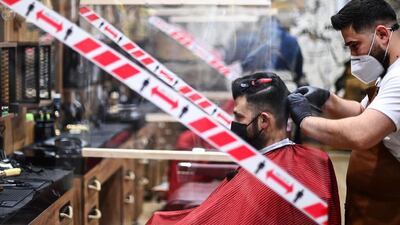
A hairdresser cuts the hair of a client in Dortmund, surrounded by screens and social distance reminders. AFP -

Hairdresser Sadiye Kisin cuts the hair of her first customer as members of the press gather around just after midnight in Duisburg. EPA -
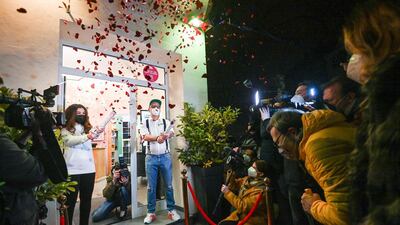
Staff members launch a confetti cannon at their hair salon in Dortmund. AFP -
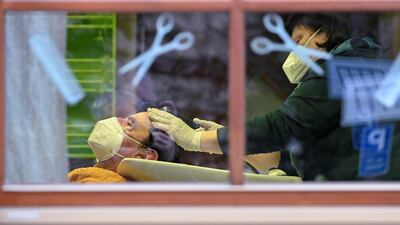
Hairdresser Manuela Friedl serves a customer as her salon reopens after a months-long lockdown, in Haselbachtal. Reuters -
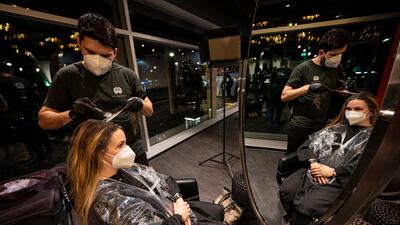
The first customer of Shan Rahimkhan's barbershop gets her hair cut and colored after the reopening in Berlin. AP Photo -
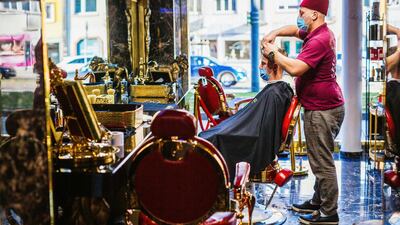
Muhammet 'Memo' Akbas cuts Aleksandar Petrovic's hair in a barber shop in Freiburg. AP Photo -

Hairdresser Marco Trapani colours the hair of a client at his hair salon reopening in Dortmund. AFP -

Hairdresser Manuela Friedl cuts their hair of a customer in Haselbachtal. The sign reads: "Sincerely welcome, please knock - I will open, wear a mask? no symptoms? Now it finally starts, I am happy". Reuters


Travel is already severely restricted between Germany, Austria and the Czech Republic.
French officials criticised the latest border measures.
“I regret this German decision because it implies a certain number of slowdowns, difficulties at the borders, again not for touristic movements, but for work,” European Affairs Minister Clement Beaune said.
The decision is indicative of the cautious approach taken by the German government, despite increasing calls for lockdown rules to be relaxed.
Bavarian Premier Markus Soder said the situation was unstable.
“This week will set the course for the coming months. It’s really important that we make smart decisions this week," he said.
"Smart decisions mean that the mood must be taken on board – we must find the right balance between caution and opening, and we absolutely must not lose our nerve … and simply fulfil all wishes.”
Others want Europe’s largest economy to reopen faster.
As more aggressive variants spread, the number of new infections is increasing, moving the country further from targets Mrs Merkel set for easing restrictions.
But Germany's Finance Minister Olaf Scholz said increased testing “must have an impact on what is possible in terms of moves to open up”.
Mrs Merkel will meet state leaders on Wednesday to decide how to proceed with Germany’s remaining coronavirus restrictions, which are scheduled to end on March 7.
Some states allowed businesses such as florists and hardware shops to open on Monday.
Most of the country's shops have been closed since December 16. Restaurants, bars, sports and leisure centres have been closed since November 2, while hotels are only allowed to accommodate business travellers.

