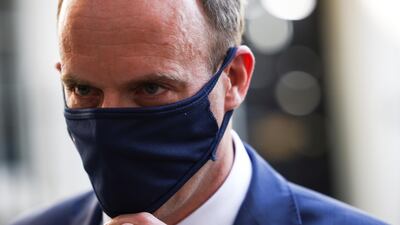
The Group of Seven richest countries will look at a proposal to provide a means to rapidly counter Russian "propaganda" and misinformation, British Foreign Secretary Dominic Raab said.
Mr Raab said the UK was "getting the G7 to come together with a rapid rebuttal mechanism" to counter Russian misinformation, Reuters reported.
He was speaking before a G7 foreign ministers' meeting in London, the first to be held in person for two years.
"So that when we see these lies and propaganda or fake news being put out there, we can … come together to provide a rebuttal and frankly to provide the truth for the people of this country, but also in Russia or China or around the world," Mr Raab said.
British, US and European security officials say Russia and China are trying to sow mistrust across the West, including through disinformation in elections.
Moscow denies it is meddling beyond its borders and says the West is gripped by anti-Russian hysteria.
"It's time to think of why the countries that are sick to the core with propaganda, and which used it more than once to justify armed intervention and toppling of governments … accuse our country of their own sins," Russian Foreign Ministry spokeswoman Maria Zakharova said on social media.
China says the West is a bully and that its leaders have a post-imperial mindset that makes them feel they can act like global policemen.
Britain has identified Russia as the biggest threat to its security, although it regards China as its greatest long-term challenge, militarily, economically and technologically.
Mr Raab will meet US Secretary of State Antony Blinken on Monday, starting a week of diplomacy aimed at reinvigorating the G7's role and protecting against those it considers to be undermining the rules-based international order.
"The scope for intense global co-operation, international co-operation with our American partners and indeed the wider G7, that we're convening this week has never been greater," Mr Raab said.
He said that meeting in person, which was only possible due to strict measures such as daily testing, would make diplomacy much easier.
"You can only do so much by Zoom," Mr Raab said.
The G7 members are Britain, the US, Canada, France, Germany, Italy and Japan. Their combined gross domestic product is about $40 trillion – just less than half of the global economy.
British and US officials have expressed concern in recent months about growing strategic co-operation between Russia, the world's largest country by territory, and China, the world's fastest-growing major economy.
"What matters to us most is that we broaden the international caucus of like-minded countries that stand up for open societies, human rights and democracy, that stand for open trade," Mr Raab said.
He said many of those allies wanted "to know how this pandemic started".
The coronavirus outbreak, which began in China in late 2019, has killed 3.2 million people and cost the world trillions of dollars in lost production.
Mr Raab said some of the barriers between the G7 and other like-minded countries should be broken down so that there could be a broader network of allies standing up for open markets and democracy.
Britain has invited India, Australia and South Korea to attend this week's meeting, from Monday to Wednesday, and the full leaders' summit in June.
Asked whether Britain could seek to join a separate group comprising the US, Japan, Australia and India, Mr Raab said there was no concrete proposal as yet, but the UK was looking at ways to engage more in the Indo-Pacific.

Super heroes
Iron Man
Reduced risk of dementia
Alcohol consumption could be an issue
Hulk
Cardiac disease, stroke and dementia from high heart rate
Spider-Man
Agility reduces risk of falls
Increased risk of obesity and mental health issues
Black Panther
Vegetarian diet reduces obesity
Unknown risks of potion drinking
Black Widow
Childhood traumas increase risk of mental illnesses
Thor
He's a god
Ten tax points to be aware of in 2026
1. Domestic VAT refund amendments: request your refund within five years
If a business does not apply for the refund on time, they lose their credit.
2. E-invoicing in the UAE
Businesses should continue preparing for the implementation of e-invoicing in the UAE, with 2026 a preparation and transition period ahead of phased mandatory adoption.
3. More tax audits
Tax authorities are increasingly using data already available across multiple filings to identify audit risks.
4. More beneficial VAT and excise tax penalty regime
Tax disputes are expected to become more frequent and more structured, with clearer administrative objection and appeal processes. The UAE has adopted a new penalty regime for VAT and excise disputes, which now mirrors the penalty regime for corporate tax.
5. Greater emphasis on statutory audit
There is a greater need for the accuracy of financial statements. The International Financial Reporting Standards standards need to be strictly adhered to and, as a result, the quality of the audits will need to increase.
6. Further transfer pricing enforcement
Transfer pricing enforcement, which refers to the practice of establishing prices for internal transactions between related entities, is expected to broaden in scope. The UAE will shortly open the possibility to negotiate advance pricing agreements, or essentially rulings for transfer pricing purposes.
7. Limited time periods for audits
Recent amendments also introduce a default five-year limitation period for tax audits and assessments, subject to specific statutory exceptions. While the standard audit and assessment period is five years, this may be extended to up to 15 years in cases involving fraud or tax evasion.
8. Pillar 2 implementation
Many multinational groups will begin to feel the practical effect of the Domestic Minimum Top-Up Tax (DMTT), the UAE's implementation of the OECD’s global minimum tax under Pillar 2. While the rules apply for financial years starting on or after January 1, 2025, it is 2026 that marks the transition to an operational phase.
9. Reduced compliance obligations for imported goods and services
Businesses that apply the reverse-charge mechanism for VAT purposes in the UAE may benefit from reduced compliance obligations.
10. Substance and CbC reporting focus
Tax authorities are expected to continue strengthening the enforcement of economic substance and Country-by-Country (CbC) reporting frameworks. In the UAE, these regimes are increasingly being used as risk-assessment tools, providing tax authorities with a comprehensive view of multinational groups’ global footprints and enabling them to assess whether profits are aligned with real economic activity.
Contributed by Thomas Vanhee and Hend Rashwan, Aurifer
Ferrari 12Cilindri specs
Engine: naturally aspirated 6.5-liter V12
Power: 819hp
Torque: 678Nm at 7,250rpm
Price: From Dh1,700,000
Available: Now
Mercer, the investment consulting arm of US services company Marsh & McLennan, expects its wealth division to at least double its assets under management (AUM) in the Middle East as wealth in the region continues to grow despite economic headwinds, a company official said.
Mercer Wealth, which globally has $160 billion in AUM, plans to boost its AUM in the region to $2-$3bn in the next 2-3 years from the present $1bn, said Yasir AbuShaban, a Dubai-based principal with Mercer Wealth.
“Within the next two to three years, we are looking at reaching $2 to $3 billion as a conservative estimate and we do see an opportunity to do so,” said Mr AbuShaban.
Mercer does not directly make investments, but allocates clients’ money they have discretion to, to professional asset managers. They also provide advice to clients.
“We have buying power. We can negotiate on their (client’s) behalf with asset managers to provide them lower fees than they otherwise would have to get on their own,” he added.
Mercer Wealth’s clients include sovereign wealth funds, family offices, and insurance companies among others.
From its office in Dubai, Mercer also looks after Africa, India and Turkey, where they also see opportunity for growth.
Wealth creation in Middle East and Africa (MEA) grew 8.5 per cent to $8.1 trillion last year from $7.5tn in 2015, higher than last year’s global average of 6 per cent and the second-highest growth in a region after Asia-Pacific which grew 9.9 per cent, according to consultancy Boston Consulting Group (BCG). In the region, where wealth grew just 1.9 per cent in 2015 compared with 2014, a pickup in oil prices has helped in wealth generation.
BCG is forecasting MEA wealth will rise to $12tn by 2021, growing at an annual average of 8 per cent.
Drivers of wealth generation in the region will be split evenly between new wealth creation and growth of performance of existing assets, according to BCG.
Another general trend in the region is clients’ looking for a comprehensive approach to investing, according to Mr AbuShaban.
“Institutional investors or some of the families are seeing a slowdown in the available capital they have to invest and in that sense they are looking at optimizing the way they manage their portfolios and making sure they are not investing haphazardly and different parts of their investment are working together,” said Mr AbuShaban.
Some clients also have a higher appetite for risk, given the low interest-rate environment that does not provide enough yield for some institutional investors. These clients are keen to invest in illiquid assets, such as private equity and infrastructure.
“What we have seen is a desire for higher returns in what has been a low-return environment specifically in various fixed income or bonds,” he said.
“In this environment, we have seen a de facto increase in the risk that clients are taking in things like illiquid investments, private equity investments, infrastructure and private debt, those kind of investments were higher illiquidity results in incrementally higher returns.”
The Abu Dhabi Investment Authority, one of the largest sovereign wealth funds, said in its 2016 report that has gradually increased its exposure in direct private equity and private credit transactions, mainly in Asian markets and especially in China and India. The authority’s private equity department focused on structured equities owing to “their defensive characteristics.”
25%20Days%20to%20Aden
%3Cp%3EAuthor%3A%20Michael%20Knights%3C%2Fp%3E%0A%3Cp%3EPages%3A%20256%3C%2Fp%3E%0A%3Cp%3EAvailable%3A%20January%2026%3C%2Fp%3E%0A
UAE Falcons
Carly Lewis (captain), Emily Fensome, Kelly Loy, Isabel Affley, Jessica Cronin, Jemma Eley, Jenna Guy, Kate Lewis, Megan Polley, Charlie Preston, Becki Quigley and Sophie Siffre. Deb Jones and Lucia Sdao – coach and assistant coach.
The Sheikh Zayed Future Energy Prize
This year’s winners of the US$4 million Sheikh Zayed Future Energy Prize will be recognised and rewarded in Abu Dhabi on January 15 as part of Abu Dhabi Sustainable Week, which runs in the capital from January 13 to 20.
From solutions to life-changing technologies, the aim is to discover innovative breakthroughs to create a new and sustainable energy future.
