
On a visit to Turkey’s eastern city of Malatya at the weekend, President Recep Tayyip Erdogan came face to face with the stark financial hardships facing many as coronavirus and high inflation ravage the economy.
“We’re unemployed. We can’t take bread home,” one member of the crowd in front of the president’s coach shouted.
Mr Erdogan responded that the man’s plea seemed “too exaggerated” as he tossed bags of tea into the crowd.
Although the man, head of Malatya’s chamber of minibus drivers and public servants, later claimed his words had been “distorted” in the media, the videoed exchange touched a nerve with many Turks facing a daily fight to provide for themselves and their families.
Hacer Foggo, the founder of the Deep Poverty Network that has distributed food to thousands of families in Istanbul since the start of the pandemic, said many people dependent on casual work were facing desperate conditions.
"We continue to send food to families during the pandemic," she told The National. "These families now have difficulty accessing food.
“Many of them cannot pay their rent, bills are piled up and the electricity is out. In addition, many children have difficulty in accessing distance education because there is no internet at home.”

A recent report from two traders’ unions claimed that more than 40 per cent of Turks – 34 million in a population of 83 million – are below the poverty line or survive close to it.
Turkey’s economy has been on a downward trend since before a 2018 currency crisis.
On Monday, the lira dipped below eight to the US dollar, the latest record low in a decline that has seen the currency lose a quarter of its value since January.
Although Berat Albayrak, Mr Erdogan’s finance minister and son-in-law, has tried to downplay the significance of the collapse, the falling lira has placed added pressure on an inflation rate that stands at 11.75 per cent annually.
This has raised prices for essentials such as energy and fuel, for which Turkey is largely dependent on imports.
Unemployment remains in double digits, with the latest figures showing 13.4 per cent of workers jobless. Youth unemployment stands at 25.9 per cent.
“Both the health and economic side are really putting a lot of pressure on individuals,” said Can Selcuki, general manager of Istanbul Economics Research.
-
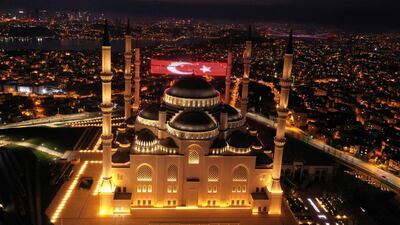
Mahya depicts Turkey's national flag which is installed between the minarets of Camlica mosque, as the outbreak of COVID-19 continues in Istanbul, April 28, 2020. Reuters -
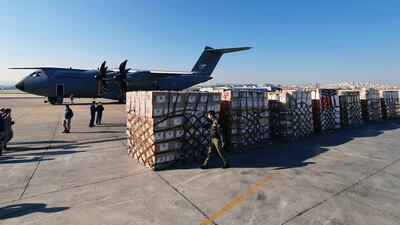
Turkish soldiers load medical protection equipment into a Turkish military cargo plane to be donated to the United States at the Etimesgut airport in Ankara, Turkey, April 28, 2020. EPA -

A flight crew member stands in front of a donation of medical supplies from Turkey on April 28, 2020, at Andrews Air Force Base, Maryland. The donation to help fight the new coronavirus in the United States included surgical masks, sanitisers and protective suits. AP Photo -
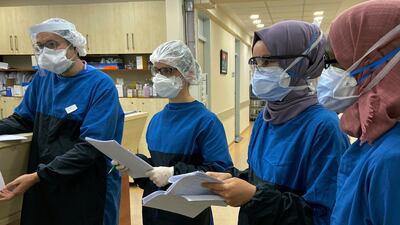
Medical personnel participate in a briefing at Istanbul University Cerrahpasa - Cerrahpasa Medical Faculty Hospital's ward dedicated to patients with coronavirus (COVID-19) in Istanbul, Tuesday, April 28, 2020. Turkey has seen a decline this week in the number of daily deaths and rates of infection since it started to grapple with the novel coronavirus pandemic last month. The government has refrained from imposing a total lockdown, fearing its negative impact on the already fragile economy. (AP Photo/Mehmet Guzel) -
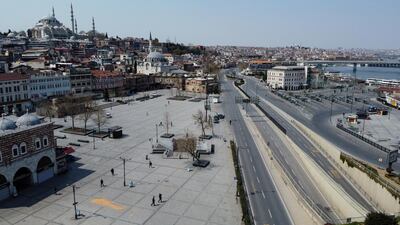
An aerial view of Eminonu district during a two-day curfew imposed to prevent the spread of the coronavirus in Istanbul, Turkey, on April 11, 2020. Reuters -
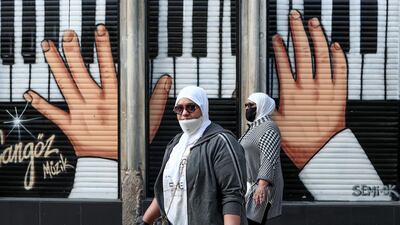
epa08392157 Women walk with face masks in Istanbul, Turkey, 29 April 2020. Turkish President Recep Tayip Erdogan announced that there will be another curfew in 31 big cities, including Istanbul (the country's most populous urban agglomeration), between 01-03 May due to the ongoing pandemic of the COVID-19 disease caused by the SARS-CoV-2 coronavirus. The government has also decreed the cancellation of public events and has temporarily shut down schools and suspended sporting events amid the pandemic. EPA/SEDAT SUNA -
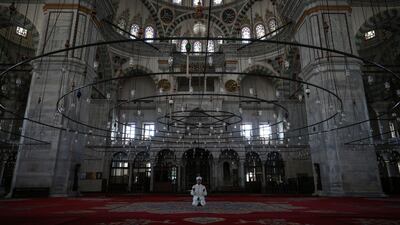
Esat Sahin, Imam of the iconic Fatih Mosque, holds a prayer held without public due to the coronavirus restrictions in Istanbul, April 24, 2020, during the first day of the holy fasting month of Ramadan. (AP Photo/Emrah Gurel) -
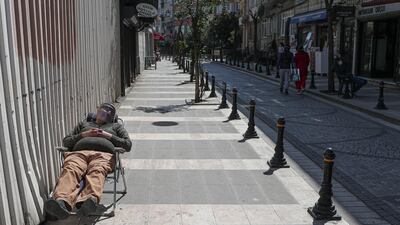
epa08392155 A man sleeps with face protective equipment on street in Istanbul, Turkey, 29 April 2020. Turkish President Recep Tayip Erdogan announced that there will be another curfew in 31 big cities, including Istanbul (the country's most populous urban agglomeration), between 01-03 May due to the ongoing pandemic of the COVID-19 disease caused by the SARS-CoV-2 coronavirus. The government has also decreed the cancellation of public events and has temporarily shut down schools and suspended sporting events amid the pandemic. EPA/SEDAT SUNA -
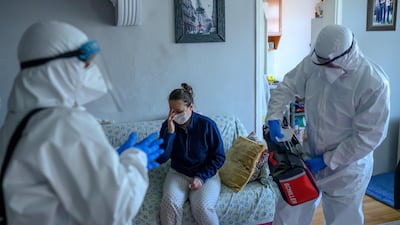
TOPSHOT - Health workers help a woman who tested positive for the novel coronavirus COVID-19, at Bagcilar in Istanbul, on April 28, 2019, in Istanbul. / AFP / Bulent Kilic -
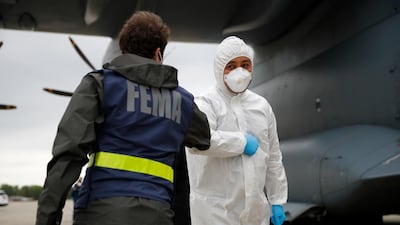
A Turkish military flight crew member, right, bumps elbows with a FEMA worker as crews unload a donation of medical supplies from Turkey, Tuesday, April 28, 2020, at Andrews Air Force Base, Md. The donation to help fight the new coronavirus in the United States included surgical masks, sanitizers and protective suits. (AP Photo/Patrick Semansky) -
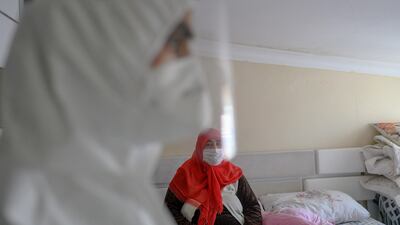
Health workers help a woman who tested positive for the novel coronavirus COVID-19, at Bagcilar in Istanbul, on April 28, 2019, in Istanbul. / AFP / Bulent Kilic -
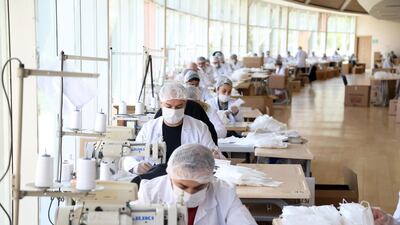
TOPSHOT - Employees of Ankara Metropolitan Municipality youth center sews face masks, in Ankara, Turkey, on April 28, 2020, amid the spread of the novel COVID-19 coronavirus. / AFP / Adem ALTAN -

Employees of Ankara Metropolitan Municipality youth center sews face masks, in Ankara, Turkey, on April 28, 2020, amid the spread of the novel COVID-19 coronavirus. / AFP / Adem ALTAN -
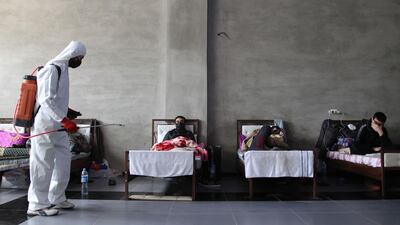
TOPSHOT - A man sanitises the room as Syrians who returned from Turkey rest at a quarantine facility in the countryside of the town of Jisr al-Shughur, west of the mostly rebel-held Syrian province of Idlib, on April 27, 2020 during the coronavirus COVID-19 pandemic. / AFP / Abdulaziz KETAZ -
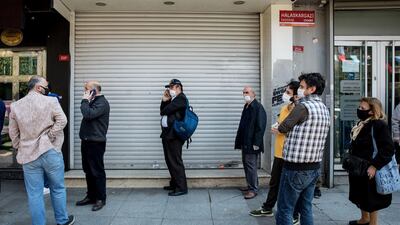
Customers wearing protective face masks maintain social distancing while queuing before the opening of a bank branch in Istanbul, Turkey, on Monday, April 27, 2020. Coming off a brief recession just over a year ago, the urgency is mounting for Turkey to loosen the screws on the economy as its currency and reserves come under pressure more than a month after it introduced social-distancing measures. Photographer: Kerem Uzel/Bloomberg -
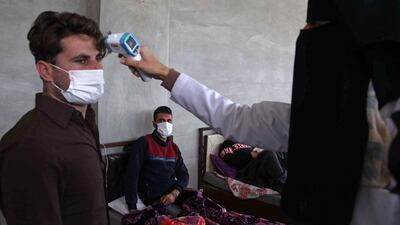
A health worker measures the temperature of a man at a quarantine facility for Syrians who returned from Turkey in the countryside of the town of Jisr al-Shughur, west of the mostly rebel-held Syrian province of Idlib, on April 27, 2020 amid the coronavirus COVID-19 pandemic. / AFP / Abdulaziz KETAZ -
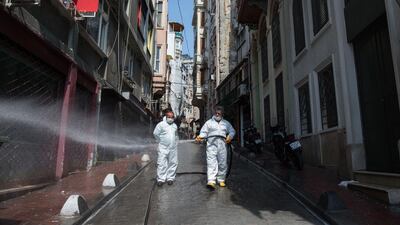
Istanbul Metropolitan Municipality workers spray a street with disinfectant to prevent the spread of coronavirus in Istanbul, Turkey, on Monday, April 27, 2020. Coming off a brief recession just over a year ago, the urgency is mounting for Turkey to loosen the screws on the economy as its currency and reserves come under pressure more than a month after it introduced social-distancing measures. Photographer: Kerem Uzel/Bloomberg -
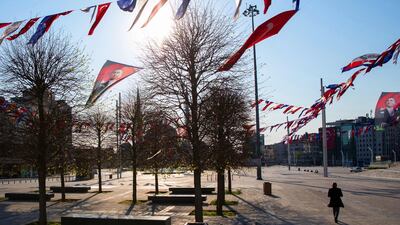
A lone pedestrian walks across an empty Taksim square during curfew in Istanbul, Turkey, on Sunday, April 26, 2020. Coming off a brief recession just over a year ago, the urgency is mounting for Turkey to loosen the screws on the economy as its currency and reserves come under pressure more than a month after it introduced social-distancing measures. Photographer: Kerem Uzel/Bloomberg


“We had a break over summer in terms of economic activity but it seems like the prospects are turning negative and the sentiment among the public is worsening.
“This is hard as it is but it’s much worse when it’s over a prolonged period of time and it’s becoming very challenging for average households.”
Although the economic data presents a dire picture for Turkey, many believe it is worse than the official figures suggest.
Last week the independent Inflation Research Group reported that September’s real inflation rate was four times higher than government statistics.
“The inflation rate doesn’t satisfy anyone because many people don’t believe the official figures while unemployment is measured in a very narrow way,” economist and writer Mustafa Sonmez said.
“Many people are experiencing serious problems like unemployment but they are too afraid to speak out or protest. Fear is dominant in society and people feel they can’t express themselves.”
Meanwhile, critics say the government has adopted diversionary tactics, highlighting rows such as the one with French President Emmanuel Macron over European attitudes to Islam or heralding "wins" such as the reopening of Istanbul's Hagia Sophia as a mosque in July.
“The situation is getting worse and worse and Erdogan isn’t doing anything economically,” Mr Sonmez said. “So, they try to change the agenda, mainly through foreign affairs such as the French issue or through religious or nationalist issues, to consolidate their base.”
Mr Erdogan’s party has held power in Turkey for 18 years largely through the votes of poorer sections of Turkish society but the economic crisis is threatening to erode that support.
In a sign of rising desperation, newspapers have reported a surge in suicides due to financial hardship.
A month before coronavirus hit Turkey, a painter in the southern province of Hatay set himself alight in front of the governor’s office after complaining of being jobless.
“My children are hungry, I want work. Don’t you understand?” Adem Yarici, 42, pleaded before dousing himself in petrol and sparking his cigarette lighter.

