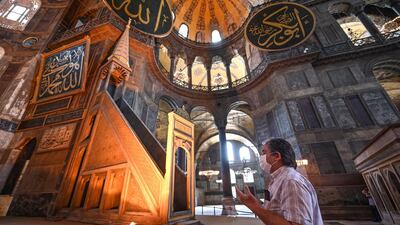
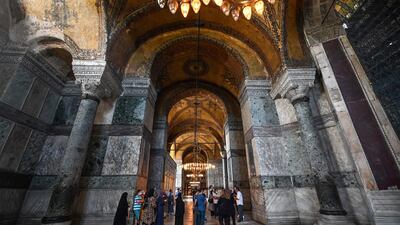
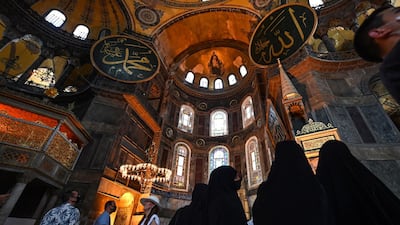
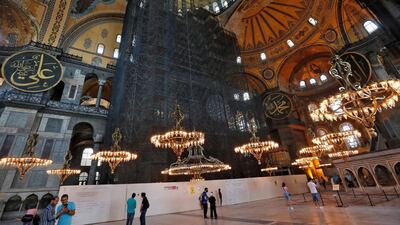
• Turkey's President Recep Tayyip Erdogan and invited guests at the Hagia Sophia in Istanbul on July 24, 2020 to attend the first Friday prayers there since it was converted back to mosque by his government. Turkish Presidential Service / AFP
    Turkey's President Recep Tayyip Erdogan and invited guests at the Hagia Sophia in Istanbul on July 24, 2020 to attend the first Friday prayers there since it was converted back to mosque by his government. Turkish Presidential Service / AFP
  • President Erdogan said afterwards that reverting the 6th-century structure from a museum to a mosque 'was a dream of my youth'. Turkish Presidential Service / AFP
    President Erdogan said afterwards that reverting the 6th-century structure from a museum to a mosque 'was a dream of my youth'. Turkish Presidential Service / AFP
  • About 500 dignitaries were invited to attend the inaugural Friday prayers at the converted mosque. Turkish Presidential Service / AFP
    About 500 dignitaries were invited to attend the inaugural Friday prayers at the converted mosque. Turkish Presidential Service / AFP
  • The Turkish president estimated that about 350,000 worshippers converged on the mosque for the occasion. Turkish Presidential Service / AFP
    The Turkish president estimated that about 350,000 worshippers converged on the mosque for the occasion. Turkish Presidential Service / AFP
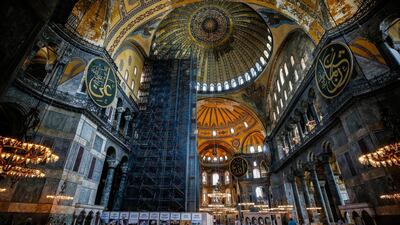
  • The Hagia Sophia's famed Byzantine frescoes and mosaics were obscured by curtains during the prayers. Turkish Presidential Service / AFP
    The Hagia Sophia's famed Byzantine frescoes and mosaics were obscured by curtains during the prayers. Turkish Presidential Service / AFP
  • A man wearing a t-shirt with the Turkish flag stands as people wait for the beginning of Friday prayers outside Hagia Sophia Grand Mosque, after it was once again declared a mosque after 86 years, in Istanbul, Turkey. Reuters
    A man wearing a t-shirt with the Turkish flag stands as people wait for the beginning of Friday prayers outside Hagia Sophia Grand Mosque, after it was once again declared a mosque after 86 years, in Istanbul, Turkey. Reuters
  • People wait for the beginning of Friday prayers outside Hagia Sophia. Reuters
    People wait for the beginning of Friday prayers outside Hagia Sophia. Reuters
  • Turkish President Recep Tayyip Erdogan is due attend the inaugural prayers. EPA
    Turkish President Recep Tayyip Erdogan is due attend the inaugural prayers. EPA
  • The Turkish president, Recep Tayyip Erdogan said the move was the 'yearning of our people'. EPA
    The Turkish president, Recep Tayyip Erdogan said the move was the 'yearning of our people'. EPA
  • Dozens of worshippers broke through one police checkpoint to rush toward Hagia Sophia and social distancing practices, in place due to the coronavirus outbreak, were being ignored, Turkish media reported. Reuters
    Dozens of worshippers broke through one police checkpoint to rush toward Hagia Sophia and social distancing practices, in place due to the coronavirus outbreak, were being ignored, Turkish media reported. Reuters
  • Thousands of men and women, including many who travelled from across Turkey, quickly filled segregated areas outside of Hagia Sophia to be part of the first prayers. AP
    Thousands of men and women, including many who travelled from across Turkey, quickly filled segregated areas outside of Hagia Sophia to be part of the first prayers. AP
  • Brushing aside international criticism, Erdogan issued a decree restoring the iconic building as a mosque earlier this month, shortly after a Turkish high court ruled that the Hagia Sophia had been illegally made into a museum more than eight decades ago. EPA
    Brushing aside international criticism, Erdogan issued a decree restoring the iconic building as a mosque earlier this month, shortly after a Turkish high court ruled that the Hagia Sophia had been illegally made into a museum more than eight decades ago. EPA
  • The move sparked dismay in Greece, the US and among Christian churches who had called on Mr Erdogan to maintain it as a museum as a nod to Istanbul's multi-religious heritage. EPA
    The move sparked dismay in Greece, the US and among Christian churches who had called on Mr Erdogan to maintain it as a museum as a nod to Istanbul's multi-religious heritage. EPA
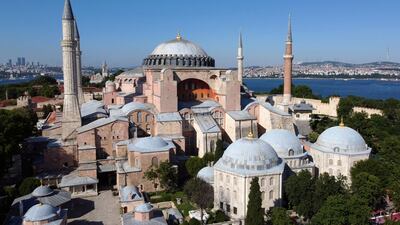
  • Built by the Byzantine Emperor Justinian in 537, Hagia Sophia was turned into a mosque with the 1453 Ottoman conquest of Istanbul. EPA
    Built by the Byzantine Emperor Justinian in 537, Hagia Sophia was turned into a mosque with the 1453 Ottoman conquest of Istanbul. EPA
  • Mustafa Kemal Ataturk, the founding leader of the secular Turkish republic converted the structure into a museum in 1934. Reuters
    Mustafa Kemal Ataturk, the founding leader of the secular Turkish republic converted the structure into a museum in 1934. Reuters

Istanbul's Hagia Sophia opens as a mosque for first Friday prayers


  • English
  • Arabic


Hundreds of Muslims took part in congregational prayers inside Istanbul's Hagia Sophia for the first time in 86 years on Friday, joined by tens of thousands worshipping outside the 1,500-year-old former cathedral.
The Friday prayers were televised around the world in the culmination of a decades-long fight over changing the building from a museum to use as a mosque.
President Recep Tayyip Erdogan was at the fore of 500 dignitaries for the landmark service, kneeling on a 2,000 square metre turquoise-coloured carpet, which the manufacturer boasted consisted of wool fibres pointing towards Makkah.

Mr Erdogan read passages from the Quran during the service, after which he visited the nearby tomb of Ottoman Sultan Mehmet II. “Reverting Hagia Sophia to its original form as a mosque was a dream of my youth,” he said, adding that 350,000 had attended the prayers.

He arrived at midday to cheers and shouts of "The chain has been broken, Hagia Sophia has been opened" from the crowds surrounding the 6th-century Unesco World Heritage site.
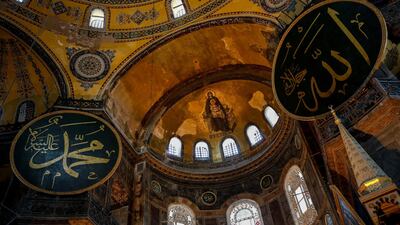
Hagia Sophia's famed Byzantine frescoes and mosaics – relics of its 900-year history as a centrepiece of Christianity – were obscured by curtains to comply with Islam's rejection of the representation of the human form.
Worshippers camped out overnight to secure a prayer place in the streets and squares surrounding the newly-designated mosque. Istanbul's governor had warned them to bring just four things to the event, "a mask, a prayer mat, patience and understanding".
"We have turned years of sadness into joy, that's the reason for our happiness," Ali Kemal Evlioglu, who hitchhiked from the Black Sea city of Samsun, told the state-run Anadolu news agency.
Some 21,000 security personnel and 700 health workers were on duty for what Health Minister Fahrettin Koca said would be the largest mass gathering during the coronavirus pandemic. Free buses were laid on to bring people from around Istanbul and beyond.
The Treasury minted commemorative coins to mark the event.

  • Hagia Sophia, a Unesco World Heritage Site in Istanbul. Turkey’s top administrative court revoked the 1,500-year-old former cathedral’s status as a museum. Reuters
    Hagia Sophia, a Unesco World Heritage Site in Istanbul. Turkey’s top administrative court revoked the 1,500-year-old former cathedral’s status as a museum. Reuters
  • Hagia Sophia museum in Istanbul. Turkey’s top administrative court announced its decision to revoke the 1,500-year-old former cathedral’s status as a museum. AFP
    Hagia Sophia museum in Istanbul. Turkey’s top administrative court announced its decision to revoke the 1,500-year-old former cathedral’s status as a museum. AFP
  • Hagia Sophia museum in Istanbul. Turkey’s top administrative court announced its decision to revoke the 1,500-year-old former cathedral’s status as a museum. AFP
    Hagia Sophia museum in Istanbul. Turkey’s top administrative court announced its decision to revoke the 1,500-year-old former cathedral’s status as a museum. AFP
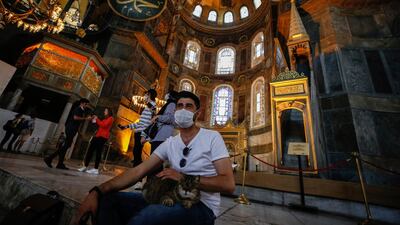
  • People visit the Byzantine-era Hagia Sophia, one of Istanbul's main tourist attractions. Turkey’s top administrative courtannounced its decision to revoke the 1,500-year-old former cathedral’s status as a museum. AP Photo
    People visit the Byzantine-era Hagia Sophia, one of Istanbul's main tourist attractions. Turkey’s top administrative courtannounced its decision to revoke the 1,500-year-old former cathedral’s status as a museum. AP Photo
  • A view of the Byzantine-era Hagia Sophia, one of Istanbul's main tourist attractions. Turkey’s top administrative court announced its decision to revoke the 1,500-year-old former cathedral’s status as a museum. AP Photo
    A view of the Byzantine-era Hagia Sophia, one of Istanbul's main tourist attractions. Turkey’s top administrative court announced its decision to revoke the 1,500-year-old former cathedral’s status as a museum. AP Photo
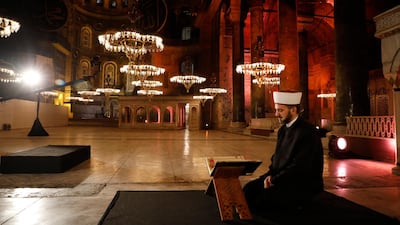
  • An imam recites the Quran inside Istanbul's 6th-century Hagia Sophia museum. Turkey’s top administrative court announced its decision to revoke the 1,500-year-old former cathedral’s status as a museum. AP Photo
    An imam recites the Quran inside Istanbul's 6th-century Hagia Sophia museum. Turkey’s top administrative court announced its decision to revoke the 1,500-year-old former cathedral’s status as a museum. AP Photo
  • People visit the Byzantine-era Hagia Sophia, one of Istanbul's main tourist attractions. Turkey’s top administrative court announced its decision to revoke the 1,500-year-old former cathedral’s status as a museum. AP Photo
    People visit the Byzantine-era Hagia Sophia, one of Istanbul's main tourist attractions. Turkey’s top administrative court announced its decision to revoke the 1,500-year-old former cathedral’s status as a museum. AP Photo
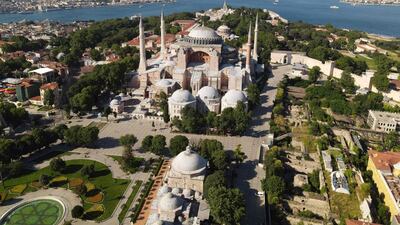
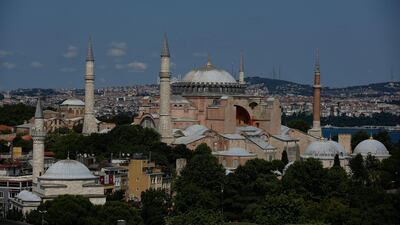
  • An aerial view of the Byzantine-era Hagia Sophia, one of Istanbul's main tourist attractions. Turkey’s top administrative court announced its decision to revoke the 1,500-year-old former cathedral’s status as a museum. AP Photo
    An aerial view of the Byzantine-era Hagia Sophia, one of Istanbul's main tourist attractions. Turkey’s top administrative court announced its decision to revoke the 1,500-year-old former cathedral’s status as a museum. AP Photo
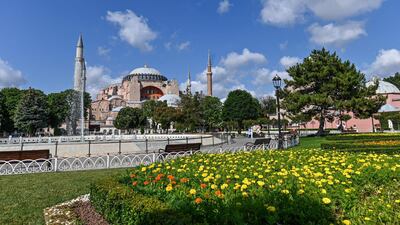
  • People walk by the Byzantine-era Hagia Sophia, one of Istanbul's main tourist attractions, in March 2017. Turkey’s top administrative court announced its decision to revoke the 1,500-year-old former cathedral’s status as a museum. AP Photo
    People walk by the Byzantine-era Hagia Sophia, one of Istanbul's main tourist attractions, in March 2017. Turkey’s top administrative court announced its decision to revoke the 1,500-year-old former cathedral’s status as a museum. AP Photo
  • A Turkish visitor prays in Hagia Sophia museum in Istanbul. Turkey’s top administrative court announced its decision to revoke the 1,500-year-old former cathedral’s status as a museum. AFP
    A Turkish visitor prays in Hagia Sophia museum in Istanbul. Turkey’s top administrative court announced its decision to revoke the 1,500-year-old former cathedral’s status as a museum. AFP
  • A Turkish visitor prays in front of the Apsis, facing the eastern direction of Hagia Sophia, in Istanbul. Turkey’s top administrative court on Friday announced its decision to revoke the 1,500-year-old former cathedral’s status as a museum. AFP
    A Turkish visitor prays in front of the Apsis, facing the eastern direction of Hagia Sophia, in Istanbul. Turkey’s top administrative court on Friday announced its decision to revoke the 1,500-year-old former cathedral’s status as a museum. AFP
  • People visit Hagia Sophia museum in Istanbul. Turkey’s top administrative court announced its decision to revoke the 1,500-year-old former cathedral’s status as a museum. AFP
    People visit Hagia Sophia museum in Istanbul. Turkey’s top administrative court announced its decision to revoke the 1,500-year-old former cathedral’s status as a museum. AFP
  • People visit Hagia Sophia museum in Istanbul. Turkey’s top administrative court announced its decision to revoke the 1,500-year-old former cathedral’s status as a museum. AFP
    People visit Hagia Sophia museum in Istanbul. Turkey’s top administrative court announced its decision to revoke the 1,500-year-old former cathedral’s status as a museum. AFP
  • People visit Hagia Sophia, a Unesco World Heritage Site, in Istanbul. Turkey’s top administrative court announced its decision to revoke the 1,500-year-old former cathedral’s status as a museum. Reuters
    People visit Hagia Sophia, a Unesco World Heritage Site, in Istanbul. Turkey’s top administrative court announced its decision to revoke the 1,500-year-old former cathedral’s status as a museum. Reuters

Completed by the Byzantines in 537, Hagia Sophia was for centuries the world's largest building and an engineering marvel. After conquering Istanbul in 1453, Mehmet II made it a place of worship for Muslims.
In 1934, Mustafa Kemal Ataturk's secular regime turned it into a museum, a decree reversed two weeks ago, allowing Mr Erdogan to rename it Hagia Sophia Grand Mosque.
Before last year, the president remained outwardly ambivalent about Hagia Sophia but in the run-up to local elections he outlined his support for its role as a mosque.
The status of the iconic building, which received 3.7 million visitors last year, has served as a rallying cry for Mr Erdogan's conservative and nationalist base and some observers say the president has used the issue to distract voters.
Ismail Kandemir, head of the association that brought the case to revoke the 1934 decision, said he was excited after years of legal wrangling. "I want to see it and live it," he said. "It's an unspeakable feeling."

The case led to foreign officials and church leaders calling on Turkey to back away from reclaiming the building for Islam.
Tugba Tanyeri-Erdemir, a research associate at the University of Pittsburgh and a member of Turkey's Association for the Protection of Cultural Heritage, said the "televised spectacle of conquest will cause further offence to stakeholders around the world who feel hurt by Erdogan's sectarian practice and rhetoric".
She added: "It reinforces their suspicions that Hagia Sophia's conversion is a political manoeuvre showcasing the Turkish president's supremacist foreign policy."
Meanwhile, Omer Saglam, a writer and a former official in Diyanet, Turkey's authority for religious affairs, said conservative justification for returning Hagia Sophia to use as a mosque – that it was decreed so by right of conquest in the 15th century – was disingenuous.
"Hagia Sophia is entirely governed by Turkey's domestic law and its use is at the discretion of political power," he said. "Therefore, there is no need to justify the change with such nonsense as the 'right of the sword' or 'Fatih Sultan Mehmet's will'."