• A Sainsbury's worker walks past a customer next to empty shelves at a Sainsbury's store in Harpenden, southern England. Reuters
    A Sainsbury's worker walks past a customer next to empty shelves at a Sainsbury's store in Harpenden, southern England. Reuters
  • A senior citizen gets the last pack of toilet rolls at Sainsbury's Supermarket in Northwich, northern England. Getty Images
    A senior citizen gets the last pack of toilet rolls at Sainsbury's Supermarket in Northwich, northern England. Getty Images
  • Senior citizens walk past empty shelves as they shop at Sainsbury's Supermarket in Northwich. Getty Images
    Senior citizens walk past empty shelves as they shop at Sainsbury's Supermarket in Northwich. Getty Images
  • Empty shelves inside a Sainsburys supermarket in Watford, southern England. Reuters
    Empty shelves inside a Sainsburys supermarket in Watford, southern England. Reuters
  • A shopper passes empty shelves at a Tesco supermarket in London. EPA
    A shopper passes empty shelves at a Tesco supermarket in London. EPA
  • Shoppers look over empty shelves at a Tesco supermarket in London. EPA
    Shoppers look over empty shelves at a Tesco supermarket in London. EPA
  • People look on empty shelves in a supermarket in London, Britain. EPA
    People look on empty shelves in a supermarket in London, Britain. EPA
  • People look on empty shelves in a supermarket in London, Britain. EPA
    People look on empty shelves in a supermarket in London, Britain. EPA
  • People look on empty shelves in a supermarket in London, Britain. EPA
    People look on empty shelves in a supermarket in London, Britain. EPA
  • Senior citizens queue to shop at Sainsbury's Supermarke in Northwich. Getty Images
    Senior citizens queue to shop at Sainsbury's Supermarke in Northwich. Getty Images
  • Customers walk next to empty shelves at a Sainsbury's store in Harpenden. Reuters
    Customers walk next to empty shelves at a Sainsbury's store in Harpenden. Reuters
  • Shoppers queue outside a Sainsbury's supermarket prior to opening in Plymouth, south-west England. Reuters
    Shoppers queue outside a Sainsbury's supermarket prior to opening in Plymouth, south-west England. Reuters

Empty shelves and long queues as coronavirus panic buying grips Britain


  • English
  • Arabic

Long queues and empty shelves are becoming familiar scenes across the UK as panic buying grips the nation.

On Friday, shoppers lined up early waiting for stores to open as fears grow that the UK will be put into full lockdown.

Bread, fresh fruit and vegetables and dry goods such as pasta have disappeared from shelves.

It left one critical care nurse to make a tearful request to the public to stop panic buying.

Dawn Bilbrough, 51, from York, pleaded for people to "just stop taking more food than needed".

"I don't know how I'm supposed to stay healthy. And those people... people are  just stripping the shelves of basic foods. You just need to stop it," she said in tears.

"Because it's people like me that are going to be looking after you when you're at your lowest so just stop it. Please!"

Her pleas come as the government looks at bringing in more stringent measures to ensure food is distributed more evenly among society.

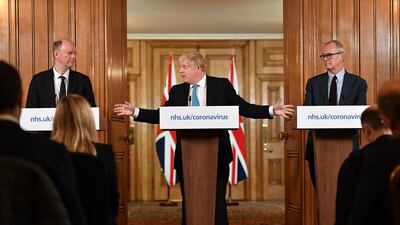
  • Boris Johnson, U.K. prime minister, center, speaks while Chris Whitty, U.K. chief medical officer, left, and Patrick Vallance, U.K. lead science adviser, listens during a daily coronavirus briefing inside number 10 Downing Street in London, U.K. Johnson said the U.K. can "turn the tide" on its burgeoning coronavirus outbreak within three months, as he said ministers will unveil measures to protect businesses and workers from the crisis. Getty Images
    Boris Johnson, U.K. prime minister, center, speaks while Chris Whitty, U.K. chief medical officer, left, and Patrick Vallance, U.K. lead science adviser, listens during a daily coronavirus briefing inside number 10 Downing Street in London, U.K. Johnson said the U.K. can "turn the tide" on its burgeoning coronavirus outbreak within three months, as he said ministers will unveil measures to protect businesses and workers from the crisis. Getty Images
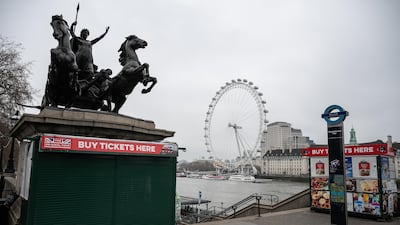
  • Westminster Bridge is seen while totally empty of traffic and people in London, England. As the COVID-19 coronavirus pandemic continues to escalate, London's streets have grown quieter as more people are encouraged to work from home and respect "social distancing" in a bid to slow the spread of the virus. Getty Images
    Westminster Bridge is seen while totally empty of traffic and people in London, England. As the COVID-19 coronavirus pandemic continues to escalate, London's streets have grown quieter as more people are encouraged to work from home and respect "social distancing" in a bid to slow the spread of the virus. Getty Images
  • A children's playground stands closed with signs explaining it is because of the coronavirus, backdropped by the Houses of Parliament, in central London. For most people, the new coronavirus causes only mild or moderate symptoms, such as fever and cough. For some, especially older adults and people with existing health problems, it can cause more severe illness, including pneumonia. AP Photo
    A children's playground stands closed with signs explaining it is because of the coronavirus, backdropped by the Houses of Parliament, in central London. For most people, the new coronavirus causes only mild or moderate symptoms, such as fever and cough. For some, especially older adults and people with existing health problems, it can cause more severe illness, including pneumonia. AP Photo
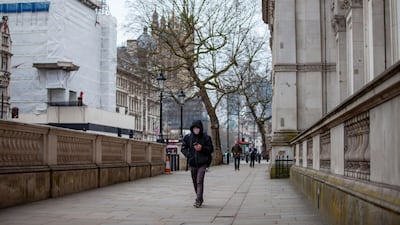
  • A pedestrian, wearing a protective face mask, while walking through the Westminster district of London, U.K.. U.K. Prime Minister Boris Johnson's government is considering tougher action to fight the spread of the coronavirus in London but has denied it is planning to confine residents to their homes or seal off the city. Bloomberg
    A pedestrian, wearing a protective face mask, while walking through the Westminster district of London, U.K.. U.K. Prime Minister Boris Johnson's government is considering tougher action to fight the spread of the coronavirus in London but has denied it is planning to confine residents to their homes or seal off the city. Bloomberg
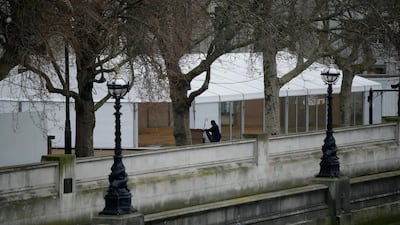
  • A worker walks past a newly built structure in the grounds of St Thomas' Hospital in central London. For most people, the new coronavirus causes only mild or moderate symptoms, such as fever and cough. For some, especially older adults and people with existing health problems, it can cause more severe illness, including pneumonia. AP Photo
    A worker walks past a newly built structure in the grounds of St Thomas' Hospital in central London. For most people, the new coronavirus causes only mild or moderate symptoms, such as fever and cough. For some, especially older adults and people with existing health problems, it can cause more severe illness, including pneumonia. AP Photo
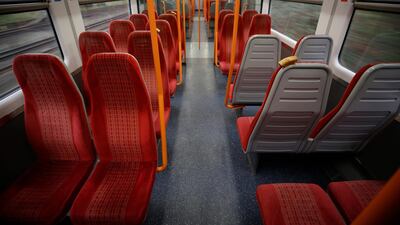
  • An empty train carriage on a South Western Railway train from Surbiton to Waterloo in London, just before 3pm local time. For most people, the new coronavirus causes only mild or moderate symptoms, such as fever and cough. For some, especially older adults and people with existing health problems, it can cause more severe illness, including pneumonia. AP Photo
    An empty train carriage on a South Western Railway train from Surbiton to Waterloo in London, just before 3pm local time. For most people, the new coronavirus causes only mild or moderate symptoms, such as fever and cough. For some, especially older adults and people with existing health problems, it can cause more severe illness, including pneumonia. AP Photo
  • Tourist stalls remain closed on Westminster Bridge in London, England. As the COVID-19 coronavirus pandemic continues to escalate, London's streets have grown quieter as more people are encouraged to work from home and respect "social distancing" in a bid to slow the spread of the virus. Getty Images
    Tourist stalls remain closed on Westminster Bridge in London, England. As the COVID-19 coronavirus pandemic continues to escalate, London's streets have grown quieter as more people are encouraged to work from home and respect "social distancing" in a bid to slow the spread of the virus. Getty Images
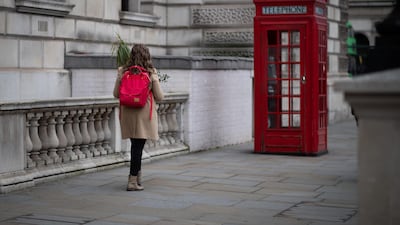
  • A woman carries two pot plants towards Westminster underground station in London, England. As the COVID-19 coronavirus pandemic continues to escalate, London's streets have grown quieter as more people are encouraged to work from home and respect "social distancing" in a bid to slow the spread of the virus. Getty Images
    A woman carries two pot plants towards Westminster underground station in London, England. As the COVID-19 coronavirus pandemic continues to escalate, London's streets have grown quieter as more people are encouraged to work from home and respect "social distancing" in a bid to slow the spread of the virus. Getty Images
  • Empty offices are seen as the spread of the coronavirus disease (COVID-19) continues, in London, Britain. REUTERS
    Empty offices are seen as the spread of the coronavirus disease (COVID-19) continues, in London, Britain. REUTERS
  • A pedestrian, wearing a protective face mask, passes a Satander bank branch, operated by Banco Santander SA, in London, U.K., on Thursday, March 19, 2020. U.K. Prime Minister Boris Johnson's government is considering tougher action to fight the spread of the coronavirus in London but has denied it is planning to confine residents to their homes or seal off the city. Photographer: Hollie Adams/Bloomberg
    A pedestrian, wearing a protective face mask, passes a Satander bank branch, operated by Banco Santander SA, in London, U.K., on Thursday, March 19, 2020. U.K. Prime Minister Boris Johnson's government is considering tougher action to fight the spread of the coronavirus in London but has denied it is planning to confine residents to their homes or seal off the city. Photographer: Hollie Adams/Bloomberg
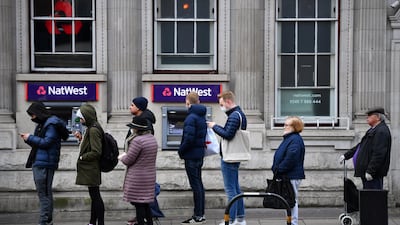
  • A pedestrian, wearing a protective face mask, passes a bank branch of Natwest, operated by National Westminster Bank Plc, in London, U.K. U.K. Prime Minister Boris Johnson's government is considering tougher action to fight the spread of the coronavirus in London but has denied it is planning to confine residents to their homes or seal off the city. Bloomberg
    A pedestrian, wearing a protective face mask, passes a bank branch of Natwest, operated by National Westminster Bank Plc, in London, U.K. U.K. Prime Minister Boris Johnson's government is considering tougher action to fight the spread of the coronavirus in London but has denied it is planning to confine residents to their homes or seal off the city. Bloomberg
  • A woman takes a selfie on a near empty Westminster Bridge backdropped by the scaffolded Houses of Parliament in central London. For most people, the new coronavirus causes only mild or moderate symptoms, such as fever and cough. For some, especially older adults and people with existing health problems, it can cause more severe illness, including pneumonia. AP Photo
    A woman takes a selfie on a near empty Westminster Bridge backdropped by the scaffolded Houses of Parliament in central London. For most people, the new coronavirus causes only mild or moderate symptoms, such as fever and cough. For some, especially older adults and people with existing health problems, it can cause more severe illness, including pneumonia. AP Photo
  • People queue for a supermarket, as the spread of the coronavirus disease (COVID-19) continues, in London, Britain, March 20, 2020. REUTERS/Dylan Martinez
    People queue for a supermarket, as the spread of the coronavirus disease (COVID-19) continues, in London, Britain, March 20, 2020. REUTERS/Dylan Martinez

Major supermarkets are limiting the amount of goods per customer and others have ask for support from the police in the days ahead.

It comes as violent scenes have been seen in some stores.

Prime Minister Boris Johnson has called on the public to be "considerate" in their shopping.

"Please be reasonable in your shopping, be considerate and thoughtful for others as you do it," he said.

"We’ve got good supply chains farm to fork – there’s no reason for the shops really to be empty.

“On mass buying and the price issue, I really hope that retailers will continue to be reasonable. I certainly wouldn’t want to see profiteering of any kind.”

His words have not helped ease the demand on stores though.

On Friday, Jon Tirrill witnessed long queues in Cheltenham.

"We did an early morning trip to Aldi for some essentials we were running out of. There were massive queues but once the doors opened it was ok," he said.

In London, Michelle Norgan is taking time off work so she can take her 69-year-old mother Linda Brown to the supermarket to help buy her enough food.

“From pretty much everyone I talk to, they thought today the whole of London was going to be lockdown," the 44-year-old said.

"Yesterday, every supermarket I went past there was queues outside.

“I've been in Iceland and Aldi four times and not been able to get anything. I've been buying odd things like chocolate fingers and biscuits because that's all that was left. There's no pasta, no freezables, a few bits of meat but no mince.

“If everyone's gone in there and bought a month's worth of shopping, which my mum can't do because she doesn't have the money, we're a little bit stuck because everyone has bought a month's supply of stuff or even three month's supply of stuff."

Her mother added: “I usually wake up at 10.30am, but this morning it was 7.30am. I didn't sleep last night because I was worried about getting up and going in. I’ve been trying to stay away from people."

Mohammed Ali said he is unable to go to the shops early and like many others finds there are no essentials left by the time he can.

“Yesterday, I couldn't get cereal or a parking space here. I can't go early in the morning because I have kids, so I have to drop them to the school then I have to go and everything is gone," the 46-year-old said.

"Some people have been here queuing before the supermarket opens."

In Wakefield, supermarkets are fully stocked when they open but are struggling to cope with customer demand as shelves swiftly empty within hours.

Sally Wood said: "It makes me so sad to see the shelves so empty. I came to the stores early to try and ensure I could get food for me parents. They are in self-isolation and I'm worried in case they can't get food."

Many stores are implementing a golden hour to allow elderly people to access them before larger crowds arrive to ensure they have access to essential goods.


Company%C2%A0profile
%3Cp%3E%3Cstrong%3ECompany%20name%3A%20%3C%2Fstrong%3ETuhoon%0D%3Cbr%3E%3Cstrong%3EYear%20started%3A%20%3C%2Fstrong%3EJune%202021%0D%3Cbr%3E%3Cstrong%3ECo-founders%3A%20%3C%2Fstrong%3EFares%20Ghandour%2C%20Dr%20Naif%20Almutawa%2C%20Aymane%20Sennoussi%0D%3Cbr%3E%3Cstrong%3EBased%3A%20%3C%2Fstrong%3ERiyadh%0D%3Cbr%3E%3Cstrong%3ESector%3A%20%3C%2Fstrong%3Ehealth%20care%0D%3Cbr%3E%3Cstrong%3ESize%3A%20%3C%2Fstrong%3E15%20employees%2C%20%24250%2C000%20in%20revenue%0D%3Cbr%3EI%3Cstrong%3Envestment%20stage%3A%20s%3C%2Fstrong%3Eeed%0D%3Cbr%3E%3Cstrong%3EInvestors%3A%20%3C%2Fstrong%3EWamda%20Capital%2C%20Nuwa%20Capital%2C%20angel%20investors%3C%2Fp%3E%0A
What is the FNC?

The Federal National Council is one of five federal authorities established by the UAE constitution. It held its first session on December 2, 1972, a year to the day after Federation.
It has 40 members, eight of whom are women. The members represent the UAE population through each of the emirates. Abu Dhabi and Dubai have eight members each, Sharjah and Ras al Khaimah six, and Ajman, Fujairah and Umm Al Quwain have four.
They bring Emirati issues to the council for debate and put those concerns to ministers summoned for questioning. 
The FNC’s main functions include passing, amending or rejecting federal draft laws, discussing international treaties and agreements, and offering recommendations on general subjects raised during sessions.
Federal draft laws must first pass through the FNC for recommendations when members can amend the laws to suit the needs of citizens. The draft laws are then forwarded to the Cabinet for consideration and approval. 
Since 2006, half of the members have been elected by UAE citizens to serve four-year terms and the other half are appointed by the Ruler’s Courts of the seven emirates.
In the 2015 elections, 78 of the 252 candidates were women. Women also represented 48 per cent of all voters and 67 per cent of the voters were under the age of 40.
 

Results

2pm: Serve U – Maiden (TB) Dh60,000 (Dirt) 1,400m; Winner: Violent Justice, Pat Dobbs (jockey), Doug Watson (trainer)

2.30pm: Al Shafar Investment – Conditions (TB) Dh100,000 (D) 1,400m; Winner: Desert Wisdom, Bernardo Pinheiro, Ahmed Al Shemaili

3pm: Commercial Bank of Dubai – Handicap (TB) Dh68,000 (D) 1,200m; Winner: Fawaareq, Sam Hitchcott, Doug Watson

3.30pm: Shadwell – Rated Conditions (TB) Dh100,000 (D) 1,600m; Winner: Down On Da Bayou, Xavier Ziani, Salem bin Ghadayer

4pm: Dubai Real Estate Centre – Maiden (TB) Dh60,000 (D) 1,600m; Winner: Rakeez, Patrick Cosgrave, Bhupat Seemar

4.30pm: Al Redha Insurance Brokers – Handicap (TB) Dh78,000 (D) 1,800m; Winner: Capla Crusader, Bernardo Pinheiro, Rashed Bouresly

Coal Black Mornings

Brett Anderson

Little Brown Book Group 

Pakistan squad

Sarfraz (c), Zaman, Imam, Masood, Azam, Malik, Asif, Sohail, Shadab, Nawaz, Ashraf, Hasan, Amir, Junaid, Shinwari and Afridi

Results

5pm: Wathba Stallions Cup Maiden (PA) Dh 70,000 (Dirt) 1,000m, Winner: Hazeem Al Raed, Antonio Fresu (jockey), Ahmed Al Shemaili (trainer)

5.30pm: Handicap (PA) Dh 85,000 (D) 1,000m, Winner: Ghazwan Al Khalediah, Hugo Lebouc, Helal Al Alawi

6pm: Maiden (PA) Dh 70,000 (D) 1,400m, Winner: Dinar Al Khalediah, Patrick Cosgrave, Helal Al Alawi.

6.30pm: Handicap (TB) Dh 70,000 (D) 1,600m, Winner: Faith And Fortune, Sandro Paiva, Ali Rashid Al Raihe.

7pm: Maiden (PA) Dh 70,000 (D) 1,600m, Winner: Only Smoke, Bernardo Pinheiro, Abdallah Al Hammadi.

7.30pm: Handicap (PA) Dh 70,000 (D) 1,600m, Winner: AF Ramz, Saif Al Balushi, Khalifa Al Neyadi.

8pm: Maiden (PA) Dh 70,000 (D) 2,000m, Winner: AF Mass, Tadhg O’Shea, Ernst Oertel.

Sinopharm vaccine explained

The Sinopharm vaccine was created using techniques that have been around for decades. 

“This is an inactivated vaccine. Simply what it means is that the virus is taken, cultured and inactivated," said Dr Nawal Al Kaabi, chair of the UAE's National Covid-19 Clinical Management Committee.

"What is left is a skeleton of the virus so it looks like a virus, but it is not live."

This is then injected into the body.

"The body will recognise it and form antibodies but because it is inactive, we will need more than one dose. The body will not develop immunity with one dose," she said.

"You have to be exposed more than one time to what we call the antigen."

The vaccine should offer protection for at least months, but no one knows how long beyond that.

Dr Al Kaabi said early vaccine volunteers in China were given shots last spring and still have antibodies today.

“Since it is inactivated, it will not last forever," she said.