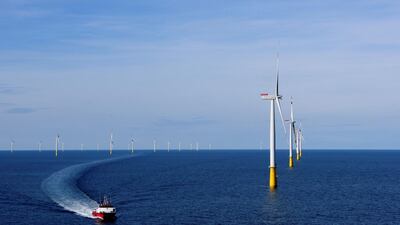
A boat sails past the DanTysk wind farm near Esbjerg, Denmark. Reuters.

Denmark to create world's first energy island in North Sea


Neil Murphy
  • English
  • Arabic

Denmark approved a plan on Thursday to build the world's first energy island, which will produce and store enough green energy to cover the power needs of three million European households.

The artificial North Sea island, which in its initial phase will be the size of 18 football fields, will be linked to hundreds of offshore wind turbines and supply power to homes and green hydrogen for use in shipping, aviation, industry and heavy transport.

The move came as the EU unveiled plans to change its electricity system to rely mostly on renewable energy within a decade and increase its offshore wind energy capacity 25-fold by 2050.

"This is truly a great moment for Denmark and for the global green transition," Energy Minister Dan Joergensen said.

"It will make a big contribution to the realisation of the enormous potential for European offshore wind.

The energy island, which will cost about 210 billion Danish krone ($33.9bn) to build, is an important part of Denmark's legally binding target to cut greenhouse gas emissions by 70 per cent by 2030 from 1990 levels, one of the world's most ambitious.

The Nordic country, home to wind turbine maker Vestas and offshore wind farm developer Orsted, was, with its favourable winds, a pioneer in onshore and offshore turbines, building the world's first offshore farm almost 30 years ago.

In December, it decided to halt the search for oil and gas in the Danish part of the North Sea and hopes instead to make it a centre for renewable energy and carbon storage.

The island, to be built 80 kilometres off Denmark's west coast, and its surrounding wind turbines will have an initial capacity of three gigawatts and be operational about 2033.

Denmark also has plans for an energy island in the Baltic Sea. The state will hold a controlling stake in both islands.


The specs

Engine: 2.0-litre 4cyl turbo

Power: 261hp at 5,500rpm

Torque: 405Nm at 1,750-3,500rpm

Transmission: 9-speed auto

Fuel consumption: 6.9L/100km

On sale: Now

Price: From Dh117,059

Key 2013/14 UAE Motorsport dates

October 4: Round One of Rotax Max Challenge, Al Ain (karting)

October 1: 1 Round One of the inaugural UAE Desert Championship (rally)

November 1-3: Abu Dhabi Grand Prix (Formula One)

November 28-30: Dubai International Rally

January 9-11: 24Hrs of Dubai (Touring Cars / Endurance)

March 21: Round 11 of Rotax Max Challenge, Muscat, Oman (karting)

April 4-10: Abu Dhabi Desert Challenge (Endurance)

The President's Cake

Director: Hasan Hadi

Starring: Baneen Ahmad Nayyef, Waheed Thabet Khreibat, Sajad Mohamad Qasem 

Rating: 4/5

The%20specs
%3Cp%3E%3Cstrong%3EEngine%3A%3C%2Fstrong%3E%202-litre%204-cylinder%3Cbr%3E%3Cstrong%3EPower%3A%20%3C%2Fstrong%3E153hp%20at%206%2C000rpm%3Cbr%3E%3Cstrong%3ETorque%3A%20%3C%2Fstrong%3E200Nm%20at%204%2C000rpm%3Cbr%3E%3Cstrong%3ETransmission%3A%20%3C%2Fstrong%3E6-speed%20auto%3Cbr%3E%3Cstrong%3EFuel%20consumption%3A%20%3C%2Fstrong%3E6.3L%2F100km%3Cbr%3E%3Cstrong%3EPrice%3A%20%3C%2Fstrong%3EDh106%2C900%3Cbr%3E%3Cstrong%3EOn%20sale%3A%20%3C%2Fstrong%3Enow%3C%2Fp%3E%0A
TCL INFO

Teams:
Punjabi Legends 
Owners: Inzamam-ul-Haq and Intizar-ul-Haq; Key player: Misbah-ul-Haq
Pakhtoons Owners: Habib Khan and Tajuddin Khan; Key player: Shahid Afridi
Maratha Arabians Owners: Sohail Khan, Ali Tumbi, Parvez Khan; Key player: Virender Sehwag
Bangla Tigers Owners: Shirajuddin Alam, Yasin Choudhary, Neelesh Bhatnager, Anis and Rizwan Sajan; Key player: TBC
Colombo Lions Owners: Sri Lanka Cricket; Key player: TBC
Kerala Kings Owners: Hussain Adam Ali and Shafi Ul Mulk; Key player: Eoin Morgan

Venue Sharjah Cricket Stadium
Format 10 overs per side, matches last for 90 minutes
Timeline October 25: Around 120 players to be entered into a draft, to be held in Dubai; December 21: Matches start; December 24: Finals

Ten tax points to be aware of in 2026

1. Domestic VAT refund amendments: request your refund within five years

If a business does not apply for the refund on time, they lose their credit.

2. E-invoicing in the UAE

Businesses should continue preparing for the implementation of e-invoicing in the UAE, with 2026 a preparation and transition period ahead of phased mandatory adoption. 

3. More tax audits

Tax authorities are increasingly using data already available across multiple filings to identify audit risks. 

4. More beneficial VAT and excise tax penalty regime

Tax disputes are expected to become more frequent and more structured, with clearer administrative objection and appeal processes. The UAE has adopted a new penalty regime for VAT and excise disputes, which now mirrors the penalty regime for corporate tax.

5. Greater emphasis on statutory audit

There is a greater need for the accuracy of financial statements. The International Financial Reporting Standards standards need to be strictly adhered to and, as a result, the quality of the audits will need to increase.

6. Further transfer pricing enforcement

Transfer pricing enforcement, which refers to the practice of establishing prices for internal transactions between related entities, is expected to broaden in scope. The UAE will shortly open the possibility to negotiate advance pricing agreements, or essentially rulings for transfer pricing purposes. 

7. Limited time periods for audits

Recent amendments also introduce a default five-year limitation period for tax audits and assessments, subject to specific statutory exceptions. While the standard audit and assessment period is five years, this may be extended to up to 15 years in cases involving fraud or tax evasion. 

8. Pillar 2 implementation 

Many multinational groups will begin to feel the practical effect of the Domestic Minimum Top-Up Tax (DMTT), the UAE's implementation of the OECD’s global minimum tax under Pillar 2. While the rules apply for financial years starting on or after January 1, 2025, it is 2026 that marks the transition to an operational phase.

9. Reduced compliance obligations for imported goods and services

Businesses that apply the reverse-charge mechanism for VAT purposes in the UAE may benefit from reduced compliance obligations. 

10. Substance and CbC reporting focus

Tax authorities are expected to continue strengthening the enforcement of economic substance and Country-by-Country (CbC) reporting frameworks. In the UAE, these regimes are increasingly being used as risk-assessment tools, providing tax authorities with a comprehensive view of multinational groups’ global footprints and enabling them to assess whether profits are aligned with real economic activity. 

Contributed by Thomas Vanhee and Hend Rashwan, Aurifer

Fourth-round clashes for British players

- Andy Murray (1) v Benoit Paire, Centre Court (not before 4pm)

- Johanna Konta (6) v Caroline Garcia (21), Court 1 (4pm)

Jeff Buckley: From Hallelujah To The Last Goodbye
By Dave Lory with Jim Irvin

UK’s AI plan
  • AI ambassadors such as MIT economist Simon Johnson, Monzo cofounder Tom Blomfield and Google DeepMind’s Raia Hadsell
  • £10bn AI growth zone in South Wales to create 5,000 jobs
  • £100m of government support for startups building AI hardware products
  • £250m to train new AI models
While you're here