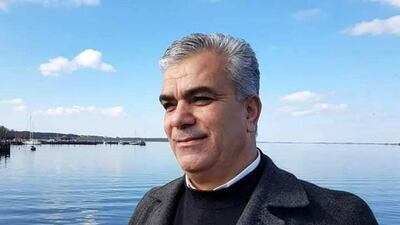
Akram Bathish's death this month in exile from his native Syria in Denmark was a family tragedy which plunged his family into wholesale uncertainty about their future.
Like 94 other Syrians who have recently had their residencies in Denmark stripped, Mr Bathish had received a letter from the Danish Immigration Services that said he was to be deported to the Syrian capital Damascus. He worried he might never see his wife or children again and subsequently spent sleepless nights, hours on the computer researching and more with a lawyer to try and appeal the decision.
Just weeks after the letter arrived Mr Bathish died of a heart attack at the age of 61, pitching the rest of the family into a legal limbo.
The letter had terrified everyone in the family, Mr Bathish's son, Ziad, tells The National from Denmark, and he believes the stress his father felt at the prospect of being sent back to the Assad regime-controlled country contributed to his poor health.
Like millions of Syrians who have endured the brutal war, Mr Bathish had reason to be scared. He had been imprisoned in 2012 by the country’s security forces for opposing the regime’s heavy-handed response to protests at the time.
He continued to be watched by the intelligence services after his release and by 2014 the situation on the ground was only becoming more violent and uncompromising.
That is when Mr Bathish decided to leave Syria with his son Ziad for Algeria, where his other son, Anas, had been living for two years. Reunited, they continued their journey onwards through the Algerian desert to Tunisia and into Libya, crossing yet another expanse of sand.
"It was a very difficult and risky journey because of dealing with human traffickers who only care about money. But we were strong together. From Libya we went in a very old and small boat to Italy; the greatest danger was the presence of about 200 passengers on a worn out boat that could only accommodate 30 or 40 passengers," Ziad tells The National.
After getting lost at sea and being rescued by the Italian coastguard and brought to shore, the three men continued onwards.
“We decided to go to Denmark because we heard it was a good country to live in peace and have a good future but unfortunately it was not,” says the software engineering student.
Ziad is referring to an increase in anti-immigration policies and xenophobic attitudes in the country he was becoming used to calling home. This month, after determining that Syria was safe enough for refugees to return to – the only European country yet to do so - the Danish government stripped 94 Syrian refugees of their residency status in preparation for deporting them back to the war-torn country.
The move was denounced as cruel by many, but the policy is in line with its goal of "zero asylum seekers".
The UN does not consider Syria a safe country for refugees to return to for several reasons, including the poor security situation and a proclivity of the regime to "disappear" returnees and anyone suspected of being anti-government.
Just last month the UN Secretary General Antonio Guterres denounced the Syrian government's widespread detention, torture and use of chemical weapons, calling them the 'greatest crimes the world has witnessed this century.'
Danish officials insist their policy is in line with the level of protection needed.
"We have made it clear to the Syrian refugees that their residence permit is temporary," Denmark's Immigration Minister, Mattias Tesfaye, told The Telegraph this year.
Despite declaring Damascus safe, however, Denmark cannot forcibly return refugees to Syria. Instead, the government is offering thousands of euros to Syrians to return "voluntarily" or face being placed in a deportation centre. “Denmark can't send people immediately to Syria on their own responsibility, but they send people to refugee camps, which are like prisons because there is no future, no life, or anything there,” explains Ziad, whose father was offered the option of a "voluntary return" and refused.
Mr Bathish's case is not unique and social media is awash with testimonies of Syrians in Denmark anxious about their status and future. There are 1,250 Syrians in the Scandinavian country and Denmark is reviewing hundreds of other refugee statuses, particularly those from Damascus, where active fighting has ceased but where the threat of imprisonment, kidnap or murder remains high.
Danish government says it's safe for Syrian refugees to return, but Syrians are fighting back
Denmark decides Syria is safe for refugees to return
Syrian atrocities are ‘greatest crimes’ this century, UN chief says

Scoreline
Bournemouth 2
Wilson 70', Ibe 74'
Arsenal 1
Bellerin 52'
Winners
Ballon d’Or (Men’s)
Ousmane Dembélé (Paris Saint-Germain / France)
Ballon d’Or Féminin (Women’s)
Aitana Bonmatí (Barcelona / Spain)
Kopa Trophy (Best player under 21 – Men’s)
Lamine Yamal (Barcelona / Spain)
Best Young Women’s Player
Vicky López (Barcelona / Spain)
Yashin Trophy (Best Goalkeeper – Men’s)
Gianluigi Donnarumma (Paris Saint-Germain and Manchester City / Italy)
Best Women’s Goalkeeper
Hannah Hampton (England / Aston Villa and Chelsea)
Men’s Coach of the Year
Luis Enrique (Paris Saint-Germain)
Women’s Coach of the Year
Sarina Wiegman (England)
Key figures in the life of the fort
Sheikh Dhiyab bin Isa (ruled 1761-1793) Built Qasr Al Hosn as a watchtower to guard over the only freshwater well on Abu Dhabi island.
Sheikh Shakhbut bin Dhiyab (ruled 1793-1816) Expanded the tower into a small fort and transferred his ruling place of residence from Liwa Oasis to the fort on the island.
Sheikh Tahnoon bin Shakhbut (ruled 1818-1833) Expanded Qasr Al Hosn further as Abu Dhabi grew from a small village of palm huts to a town of more than 5,000 inhabitants.
Sheikh Khalifa bin Shakhbut (ruled 1833-1845) Repaired and fortified the fort.
Sheikh Saeed bin Tahnoon (ruled 1845-1855) Turned Qasr Al Hosn into a strong two-storied structure.
Sheikh Zayed bin Khalifa (ruled 1855-1909) Expanded Qasr Al Hosn further to reflect the emirate's increasing prominence.
Sheikh Shakhbut bin Sultan (ruled 1928-1966) Renovated and enlarged Qasr Al Hosn, adding a decorative arch and two new villas.
Sheikh Zayed bin Sultan (ruled 1966-2004) Moved the royal residence to Al Manhal palace and kept his diwan at Qasr Al Hosn.
Sources: Jayanti Maitra, www.adach.ae
If you go...
Etihad Airways flies from Abu Dhabi to Kuala Lumpur, from about Dh3,600. Air Asia currently flies from Kuala Lumpur to Terengganu, with Berjaya Hotels & Resorts planning to launch direct chartered flights to Redang Island in the near future. Rooms at The Taaras Beach and Spa Resort start from 680RM (Dh597).
UAE%20v%20West%20Indies
%3Cp%3EFirst%20ODI%20-%20Sunday%2C%20June%204%20%0D%3Cbr%3ESecond%20ODI%20-%20Tuesday%2C%20June%206%20%0D%3Cbr%3EThird%20ODI%20-%20Friday%2C%20June%209%26nbsp%3B%3C%2Fp%3E%0A%3Cp%3EMatches%20at%20Sharjah%20Cricket%20Stadium.%20All%20games%20start%20at%204.30pm%0D%3Cbr%3E%0D%3Cbr%3E%3Cstrong%3EUAE%20squad%3C%2Fstrong%3E%0D%3Cbr%3EMuhammad%20Waseem%20(captain)%2C%20Aayan%20Khan%2C%20Adithya%20Shetty%2C%20Ali%20Naseer%2C%20Ansh%20Tandon%2C%20Aryansh%20Sharma%2C%20Asif%20Khan%2C%20Basil%20Hameed%2C%20Ethan%20D%E2%80%99Souza%2C%20Fahad%20Nawaz%2C%20Jonathan%20Figy%2C%20Junaid%20Siddique%2C%20Karthik%20Meiyappan%2C%20Lovepreet%20Singh%2C%20Matiullah%2C%20Mohammed%20Faraazuddin%2C%20Muhammad%20Jawadullah%2C%20Rameez%20Shahzad%2C%20Rohan%20Mustafa%2C%20Sanchit%20Sharma%2C%20Vriitya%20Aravind%2C%20Zahoor%20Khan%0D%3C%2Fp%3E%0A
Mercer, the investment consulting arm of US services company Marsh & McLennan, expects its wealth division to at least double its assets under management (AUM) in the Middle East as wealth in the region continues to grow despite economic headwinds, a company official said.
Mercer Wealth, which globally has $160 billion in AUM, plans to boost its AUM in the region to $2-$3bn in the next 2-3 years from the present $1bn, said Yasir AbuShaban, a Dubai-based principal with Mercer Wealth.
“Within the next two to three years, we are looking at reaching $2 to $3 billion as a conservative estimate and we do see an opportunity to do so,” said Mr AbuShaban.
Mercer does not directly make investments, but allocates clients’ money they have discretion to, to professional asset managers. They also provide advice to clients.
“We have buying power. We can negotiate on their (client’s) behalf with asset managers to provide them lower fees than they otherwise would have to get on their own,” he added.
Mercer Wealth’s clients include sovereign wealth funds, family offices, and insurance companies among others.
From its office in Dubai, Mercer also looks after Africa, India and Turkey, where they also see opportunity for growth.
Wealth creation in Middle East and Africa (MEA) grew 8.5 per cent to $8.1 trillion last year from $7.5tn in 2015, higher than last year’s global average of 6 per cent and the second-highest growth in a region after Asia-Pacific which grew 9.9 per cent, according to consultancy Boston Consulting Group (BCG). In the region, where wealth grew just 1.9 per cent in 2015 compared with 2014, a pickup in oil prices has helped in wealth generation.
BCG is forecasting MEA wealth will rise to $12tn by 2021, growing at an annual average of 8 per cent.
Drivers of wealth generation in the region will be split evenly between new wealth creation and growth of performance of existing assets, according to BCG.
Another general trend in the region is clients’ looking for a comprehensive approach to investing, according to Mr AbuShaban.
“Institutional investors or some of the families are seeing a slowdown in the available capital they have to invest and in that sense they are looking at optimizing the way they manage their portfolios and making sure they are not investing haphazardly and different parts of their investment are working together,” said Mr AbuShaban.
Some clients also have a higher appetite for risk, given the low interest-rate environment that does not provide enough yield for some institutional investors. These clients are keen to invest in illiquid assets, such as private equity and infrastructure.
“What we have seen is a desire for higher returns in what has been a low-return environment specifically in various fixed income or bonds,” he said.
“In this environment, we have seen a de facto increase in the risk that clients are taking in things like illiquid investments, private equity investments, infrastructure and private debt, those kind of investments were higher illiquidity results in incrementally higher returns.”
The Abu Dhabi Investment Authority, one of the largest sovereign wealth funds, said in its 2016 report that has gradually increased its exposure in direct private equity and private credit transactions, mainly in Asian markets and especially in China and India. The authority’s private equity department focused on structured equities owing to “their defensive characteristics.”
Real estate tokenisation project
Dubai launched the pilot phase of its real estate tokenisation project last month.
The initiative focuses on converting real estate assets into digital tokens recorded on blockchain technology and helps in streamlining the process of buying, selling and investing, the Dubai Land Department said.
Dubai’s real estate tokenisation market is projected to reach Dh60 billion ($16.33 billion) by 2033, representing 7 per cent of the emirate’s total property transactions, according to the DLD.
Groom and Two Brides
Director: Elie Semaan
Starring: Abdullah Boushehri, Laila Abdallah, Lulwa Almulla
Rating: 3/5
Desert Warrior
Starring: Anthony Mackie, Aiysha Hart, Ben Kingsley
Director: Rupert Wyatt
Rating: 3/5
The National in Davos
We are bringing you the inside story from the World Economic Forum's Annual Meeting in Davos, a gathering of hundreds of world leaders, top executives and billionaires.
