
Greece has locked down a migrant camp after 23 asylum seekers tested positive for the coronavirus, authorities said on Thursday.
It was the first migrant centre in the country to be hit with an outbreak of the disease.
Tests were conducted after a migrant, aged 19, living in a camp in central Greece, was found to be infected after giving birth at an Athens hospital last week.
It was the first confirmed case among thousands of asylum seekers living in overcrowded camps across the country.
None of the new batch showed any symptoms, the ministry said, adding that it was continuing its tests.
Health authorities said 119 of 380 people on board a ferry that authorities said had been prevented from docking in Turkey and was now anchored off Athens, had tested positive for the virus.
-
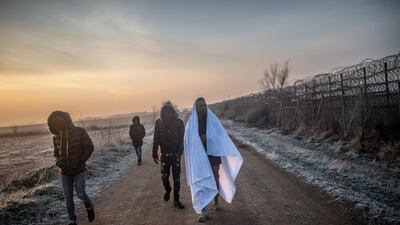
Migrants walk towards the Greek border in Pazarkule, in the Edirne district. Thousands of migrants stuck on the Turkey-Greece border clashed with Greek police. AFP -

Children sit on a beach near Skala Sykamineas on the Greek Lesbos island after crossing the Aegean sea between Turkey and Greece. AFP -
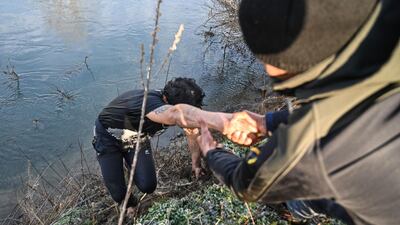
Migrants help each other after an attempt to enter Greece from a location near Edirne, Turkey, by crossing the Maritsa river. AFP -
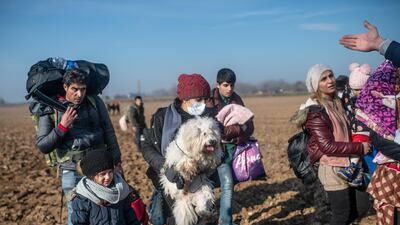
Migrants walk towards the Greek border in Pazarkule, in the Edirne district. AFP -

Migrants on a dinghy cross the Evros river to reach Greece, pictured from the Turkish border city of Edirne, Turkey. Reuters -
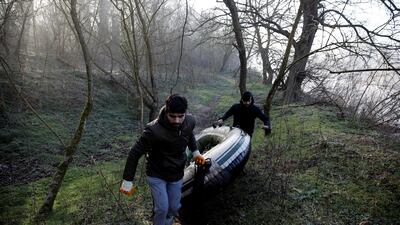
Migrants carry a dinghy to cross the Evros river to reach Greece, pictured near the Turkish border city of Edirne, Turkey. Reuters -
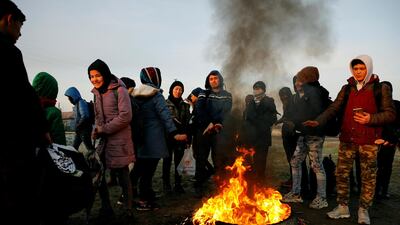
Migrants gather around a fire as they wait to cross the Evros river to reach Greece, near Doyran Village, near the Turkish border city of Edirne, Turkey. Reuters -
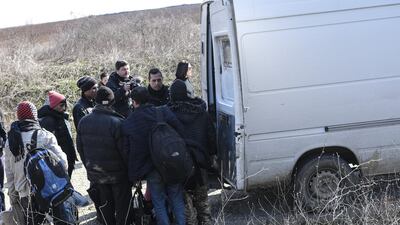
A group of migrants are detained after being caught by police on the side of the highway near the Greek-Turkish border. Getty Images -
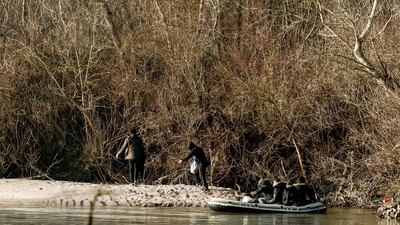
Migrants on a dinghy cross the Evros river and reach Greece, pictured from the Turkish border city of Edirne, Turkey. Reuters -
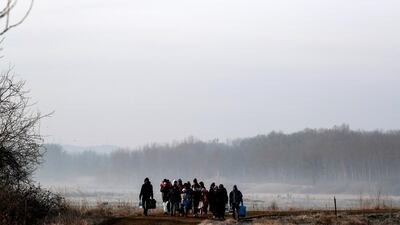
Migrants walk along the Evros river to reach Greece, near the Turkish border city of Edirne, Turkey. Reuters -

Migrants sit waiting near the buffer zone at Turkey-Greece border, at Pazarkule, in Edirne district. AFP -
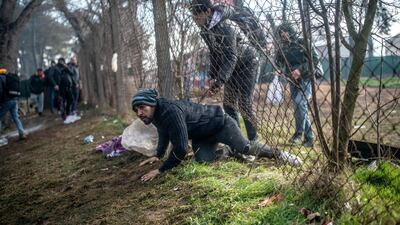
A migrant passes to the buffer zone during clashes with Greek police at the Turkey-Greece border, at Pazarkule, in Edirne distric. Thousands of migrants stuck on the Turkey-Greece border clashed with Greek police. AFP -
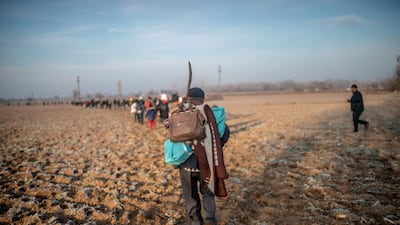
A migrant walk towards the Greek border in Pazarkule, in the Edirne district. AFP


Greece recorded its first coronavirus case at the end of February. It has reported 1,425 cases and 53 deaths, excluding those on the ferry.
It is the gateway to Europe for people fleeing conflicts and poverty in the Middle East and beyond, with more than a million passing through Greece during the migrant crisis of 2015 to 2016.
Any movement in and out of the once-open Ritsona camp, about 80 kilometres north-east of Athens and home to hundreds of people, will be restricted for 14 days, the ministry said.
Police would monitor movements, it said.
The camp has an isolation area for coronavirus patients should the need arise, sources have said.
Aid agencies renewed their call for more concerted action at the European level to tackle the migration crisis.
"It is urgently needed to evacuate migrants out of the Greek islands to EU countries," said Leila Bodeux, policy officer for Caritas Europa.
EU Home Affairs Commissioner Ylva Johansson said it was a stark warning of what might happen if the virus spilt into the even more overcrowded centres on the Greek islands.
"This may result in a massive humanitarian crisis," Ms Johansson said during a European Parliament debate conducted by video link.
"This is a danger for refugees hosted in certain countries outside the EU and for those living in unbearable conditions on the Greek islands."
More than 40,000 asylum-seekers are stuck in overcrowded refugee camps on the Greek islands, in conditions which the government itself has described as a "ticking health bomb".
Prime Minister Kyriakos Mitsotakis has said Greece was ready to protect its islands but urged the EU to provide more help.
"The conditions are far from ideal but I should also point out that Greece is dealing with this problem basically on its own," Mr Mitsotakis told CNN.
"We haven't had as much support from the EU as we wanted."

