
Britain is seeing a second wave of the coronavirus outbreak, Prime Minister Boris Johnson said on Friday, as millions more people faced new restrictions and the government warned that another national lockdown could be imminent.
"There's no question, as I've said for several weeks now, that we could expect and are now seeing a second wave coming in," said Mr Johnson as he toured the site of a new vaccines centre in Didcot, near Oxford.
"We are seeing it in France, in Spain, across Europe - it has been absolutely, I'm afraid, inevitable we were going to see it in this country."
His gloomy announcement came as government scientific advisors said the R number representing the number of people an infected person will pass the virus to rose to between 1.1 and 1.4, up from 1.0 to 1.2 last week.
"This is undoubtedly concerning," said Kevin McConway, emeritus professor of applied statistics at the Open University.
"Even at growth rates within the estimated range, the number of new cases could grow to high levels quickly if the interventions are not sufficiently effective."
Tighter rules preventing people from socialising with anyone from outside their household come into force from Tuesday across parts of northwest, northern and central England.
Food and drink venues will only be allowed to serve at tables, while pubs and bars will be shut early at 10pm.
Similar rules were imposed in north-east England on Friday, which put more than two million people under some of the most stringent restrictions since a nationwide lockdown was eased.
-

Visitors wearing protective masks ride on a roller coaster at Ocean Park during the theme park's reopening in Hong Kong, China. Bloomberg -
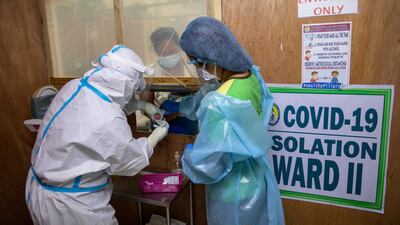
Health workers get a blood sample from a newborn through a makeshift window on the COVID-19 isolation area in Manila, Philippines. REUTERS -
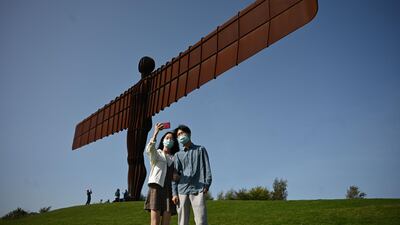
Visitors pose for photographs at Antony Gormley's 'Angel of the North' in Gateshead, northeast England. AFP -
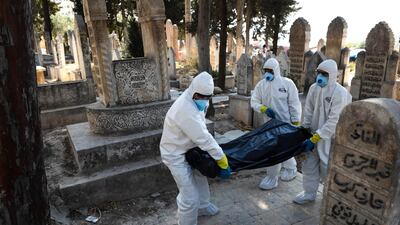
Health workers wearing protective jumpsuits carry the body of a 62-year-old displaced Syrian man who died from Covid-19 in Salqin, in the northwestern Syrian Idlib province. AFP -
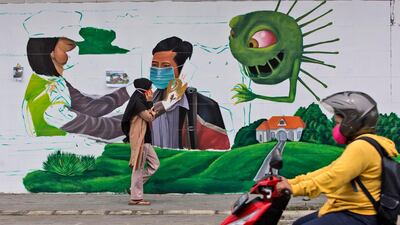
People pass a coronavirus-themed mural in Medan, North Sumatra, Indonesia. AP Photo -
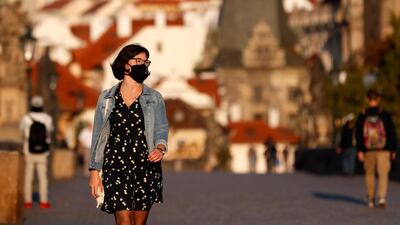
A young woman wearing a face mask walks across the medieval Charles Bridge in Prague, Czech Republic. AP Photo -
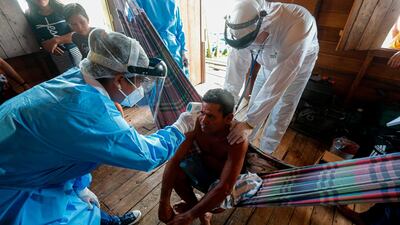
Government health workers check the temperature of a man at a Murutipucu River riverside community in Igarape-Miri, Baixo Tocantins, Para state, Brazil. AFP -

Empty chairs sit under parasols on a beach in Legian, Bali, Indonesia. Bloomberg -
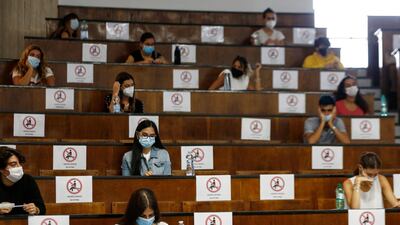
Students sit at a distance as a precaution against COVID-19, as they undergo an aptitude test to access the University of Medicine, in Rome. AP Photo -
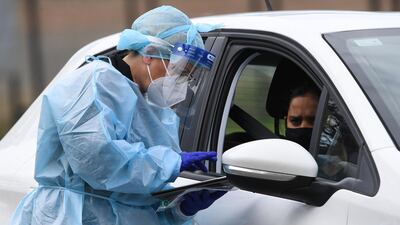
A healthcare working in protective gear works at a COVID-19 testing facility in Melbourne, Victoria. EPA -
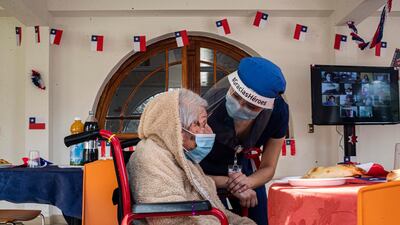
An employee chats with a resident who had been infected with the new coronavirus at a nursing home in Santiago, Chile. AP Photo


Health Secretary Matt Hancock said the move followed a request from local authorities because of a surge in positive cases.
He also warned the government could re-impose the nationwide lockdown which was partially lifted in June, as the rates of hospital admissions were now doubling every eight days.
"We want to avoid a national lockdown but we're prepared to do it if we need to," he told BBC television, vowing to "do what it takes" to protect the public.
Mr Johnson said a second national lockdown was "the last thing anybody wants", and urged adherence to social distancing guidelines limiting contacts to groups of six or fewer.
Government's pandemic response under scrutiny
The rise in cases heaps fresh pressure on Mr Johnson's government, which has been criticised for its response to the outbreak, which has claimed nearly 42,000 lives - the highest toll in Europe.
Numbers of new cases are reaching levels not seen since April, reflecting a similar picture across the continent, where the World Health Organisation said there were "alarming rates of transmission".
Britain's Office for National Statistics (ONS) confirmed on Friday in its weekly infection survey that "the incidence rate for England has increased in recent weeks".
It estimated there were around 6,000 new daily cases nationwide over the week to September 10 -roughly double the number typically recorded in statistics released every day by the health ministry.
Public Health England medical director Yvonne Doyle said there were "clear signs" of a spread of the virus across all age groups, and a rise in hospital admissions of older people.
"This could be a warning of far worse things to come," she added.
The ONS noted there was evidence of higher infection rates in London, as well as north-west England. But Mr Johnson's spokesman said "no restrictions are currently planned" in the capital.
Government scientists have reportedly proposed a blanket lockdown to come into force across England over two weeks in October, to coincide with English schools' half-term holiday.
But the spokesman pushed back against the report.
The government has faced sustained criticism for its failure to achieve the "world-beating" testing and tracing system it promised would be in place over the summer months.
Mr Hancock defended the testing programme, and said the government was "doing everything we possibly can for the cavalry that's on the horizon of the vaccine and mass testing".

