
Armenian Prime Minister Nikol Pashinyan said the actions of Turkey and Azerbaijan’s offensive on the disputed Nagorno-Karabakh region was a terrorist attack and the continuation of the genocide against his people.
Azerbaijan and Turkey are waging a "terrorist war against a people struggling for their freedom", Mr Pashinyan told AFP.
"To me, there is no doubt that this is a policy of continuing the Armenian genocide and a policy of reinstating the Turkish Empire," he told Sky News.
"Turkey has returned to the South Caucasus to continue the Armenian genocide."
Mr Pashinyan said Armenia was the "the last obstacle" to Turkish expansion.
He was referring to the killing of 1.5 million Armenians by the Ottoman Empire from 1915 to 1923.
Turkey accepts that many Armenians were killed in clashes with Ottoman forces during the First World War, but contests the figures and denies that the killings were systematically orchestrated.
Ankara says the deaths were the result of civil strife, which does not constitute a genocide.
-
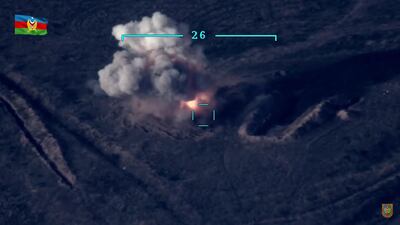
A frame grab from handout video provided by the Ministry of Defence of the Republic of Azerbaijan allegedly shows an Armenian tank being destroyed by Azerbaijan's military at Nagorno-Karabakh Republic, on the border of Armenia and Azerbaijan. EPA -

In this handout photo taken from a footage released by Azerbaijan's Defense Ministry, Azerbaijan's forces destroy Armenian anti-aircraft system at the contact line of the self-proclaimed Republic of Nagorno-Karabakh, Azerbaijan. AP -

In this photo released by the Armenian Foreign Ministry, a woman with her child sit in a bombshelter to protect against shelling, in Stepanakert, the self-proclaimed Republic of Nagorno-Karabakh, Azerbaijan. AP -
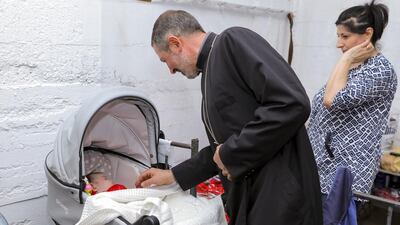
In this handout photo released by Armenian Foreign Ministry, an Armenian church priest looks a a baby in a bombshelter to protect against shelling in Stepanakert, the self-proclaimed Republic of Nagorno-Karabakh, Azerbaijan. AP -

In this photo released by the Armenian Foreign Ministry, people gather in a bombshelter to protect against shelling in Stepanakert, the self-proclaimed Republic of Nagorno-Karabakh, Azerbaijan. AP -
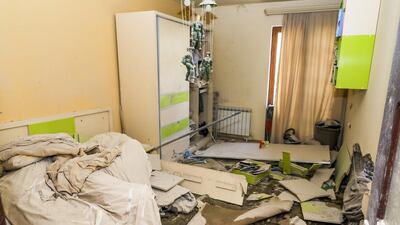
This handout photo released by Armenian Foreign Ministry, shows a damaged after shelling flat in Stepanakert, the self-proclaimed Republic of Nagorno-Karabakh, Azerbaijan. AP -
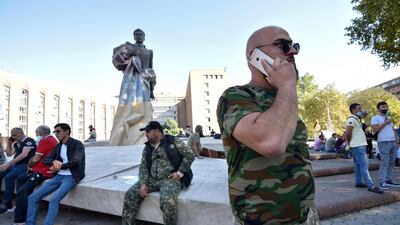
Volunteers and veterans, who are ready to go to the frontline in Nagorny Karabakh, gather in Yerevan. AFP -
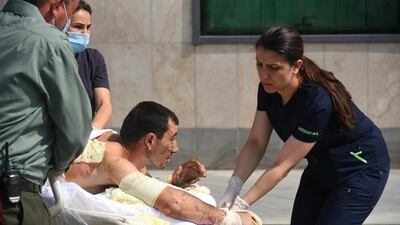
A handout photo released by the Armenian Foreign Ministry shows specialists delivering medical support to a man, who is said to be a civilian injured during clashes in the breakaway region of Nagorno-Karabakh. REUTERS -
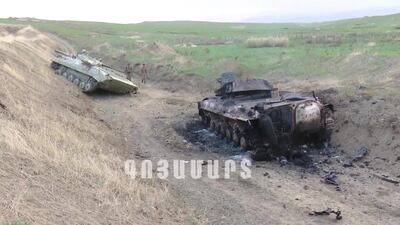
A grab taken from a handout video released by the so-called Nagorno-Karabakh (NKR) Defense Army, or Artsakh Defence Army, via Youtube claims to show tanks allegedly destroyed in shelling, artillery and air attacks along the front at Nagorno-Karabakh Republic, on a border of Armenia and Azerbaijan. EPA -
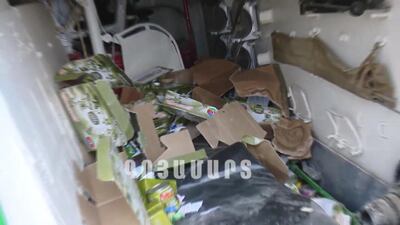
A grab taken from a handout video released by the so-called Nagorno-Karabakh (NKR) Defense Army, or Artsakh Defence Army, via Youtube claims to show Azerbaijani food rations in a tank allegedly destroyed in shelling, artillery and air attacks along the front at Nagorno-Karabakh Republic, on a border of Armenia and Azerbaijan. EPA -
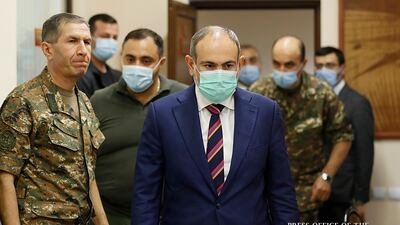
A handout photo made available by the Armenian Government Press Office shows Armenian Prime Minister Nikol Pashinyan meeting with the military leaders in Yerevan, Armenia. EPA -
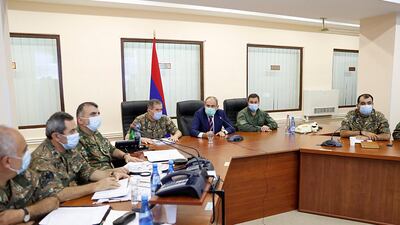
Armenian Prime Minister Nikol Pashinyan meets with top military officials in Yerevan. AFP -
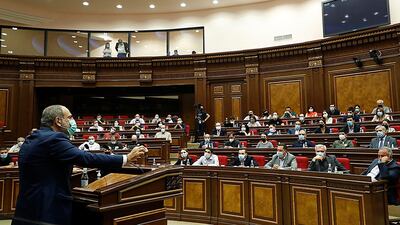
Armenian Prime Minister Nikol Pashinyan gives a speech at the parliament in Yerevan. AFP


Mr Pashinyan, 45, said Turkey’s “full support” for Azerbaijan motivated it to reignite fighting in the disputed Nagorno-Karabakh region.
"While it is true that the leadership of Azerbaijan has been actively promoting bellicose rhetoric for the past 15 years, now the decision to unleash a war was motivated by Turkey's full support," he said.
"Without Turkey's active engagement this war would not have begun."
Azerbaijan is a mainly Muslim Turkic country that is a close ally of Turkey.
Mr Pashinyan said the latest fighting was "not simply a new escalation of the Karabakh conflict", a territorial decades-old dispute over the majority ethnic Armenian mountainous region between within Azerbaijan.
The current conflict has the "active engagement of terrorist groups from the Middle East in the conflict zone", Mr Pashinyan said.
Turkey has sent mercenaries from Syria to support Azerbaijan in Karabakh, as he did for the Government of National Accord in Libya to the condemnation of much of the international community.
French President Emmanuel Macron claimed that religious extremists had arrived in the region, accusing Turkey of crossing a "red line".
Russian Foreign Intelligence Service Director Sergei Naryshkin said on Tuesday that the conflict was drawing in extremists “like a magnet”.
“We cannot but be concerned [that militants may] subsequently infiltrate into states adjacent to Azerbaijan and Armenia, including Russia,” Mr Naryshkin said.
Armenia also accuses Turkish forces of fighting directly in the region, and Mr Pashinyan said Turkey's F-16 fighter jets were "actively engaged". Ankara has denied this.
But if the current conflict deteriorates so far that Armenia suffers a direct attack on its territory, Mr Pashinyan said he was sure that his nation's key ally, Russia, would come to its aid because of their membership in a military alliance.
"In case of a security threat to Armenia, Russia's engagement will be subject to our treaty framework," he said.
"I am confident that as per the situation Russia will uphold its treaty obligations."
Mr Pashinyan has been calling European leaders in recent days.
"The best response to this terrorist operation would be to recognise the independence of Nagorno-Karabakh," he said.
Fierce fighting reignited in Karabakh 10 days ago and has caused at least 286 deaths, according to confirmed figures that are likely to be short of the real tally.
Neither side appears to have taken a decisive advantage.
On Tuesday, Azerbaijani authorities accused Armenia of launching missiles at strategic pipeline that carries Azerbaijan’s oil from the Caspian Sea to global markets. Armenian officials rejected the accusations.
The violence, involving heavy artillery, warplanes and drones, has continued despite international calls for a ceasefire.

