'Stop saying please': Josep Borrell says US must use weapons as leverage with Israel


Sunniva Rose
  • English
  • Arabic

Live updates: Follow the latest news on Israel-Gaza

The US should consider using its clout as Israel's top weapons provider to pressure Prime Minister Benjamin Netanyahu to lower the number of civilian deaths in the Gaza strip, the EU's foreign policy chief Josep Borrell said on Monday.

The comments made by Mr Borrell, a Spanish diplomat, come as international concern mounts over a planned Israeli incursion into Rafah in southern Gaza, where more than half of the enclave's two million inhabitants have sought shelter.

US President Joe Biden said Israel needs a "credible" plan to ensure their safety. Overnight Israeli strikes killed close to 100 people.

Gaza's population has nowhere to go as the border with Egypt remains closed.

"Netanyahu doesn't listen to anyone," said Mr Borrell. "They are going to evacuate. Where? To the moon? Where are they going to evacuate these people?"

In an unusually sharp rebuttal, Mr Biden said this week that Israel was "over the top" in its military response in Gaza, where close to 30,000 people have died as Israel attempts to eradicate Hamas after the October 7 attacks, which killed around 1,200 people.

"President Biden says it's over the top, it's not proportional," Mr Borrell told reporters at a press conference in Brussels attended by the head of the UN agency for Palestinian refugees, Philippe Lazzarini.

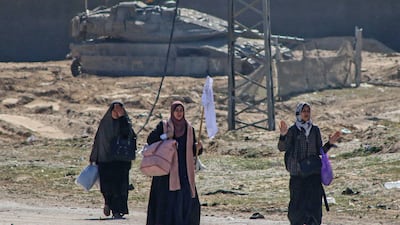
  • Displaced Palestinians hold a white flag as they pass an Israeli tank position while fleeing the Hamad Town district of Khan Younis. Bloomberg
    Displaced Palestinians hold a white flag as they pass an Israeli tank position while fleeing the Hamad Town district of Khan Younis. Bloomberg
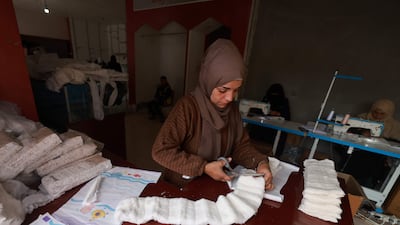
  • A Palestinian woman cuts material to be used for sewing nappies at a workshop in Rafah. AFP
    A Palestinian woman cuts material to be used for sewing nappies at a workshop in Rafah. AFP
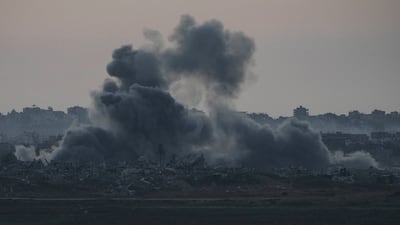
  • Smoke rises following an explosion in Gaza, as seen from southern Israel. AP
    Smoke rises following an explosion in Gaza, as seen from southern Israel. AP
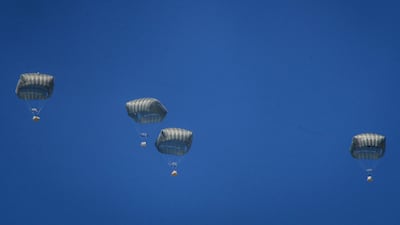
  • Parachutes carrying relief for Palestinians drop from an Egyptian Air Force cargo plane over central Gaza. Bloomberg
    Parachutes carrying relief for Palestinians drop from an Egyptian Air Force cargo plane over central Gaza. Bloomberg
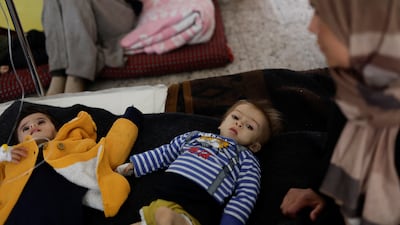
  • A Palestinian boy who is suffering from malnutrition is treated at a healthcare centre amid widespread hunger. Reuters
    A Palestinian boy who is suffering from malnutrition is treated at a healthcare centre amid widespread hunger. Reuters
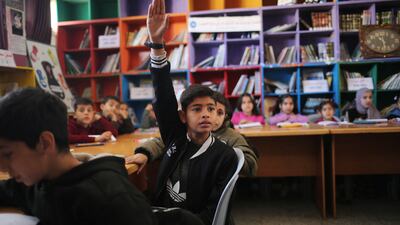
  • Palestinian children attend an English class in the library of the school housing displaced people in Rafah, the southern Gaza Strip. AFP
    Palestinian children attend an English class in the library of the school housing displaced people in Rafah, the southern Gaza Strip. AFP
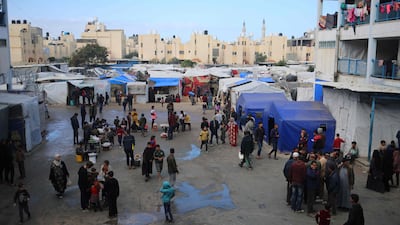
  • An UNRWA-run school housing displaced Palestinians in Rafah. AFP
    An UNRWA-run school housing displaced Palestinians in Rafah. AFP
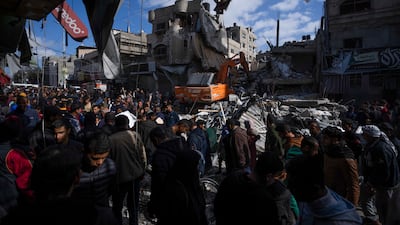
  • Palestinians search for bodies and survivors in the rubble of a residential building destroyed in an Israeli air strike in Rafah. AP
    Palestinians search for bodies and survivors in the rubble of a residential building destroyed in an Israeli air strike in Rafah. AP
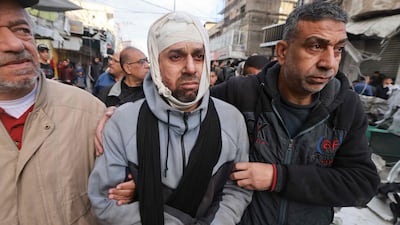
  • A wounded Palestinian man who lost his wife and daughter walks past a neighbours' house destroyed by Israeli bombing in Rafah. AFP
    A wounded Palestinian man who lost his wife and daughter walks past a neighbours' house destroyed by Israeli bombing in Rafah. AFP
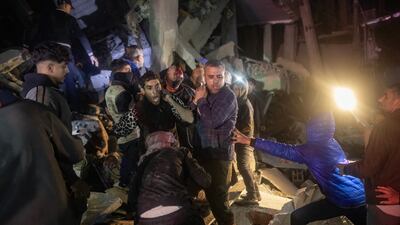
  • An injured man is rescued from the rubble after an Israeli air strike on the Rafah camp in Gaza. EPA
    An injured man is rescued from the rubble after an Israeli air strike on the Rafah camp in Gaza. EPA
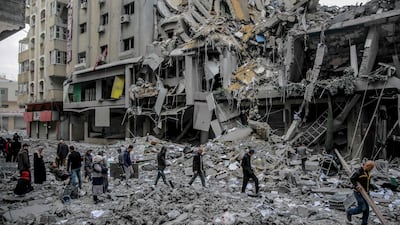
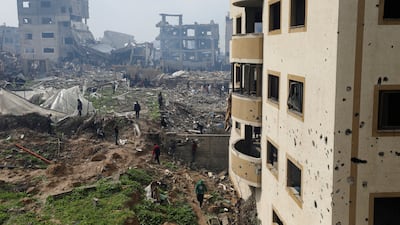
  • Palestinians walk amid the rubble of houses destroyed by the Israeli bombardment of Gaza city. AFP
    Palestinians walk amid the rubble of houses destroyed by the Israeli bombardment of Gaza city. AFP
  • Aid is dropped into Gaza from US military aircraft. Reuters
    Aid is dropped into Gaza from US military aircraft. Reuters
  • Palestinians gather at air lorries in Gaza. More than 100 were killed when Israeli troops opened fire. AP
    Palestinians gather at air lorries in Gaza. More than 100 were killed when Israeli troops opened fire. AP
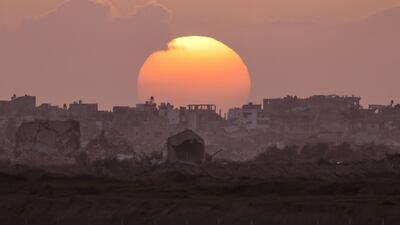
  • The sun sets behind destroyed buildings in Gaza. AFP
    The sun sets behind destroyed buildings in Gaza. AFP
  • A Palestinian man enters a heavily damaged house following an Israeli strike in Rafah, in the southern Gaza Strip. AFP
    A Palestinian man enters a heavily damaged house following an Israeli strike in Rafah, in the southern Gaza Strip. AFP
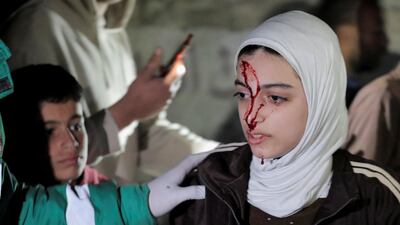
  • A wounded Palestinian is assisted at the site of an Israeli strike in Deir Al Balah, in the central Gaza Strip. Reuters
    A wounded Palestinian is assisted at the site of an Israeli strike in Deir Al Balah, in the central Gaza Strip. Reuters
  • Palestinians gather in the hope of getting bags of flour carried by air lorries near an Israeli checkpoint in Gaza city, as the enclave's residents face crisis levels of hunger. Reuters
    Palestinians gather in the hope of getting bags of flour carried by air lorries near an Israeli checkpoint in Gaza city, as the enclave's residents face crisis levels of hunger. Reuters
  • Palestinian children wait to receive food cooked by a charity kitchen as the conflict between Israel and Hamas continues in Gaza. Reuters
    Palestinian children wait to receive food cooked by a charity kitchen as the conflict between Israel and Hamas continues in Gaza. Reuters
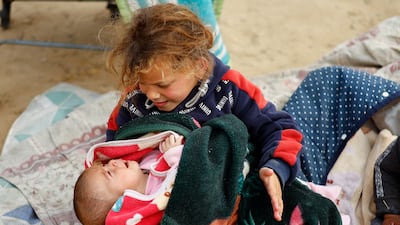
  • A displaced Palestinian child holds a crying baby in a camp in Rafah, in the southern Gaza Strip. Reuters
    A displaced Palestinian child holds a crying baby in a camp in Rafah, in the southern Gaza Strip. Reuters

"Well, if you believe too many are being killed, maybe you should provide less arms in order to prevent so many being killed. It's not logical?

"This is a little bit contradictory to continue saying too many people are being killed, please take care of people, please don't kill so many people. Stop saying please, and do something," Mr Borrell said.

The US is the world's biggest supplier of military aid to Israel. Some European countries also sell weapons to Israel. German defence exports approvals to Israel rose tenfold last year to $323 million. The EU as a bloc does not provide military aid to Israel.

Mr Borrell pointed to a court ruling in the Netherlands on Monday that ordered the Dutch government to stop sending F-35 parts to Israel, citing risks of violations of international law. Three human rights organisations sued the government in December saying it risked becoming complicit in war crimes committed by Israel.

"By the way, today a court in the Netherlands has ordered the government to stop exporting spare parts of F-35 fighters to Israel in order to be sure that an international court of justice ruling is being implemented," said Mr Borrell.

The court said the state had to comply with the order within seven days and dismissed a request by government lawyers to suspend the order pending an appeal to the Supreme Court.

Presiding Judge Bas Boele said there was a possibility the Dutch government could allow the export of F-35 parts to Israel in future, but only on the strict condition they would not be used in military operations in Gaza.

In a first ruling in December, a Dutch lower court stopped short of ordering the Dutch government to halt the exports, even though it said it was likely that F-35s contributed to violations of the laws of war.

EU foreign policy chief Josep Borrell wanted the US to pressure Israel. Reuters

The state immediately appealed the decision at the Supreme Court, but in the meantime it must implement the court’s decision. This may take several months.

"In the government's view, the distribution of American F-35 parts is not unlawful. The government believes it is up to the State to determine its foreign policy," it said. "The government will do everything it can to convince allies and partners that the Netherlands remains a reliable partner in the F-35 project and in European and international defence co-operation."

The government said the provision of F-35 parts to Israel was crucial both for Dutch and for Israeli security, "in particular with regard to threats emanating from the region, for instance from Iran, Yemen, Syria and Lebanon."

The state's decision to lodge an appeal is "separate from the situation in Gaza," it said.

"The Netherlands continues to call for an immediate temporary humanitarian ceasefire, and for as much humanitarian aid as possible to be allowed to reach the suffering people of Gaza."

Yet one of the NGOs involved told The National that there was a clear link with the continuing war in the enclave.

"Hopefully, it contributes to protect the people in Gaza," said Dirk Jan Jalvingh, policy adviser for conflict and humanitarian response at Oxfam Novib.

"The fact that we had to take the state to court is quite depressing. Ideally, you'd want the Dutch government to stand firmly for international humanitarian law. Hopefully this will bring a change in the political discussion," said Mr Jalvingh.

He described the court ruling as a "slap on the fingers legally speaking regarding how the Netherlands has been operating and the wider positioning of the Netherlands as a whole. The Dutch state has basically said they unequivocally support Israel since the October 7 attacks and have been very uncritical of the Israeli government’s actions.”

He said he hoped that the ruling would give EU countries “something to think about.”

The Netherlands is bound by the EU's common position on arms exports, which includes a clause on respect for human rights and international humanitarian law in the country of final destination. The court ruling was all the more symbolic because it came on the same day as Dutch Prime Minister Mark Rutte visited Israel and the Palestinian territories.

“It’s quite a coincidence,” said Mr Jalvingh. “It could be that he’s there to explain his position.”


Avatar: Fire and Ash

Director: James Cameron

Starring: Sam Worthington, Sigourney Weaver, Zoe Saldana

Rating: 4.5/5

The Dark Blue Winter Overcoat & Other Stories From the North
Edited and Introduced by Sjón and Ted Hodgkinson
Pushkin Press 

UAE SQUAD FOR ASIAN JIU-JITSU CHAMPIONSHIP

Men’s squad: Faisal Al Ketbi, Omar Al Fadhli, Zayed Al Kathiri, Thiab Al Nuaimi, Khaled Al Shehhi, Mohamed Ali Al Suwaidi, Farraj Khaled Al Awlaqi, Muhammad Al Ameri, Mahdi Al Awlaqi, Saeed Al Qubaisi, Abdullah Al Qubaisi and Hazaa Farhan

Women's squad: Hamda Al Shekheili, Shouq Al Dhanhani, Balqis Abdullah, Sharifa Al Namani, Asma Al Hosani, Maitha Sultan, Bashayer Al Matrooshi, Maha Al Hanaei, Shamma Al Kalbani, Haya Al Jahuri, Mahra Mahfouz, Marwa Al Hosani, Tasneem Al Jahoori and Maryam Al Amri

How to wear a kandura

Dos

  • Wear the right fabric for the right season and occasion 
  • Always ask for the dress code if you don’t know
  • Wear a white kandura, white ghutra / shemagh (headwear) and black shoes for work 
  • Wear 100 per cent cotton under the kandura as most fabrics are polyester

Don’ts 

  • Wear hamdania for work, always wear a ghutra and agal 
  • Buy a kandura only based on how it feels; ask questions about the fabric and understand what you are buying
Wicked
Director: Jon M Chu
Stars: Cynthia Erivo, Ariana Grande, Jonathan Bailey
Rating: 4/5
Allardyce's management career

Clubs (10) - Limerick (1991-1992), Perston North End (1992), Blackpool (1994-1996), Notts County (1997-1999), Bolton Wanderers (1999-2007), Newcastle United (2007-2008), Blackburn Rovers (2008-2010), West Ham United (2011-2015), Sunderland (2016), Crystal Palace (2016-2017)

Countries (1) - England (2016)

About Okadoc

Date started: Okadoc, 2018

Founder/CEO: Fodhil Benturquia

Based: Dubai, UAE

Sector: Healthcare

Size: (employees/revenue) 40 staff; undisclosed revenues recording “double-digit” monthly growth

Funding stage: Series B fundraising round to conclude in February

Investors: Undisclosed

Key facilities
  • Olympic-size swimming pool with a split bulkhead for multi-use configurations, including water polo and 50m/25m training lanes
  • Premier League-standard football pitch
  • 400m Olympic running track
  • NBA-spec basketball court with auditorium
  • 600-seat auditorium
  • Spaces for historical and cultural exploration
  • An elevated football field that doubles as a helipad
  • Specialist robotics and science laboratories
  • AR and VR-enabled learning centres
  • Disruption Lab and Research Centre for developing entrepreneurial skills
The specs

Engine: 4.0-litre V8 twin-turbocharged and three electric motors

Power: Combined output 920hp

Torque: 730Nm at 4,000-7,000rpm

Transmission: 8-speed dual-clutch automatic

Fuel consumption: 11.2L/100km

On sale: Now, deliveries expected later in 2025

Price: expected to start at Dh1,432,000

Mercer, the investment consulting arm of US services company Marsh & McLennan, expects its wealth division to at least double its assets under management (AUM) in the Middle East as wealth in the region continues to grow despite economic headwinds, a company official said.

Mercer Wealth, which globally has $160 billion in AUM, plans to boost its AUM in the region to $2-$3bn in the next 2-3 years from the present $1bn, said Yasir AbuShaban, a Dubai-based principal with Mercer Wealth.

Within the next two to three years, we are looking at reaching $2 to $3 billion as a conservative estimate and we do see an opportunity to do so,” said Mr AbuShaban.

Mercer does not directly make investments, but allocates clients’ money they have discretion to, to professional asset managers. They also provide advice to clients.

“We have buying power. We can negotiate on their (client’s) behalf with asset managers to provide them lower fees than they otherwise would have to get on their own,” he added.

Mercer Wealth’s clients include sovereign wealth funds, family offices, and insurance companies among others.

From its office in Dubai, Mercer also looks after Africa, India and Turkey, where they also see opportunity for growth.

Wealth creation in Middle East and Africa (MEA) grew 8.5 per cent to $8.1 trillion last year from $7.5tn in 2015, higher than last year’s global average of 6 per cent and the second-highest growth in a region after Asia-Pacific which grew 9.9 per cent, according to consultancy Boston Consulting Group (BCG). In the region, where wealth grew just 1.9 per cent in 2015 compared with 2014, a pickup in oil prices has helped in wealth generation.

BCG is forecasting MEA wealth will rise to $12tn by 2021, growing at an annual average of 8 per cent.

Drivers of wealth generation in the region will be split evenly between new wealth creation and growth of performance of existing assets, according to BCG.

Another general trend in the region is clients’ looking for a comprehensive approach to investing, according to Mr AbuShaban.

“Institutional investors or some of the families are seeing a slowdown in the available capital they have to invest and in that sense they are looking at optimizing the way they manage their portfolios and making sure they are not investing haphazardly and different parts of their investment are working together,” said Mr AbuShaban.

Some clients also have a higher appetite for risk, given the low interest-rate environment that does not provide enough yield for some institutional investors. These clients are keen to invest in illiquid assets, such as private equity and infrastructure.

“What we have seen is a desire for higher returns in what has been a low-return environment specifically in various fixed income or bonds,” he said.

“In this environment, we have seen a de facto increase in the risk that clients are taking in things like illiquid investments, private equity investments, infrastructure and private debt, those kind of investments were higher illiquidity results in incrementally higher returns.”

The Abu Dhabi Investment Authority, one of the largest sovereign wealth funds, said in its 2016 report that has gradually increased its exposure in direct private equity and private credit transactions, mainly in Asian markets and especially in China and India. The authority’s private equity department focused on structured equities owing to “their defensive characteristics.”

Who's who in Yemen conflict

Houthis: Iran-backed rebels who occupy Sanaa and run unrecognised government

Yemeni government: Exiled government in Aden led by eight-member Presidential Leadership Council

Southern Transitional Council: Faction in Yemeni government that seeks autonomy for the south

Habrish 'rebels': Tribal-backed forces feuding with STC over control of oil in government territory

Updated: February 13, 2024, 12:45 PM